ProjectManagementOER
Stakeholder Management
Stakeholders are parties who have a stake or an interest in a project or strategy undertaken by a company or an organization, or are impacted by it. Stakeholder management focuses on building, maintaining and nurturing relationships with stakeholders, be it internal or external to the organization or project.
Effective stakeholder engagement involves the following steps:
- Identify: Who are the stakeholders?
- Understand: At this step, our aim is to understand factors such as power, impact. attitude, beliefs, expectations, degree of influence, proximity to project, and interest in the project.
- Analyze: Determine how you should engage the stakeholders
- Prioritize: Determine the relative importance of the stakeholders
- Engage: Implement your plan
- Monitor: Check for new stakeholders, and ensure that your plan is implemented correctly
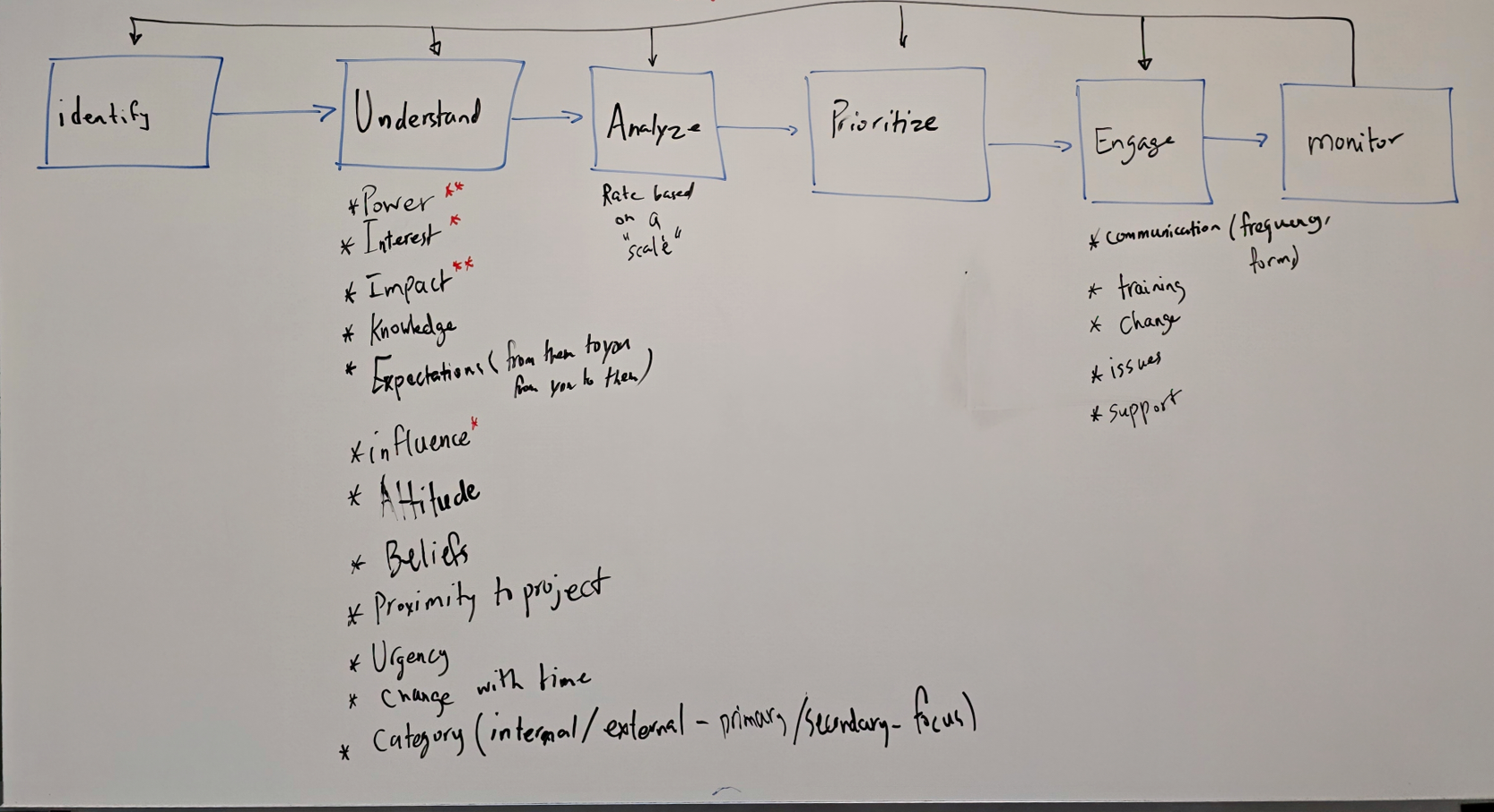
By managing stakeholders, you can ensure all stakeholders involved in the project understand their roles and responsibilities, and control their expectations. This keeps everyone on track and mitigates potential issues or conflicts before they arise., and sets the tone for how the entire project is seen moving forward.
Most projects create a stakeholder engagement plan which identifies the strategies and actions required to promote productive involvement of stakeholders in decision-making and execution. It can be formal or informal and highly detailed or broadly framed, based on the needs of the project and the expectations of stakeholders. In addition to this, a stakeholder register is created which includes the identified stakeholders (Name, organizational position, location and contact details, and role on the project) alongside your assessment of them (major requirements, expectations, potential for influencing project outcomes, and the phase of the project life cycle where the stakeholder has the most influence or impact), and their classification (internal/external, impact/influence/power/interest, upward/downward/outward/sideward, or any other classification model chosen by the project manager).
Stakeholder Analysis and Prioritization
Stakeholder analysis can be used to understand the stakeholder environment and to prioritize management resources. The most common approach is analyzing stakeholders based on their level of power and interest. First you need to understand the power and interest of the stakeholders, then you can categorize them using a ranking system:
- High Power, High Interest stakeholders: Manage closely
- If they are positive, you want to provide them with information to maintain their support, consult with them prior to taking project decisions, meet them regularly and build their confidence in the project. Don’t ignore them just because they are not causing you any problems at the moment. Involve them in your project, make them part of your project steering group (if they are not already), involve them in decisions, use them to lobby other groups and make sure they voice their support.
- If they are negative, you need to put effort into dealing with them. Use other positive stakeholders to lobby them and hopefully change their views, attempt to counter any negative influence they may have on other groups. Their resistance maybe due to lack of information or understanding. Attempt to build their confidence in you and in the team. Find out what is important to them, if you can help them out or minimise negative impact on them they may be more helpful. Demonstrate that you are doing your best to limit adverse effects on them.
- High Power, Low interest: Keep satisfied - their interest may increase as the project evolve and they may use their power.
- Low Power, High Interest: Keep informed - while they may not be able to derail the project, they can help you by sharing information, lobbying for you and promoting you.
- Low Power, Low Interest: Monitor - while you do not need to actively engage them, you need to keep an eye on them to see if their power or interest changes.
Communicating with Stakeholders
Project managers need to decide how to communicate with stakeholders:
- Push: This method involves sending information to stakeholders, examples include memos and emails. It is primarily for one-way communication and makes it difficult to get immediate feedback.
- Pull: This is when stakeholders actively seek information, such as accessing internal websites or online repositories. This allows for indirect understanding of their concerns.
- Interactive: This is when two-way communication takes place. Other than which method is best to approach a particular stakeholder, project managers should consider the medium and form of communication (meeting, website, presentation, memo, e-mail, briefing, report, etc), alongside the level of formality.
PMI Processes Relating to Stakeholder Engagement
Identify Stakeholders
This process takes place during project initiation.
- Inputs
- Project charter
- Business documents (Business case, Benefits management plan)
- Project management plan (Communications management plan, Stakeholder engagement plan)
- Project documents (Change log, Issue log, Requirements documentation)
- Agreements
- Enterprise environmental factors
- Organizational process assets
- Tools & Techniques
- Expert judgment
- Data gathering (Questionnaires and surveys, Brainstorming)
- Data analysis (Stakeholder analysis, Document analysis)
- Data representation (Stakeholder mapping/representation)
- Meetings
- Outputs
- Stakeholder register
- Change requests
- Project management plan updates (Requirements management plan, Communications management plan, Risk management plan, Stakeholder engagement plan)
- Project documents updates (Assumption log, Issue log, Risk register)
Manage Stakeholder Engagement
This process takes place during project execution.
- Inputs
- Project management plan (Communications management plan, Risk management plan, Stakeholder engagement plan, Change management plan)
- Project documents (Change log, Issue log, Lessons learned register, Stakeholder register)
- Enterprise environmental factors
- Organizational process assets
- Tools & Techniques
- Expert judgment
- Communication skills (Feedback)
- Interpersonal and team skills (Conflict management, Cultural awareness, Negotiation, Observation/conversation, Political awareness)
- Ground rules
- Meetings
- Outputs
- Change requests
- Project management plan updates (Communications management plan, Stakeholder engagement plan)
- Project documents updates (Change log, Issue log, Lessons learned register, Stakeholder register)
Monitor Stakeholder Engagement
This process is part of the monitoring and controlling process group.
- Inputs
- Project management plan (Resource management plan, Communications management plan, Stakeholder engagement plan)
- Project documents (Issue log, Lessons learned register, Project communications, Risk register, Stakeholder register)
- Work performance data
- Enterprise environmental factors
- Organizational process assets
- Tools & Techniques
- Data analysis (Alternatives analysis, Root cause analysis, Stakeholder analysis)
- Decision making (Multicriteria decision analysis, Voting)
- Data representation (Stakeholder engagement assessment matrix)
- Communication skills (Feedback, Presentations)
- Interpersonal and team skills (Active listening, Cultural awareness, Leadership, Networking, Political awareness)
- Meetings Outputs
- Work performance information
- Change requests
- Project management plan updates (Resource management plan, Communications management plan, Stakeholder engagement plan)
- Project documents updates (Issue log, Lessons learned register, Risk register, Stakeholder register)