ProjectManagementOER
Procurement
Procurement refers to the process of acquiring goods or services from an external source. This may involve large scale acquisition through a competitive tendering or bidding process. The goal of the process is to ensure best possible price, quality and timely delivery. The process helps a company find reliable suppliers that can provide competitively priced goods and services that match the company’s needs. A big part of procurement is making the make or buy decision. This decision is made taking into account expertise and resource availability within the company, licensing and regulatory requirements, and alignment with organizational strategy.
Based on how the item will be used, procurement can be classified as:
- Direct procurement: obtaining anything that’s required to produce an end-product. For a manufacturing company, this includes raw materials and components. For a retailer, it includes any items purchased from a wholesaler for resale to customers.
- Indirect procurement: purchases of items that are essential for day-to-day operations but don’t directly contribute to the company’s bottom line.This can include anything from office supplies and furniture to advertising campaigns, consulting services and equipment maintenance.
Based on the item being procured, procurement may be classified as:
- Goods procurement, focused on procuring physical items, or items like software subscriptions. Effective goods procurement generally relies on good supply chain management practices. It may include both direct and indirect procurement.
- Services procurement focuses on procuring people-based services. Depending on the company, this may include hiring individual contractors, contingent labor, law firms or on-site security services. It may include both direct and indirect procurement.
Other factors to consider are export control rules (controlled goods or dual-use technologies may need clearance from governments), and intellectual property considerations.
The Procurement Process and Stages
- Sourcing stage
- Identify which goods and services the company needs: This may involve identifying the item, the business needs, precise technical specifications, materials, part numbers or service characteristics. At this stage, it’s a good idea to consult all business departments affected by the purchasing decision to ensure the procured items accurately reflect the needs of each department.
- Submit purchase request: When an employee or business group needs to procure a significant quantity of new supplies or services, they make a formal purchase request (also known as a purchase requisition). A purchase request notifies the company that a need exists, usually via department managers, purchasing staff or the financial team, as well as specifications such as price estimate, time frame needed, quantity and other important things for the purchasing team to keep in mind. The department overseeing the purchase can then approve or deny the purchase request. If approved, the procurement team can proceed with selecting a vendor and making the purchase. Most organizations have a threshold, under which a purchase request is not necessary.
- Advertise, assess and select vendors: With a clear list of requirements and an approved purchase request, now is the time to find the best vendor and submit a request for quote (RFQ) – this is what the purchasing team sends to potential suppliers in order to receive a quote. Alternatively, the opportunity may be advertised publicly with vendors responding with their quotes. Vendor assessment should focus not only on cost but also on reputation, speed, quality and reliability. Many companies consider ethics and social responsibility as well, since procurement is often intertwined with corporate identity.
- Purchasing stage
- Negotiate price and terms: A common best practice is to get at least three quotes from suppliers before making a decision. Examine each quote carefully and negotiate where possible. If you need to walk away from a deal, be sure that you have concrete alternative options. Once you’ve agreed on final terms, be sure to get them in writing.
- Create a purchase order: Fill out a purchase order (PO) and send it to the supplier. The PO should be sufficiently detailed to identify the exact services or goods needed and to enable the supplier to fill the order.
- Receive and inspect the delivered goods: Carefully examine deliveries for any errors or damage. Make sure everything is delivered as specified in the PO and that the quality meets or exceeds expectations.
- Payment stage
- Conduct three-way matching: Accounts payable should conduct three-way matching by comparing the purchase order, order receipt or packing list and invoice. The goal is to ensure the goods or services received match the purchase order and to prevent payment for unauthorized or inaccurate invoices. Highlight any discrepancies between the three documents and resolve issues before arranging payment.
- Approve the invoice and arrange payment: If the three-way match is accurate, approve and pay the invoice. Businesses should strive to have a consistent invoice payment process through accounts payable that checks that payments match the invoice amount and due date. A standardized process can help make sure invoices are always paid on time, which can prevent late fees and build good relationships with suppliers.
- Record keeping: It’s important to maintain records for the entire procurement process, from purchase requests to price negotiations, invoices, receipts and everything in between. These records may be useful for multiple reasons. They help the company reorder goods at the right price in the future, as well as assist with auditing processes and calculating taxes. Clear, accurate records can also help resolve any potential disputes.
| Procurement | Purchasing | Sourcing | Supply Chain Management | |
|---|---|---|---|---|
| Definition | All activities related to carefully sourcing and obtaining goods and services needed to support business operations | Buying goods and services | Selecting and vetting vendors to provide goods and/or services | Managing the coordinated network of companies, facilities and business activities involved in sourcing, developing, manufacturing and delivering products |
| Scope | Includes sourcing, negotiation, purchasing, receiving and recordkeeping | Part of the procurement process | Part of the procurement process | Includes the entire procurement process |
| Focus | Ensuring the company gets the most value from goods or services to increase the business’s profitability | Usually focuses on getting a good price | Establishing good, long-term relationships with suppliers | Cutting costs while getting goods to the customer as quickly as possible, without sacrificing quality or accuracy |
Different “Request For” Documents
Depend on the nature of what is being procured, several different “request for” stages may be used in procurement:
- Request for Information (RFI): These forms of request are used in early procurement to gather general information about potential suppliers, market trends and capabilities. This will allow the organization to better define its needs and align it with what is available on the market.
- Request for Qualifications (RFQ): This is a common stage in government procurement. It is used to screen vendors and create a pool of pre-qualified providers with a supply arrangement who may be eligible to respond to request for proposals.
- Request for Proposal: For complex projects where the solution is not yet defined, an RFP is used. At this point the organization knows what it needs but not how to do it, so it asks for companies to propose solutions and selects a solution based on a preset criteria.
- Request for Quotation (RFQ): This is used to get a formal price quote from a supplier. Usually this is used late in the procurement process when product or service requirements are clear and specific. Other requests include an invitation to tender or a request for solution.
As an example of how these are used, you may use a:
- RFI to explore AI tooling vendors. This will allow you to signal to vendors that you will be opening an RFP, and engage with them to develop a better understanding of what tools can do before creating the RFP.
- RFQ for standard laptops. This will allow businesses that provide this standard piece of equipment to compete for your business.
- RFP for a complex custom software solution. This will allow providers to try to come up with custom solutions to meet your business needs, based on the information you share with them in the RFP.
In addition to the above, in projects it common to use the following documents:
- Statement of work (SoW): A formal document that outlines the specific tasks, deliverables, timelines, and costs of a project or contract between parties. In many cases, the SoW is included in the RFP or RFQ as a supplementary document.
- Terms of reference (ToR): A formal document that defines the scope, objectives, tasks, and deliverables for a project, particularly for services like consulting.
Different Forms of Contract
Generally speaking, three forms of contracts are common in projects:
- Fixed-cost: An agreement where the buyer pays a set, predetermined price for a specific scope of work, regardless of the actual costs or time the seller incurs. This transfers the cost for errors and cost overruns to the seller. It is best used for projects with a clearly defined and stable scope of work.
- Cost reimbursable (CR): An agreement where the buyer pays the contractor for all allowable project costs, plus an additional fee to represent the contractor’s profit. This type of contract is often used when the project’s scope is uncertain or high-risk, as it shifts the financial risk to the buyer. It is typically used for projects involving new technologies, research and development, or where final cost estimates are difficult to determine upfront.
- Time and materials: An agreement where a client pays a contractor based on the actual time spent by their employees and subcontractors, and for the actual cost of materials used during a project. This contract type is commonly used when the project scope, duration, or material requirements are uncertain or likely to change.
Understanding risk allocation between buyers and sellers is the central point of contract selection:
- Under a Firm Fixed Price (FFP) contract, the risk is transferred entirely to the seller. For example, if a municipality hires a software vendor to build an application with highly detailed, rigid specifications for an agreed price of $100,000, the vendor absorbs all financial liability. If the vendor encounters severe coding complications and expends $120,000 in labor, they absorb the $20,000 loss.
- Cost-Reimbursable (CR) contracts transfer the risk entirely to the buyer. If a government entity hires an aerospace contractor to develop a theoretical radar system where the scope is inherently unknown, they agree to pay all actual labor and material costs plus a fixed profit fee. If the project takes five years instead of the anticipated two, the buyer remains liable for the escalating costs.
- Time and Materials (T\&M) contracts serve as a hybrid approach, commonly utilized for immediate staff augmentation where scope is undefined but hourly rates are fixed, representing a shared risk profile.
| Type | Known Scope | Share of Risk | Incentive for Meeting Milestones | Predictability of Cost |
|---|---|---|---|---|
| Fixed Total Cost | Very High | All Contractor | Low | Very High |
| Fixed Unit Price | High | Mostly Project | Low | High |
| Fixed price with Incentive Fee | High | Mostly Project | High | Medium-high |
| Fixed Fee with Price Adjustment | High | Mostly Project | Low | Medium |
| CR with Fixed Fee | Medium | Mostly Project | Low | Medium-high |
| CR with Percentage Fee | Medium | Mostly Project | Low | Medium-high |
| CR with Incentive Fee | Medium | Mostly Project | High | Medium |
| CR with Award Fee | Medium | Mostly Project | High | Medium |
| Time and Materials | Low | All Project | Low | Low |
Contract type should be selected based on:
- Skill-level of the contractor (and the risk you are acceping
- Uniqueness of the project
- Type of relationship: supplier, vendor, partnership
- Source of supplier: RFP, RFQ, personal contact
- How well known is the scope of the work?
- Risks—what are they? Who assumes them?
- How much float is there for the work package?
- How important to be sure of cost in advance?
Other considerations may include export control (if controlled goods or dual-use technology is used) and intellectual property (whether the project owns IP or gets a license to use the IP).
Example: Make-or-Buy and Contract Choice
Let’s consider Valley College developing a new online registration system. The college must decide whether to:
- Make: Develop the registration system in‑house using existing IT staff.
- Buy: Procure a commercial off‑the‑shelf solution and hire a vendor to customize and integrate it. Factors considered:
- Internal expertise and capacity.
- Total cost of ownership.
- Time to market.
- Regulatory and security requirements.
- Competing priorities. If a vendor is selected, contract options include:
- Fixed-price for clearly defined customization and integration scope.
- Time-and-materials for exploratory work or ongoing support, where scope is less certain.
- Cost-reimbursable for high‑uncertainty R\&D components, with agreed fee structures. In this particular case the college may bring on a vendor, with a fixed-price paid to license their software and cost-reimbursable contract for customizations needed for the college.
Important Principles of Procurement
- Value for money: The organization must manage funds efficiently and economically when procuring goods and services. This may include conducting cost-benefit analyses and risk assessments. It’s worth noting that low cost does not necessarily equate to greater value; characteristics such as quality and durability also factor into determining whether the purchase represents value for money.
- Fairness: Procurement should not provide preferential treatment to individuals or suppliers. All bids should be assessed objectively, based on how well they meet the organization’s needs.
- Competition: Organizations should seek competitive bids from multiple suppliers, unless there are specific reasons not to do so, such as a sole-source provider where the good or service is only available from a single vendor.
- Efficiency: Procurement processes must be carried out efficiently to help maximize value and avoid delays.
- Transparency: Organizations should make relevant procurement information available to everyone, including the public as well as suppliers. Information should be kept confidential only when there are legal or other valid reasons to do so.
- Integrity: Those who practice public procurement should always strive to be perceived as trustworthy, reliable, honest and responsible. Funds must be used for their intended purpose and in the public interest.
- Accountability: People involved in the procurement process are accountable for their actions and decisions. They are required to report procurement activities accurately, including any errors
Procurement in PMI Process Groups
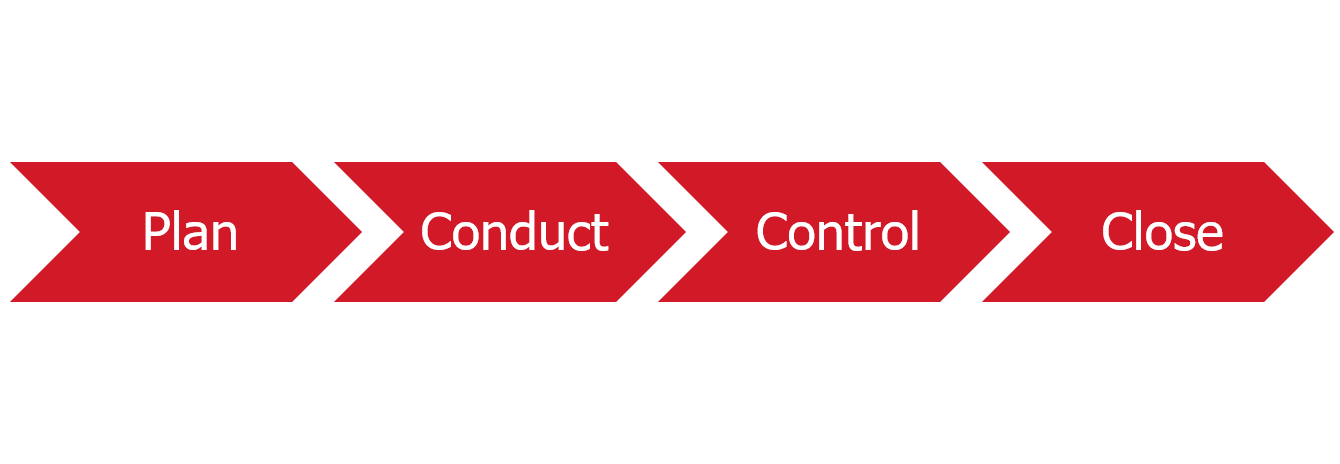
Project procurement shows up in 4 PMI defined project management processes:
- Plan Procurement Management: During the Planning Process Group, we use market research, make-or-buy analysis, source selection analysis. meetings and expert judgment to decide if we need to procure items. If so, we prepare bid documents (an SoW or various “request for” documents). The payment system is defined and put in place in support of the next processes.
- Conduct Procurements: During the Execution Process Group, we perform the advertising, review of bids and selection of the suppliers. Contracts are signed at this step with suppliers.
- Control Procurements: After contracts are signed, contractors are monitored to ensure they are meeting the project objectives and requirements in their contracts. A change control system is used to process any changes arising from suppliers. This alongside regular procurement performance reviews ensure successful delivery by suppliers.
- Close Procurements: At this stage, the suppliers has met all their obligations based on the contract. Information relevant to audits or the project are documented as part of record management and any lessons learned are documented.
Summary
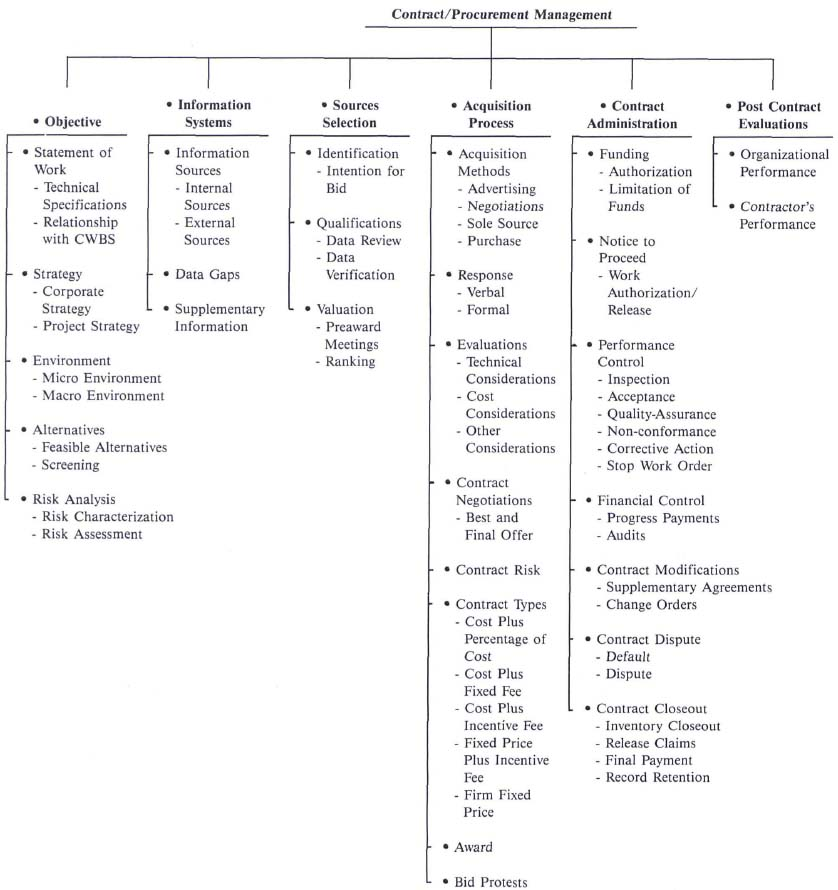
Source: Zuberi, S. H. (1986). Contract/procurement management. _Project Management Journal, 17_(3), 89–95.