ProjectManagementOER
Sources of Conflict
Conflict can arise from various sources, including:
- Scarce resources: While an easy solution is to increase resources, this may not always be possible.
- Task interdependence: Can be solved by redesigning structures and systems, but not everyone will be open to that.
- Task conflict: Conflict around a particular task, the content of decisions made in a team, and differing ideas and views on how to approach and interpret a task.
- Process conflict: Conflict around the delegation and logistics of task accomplishment, as well as responsibility and strategy. Linked to task and relationship.conflict.
- Conflicting goals: Can be solved by one-side giving in, but this is not always possible.
- Status conflict: Conflict embedded in an organization around who is (trying to be) on top of the social hierarchy, leading to power struggle over decision-making and resources.
- Organizational conflict: Conflict emerging from organizational structure as a whole, often tied to lack of communication, absence of shared visions, and different values.
- Personal and relationship conflicts: Conflict around relationships with other team members involving different attitude, preferences, personal styles. Destructive, often underpins task conflict. This requires helping members work through issues, which can be stressful.
Other sources of conflict include:
- Misunderstanding
- Information Deficiency
- Lack of Role Clarification
- Threat of Status
- Lack of Trust
- Organizational Changes
- Poor Communication
Political Behaviour
Political behavior in organizations is linked with competition among employees and complexity and uncertainty. When both these are high, political behavior is very likely. If one of these is high, there is still a strong chance of political bbehavior Increased standard operating procedures reduces political bbehavior which may in turn reduce some conflicts. Other factors influencing political behavior include:
- Individual Factors
- High self-monitors
- Internal locus of control
- High match personality
- Organizational investment
- Perceived job alternatives
- Expectations of success
- Political skill
- Organizational Factors
- Reallocation of resources
- Promotion opportunities
- Low trust
- Role ambiguity
- Unclear performance evaluation system
- Zero-sum reward practices
- Democratic decision-making
- High performance pressure
- Self serving senior managers
Levels of Conflict
Conflict is usually escalated through a series of levels.
- Problem to solve
- Information sharing and collaboration
- Language is open, fact based, friendly and constructive
- Disagreement
- Personal protection over collaboration
- Language is guarded and open to interpretation
- Contest
- Winning over resolving
- Language includes personal attacks, over-generalizations and magnified positions
- Crusade
- Protecting one’s own group becomes the focus
- Language is ideological and polarized
- World War
- Destroy the other
- Little or no language is exchanged, exchanged language is combative
Conflict resolution is focused on de-escalating the situation, so that it becomes a problem to solve.
Healthy Conflict
Appropriate conflict can lead to positive outcomes, but too much or too little results in negative outcomes. Some conflict is okay and necessary. The Five Dysfunctions of a Team by Patrick Lencioni, shows that teams start to become dysfunctional as a result of the following:
- Absence of Trust: Unwillingness to be vulnerable within the group
- Fear of Conflict: Teams that lack trust cannot engage in unfiltered debate.
- Lack of Commitment: Without passionate debate, team members rarely buy in and commit to decisions, though they may feign agreement during meetings.
- Avoidance of Accountability: With a lack of commitment people hesitate to call their peers on actions or behaviors that seem against the good of the team.
- Inattention to Results: Failure to hold one another accountable leads to putting individual goals ahead of the project. This model takes the form of a pyramid with absence of trust at its base: this is the most important factor, and one that if unresolved can give rise to the other dysfunctions. Building trust involves butting heads, hence conflict.
Building trust involves debate, a form of conflict. Yet, the way we approach these debates is key.
| Healthy | Unhealthy |
|---|---|
| Fact checking: “Are you sure all the tests past?” | Generalizations, “You always…” |
| Testing alternatives, “What if we tried…” | Hostility, “That’s BS, we never…” |
| Asking for more details “Can we see the…” | Personal attacks, “You are so full of…” |
| Confirming understanding “So, help me understand, the…” | Disputing concepts without providing room for the other’s point of view. |
Building Trust
Trust is an important factor in any team. In a work environment where people trust each other, team members are more focused, resulting in more responsible, helpful, creative, and committed team members. Conversely, a work environment without trust leads to distracted team members who are self-protective, immobilized, and risk-adverse. Trust can be built if team members follow these guidelines ( Source: These suggestions are found in Williams, C. (2007). Effective Leadership (7th ed.). LTrek Corporation.):
- Tell the truth, even when it does not serve you well.
- Never make promises you cannot reasonably expect to keep.
- Commit firmly to values that respect the interests and rights of others.
- Be known for having high standards of integrity, for doing the right thing because it is right-even if your company and society are willing to accept a lower standard.
- Don’t let personal ambition interfere with being honest and fair.
- Consistently remind yourself that it is not in your self-interest to be selfish.
Conflict Reduction Strategy
Conflict reduction focuses on improving behaviours and attitudes, which can be achieved through:
- Physical separation
- Bureaucratic method
- Limited interaction
- Integrators
- Confrontation and negotiation
- Third-party consultants
- Rotation of members
- Interdependent tasks and superordinate goals
- Intergroup training
Conflict Resolution
“Conflict resolution can be defined as the informal or formal process that two or more parties use to find a peaceful solution to their dispute.”
Managing Conflict Sustainably
Two common approaches to conflict management are: 1. Focusing on the issue, resolving it, moving on * Integrating issues, being obliging, dominating, Avoiding the issue, compromising. * Structural interventions: new team composition, new hierarchies, specified objectives, reallocated resources. 2. Focusing on the causes, examining the broader picture, looking ahead * Identifying underlying causes, talking openly, listening, open-mindedness, creating benefits for every member, mutual goals. * Structural interventions: mediation, moderation, supervision, team development.
The second approach is more holistic and sustainable. However, it requires a cohesive team to work. When conflict arises, making the issue go away quickly will only help temporarily. Focusing on nurturing team cohesion can bring long-term benefits for team members and the organization as a whole.
Styles of Conflict Management
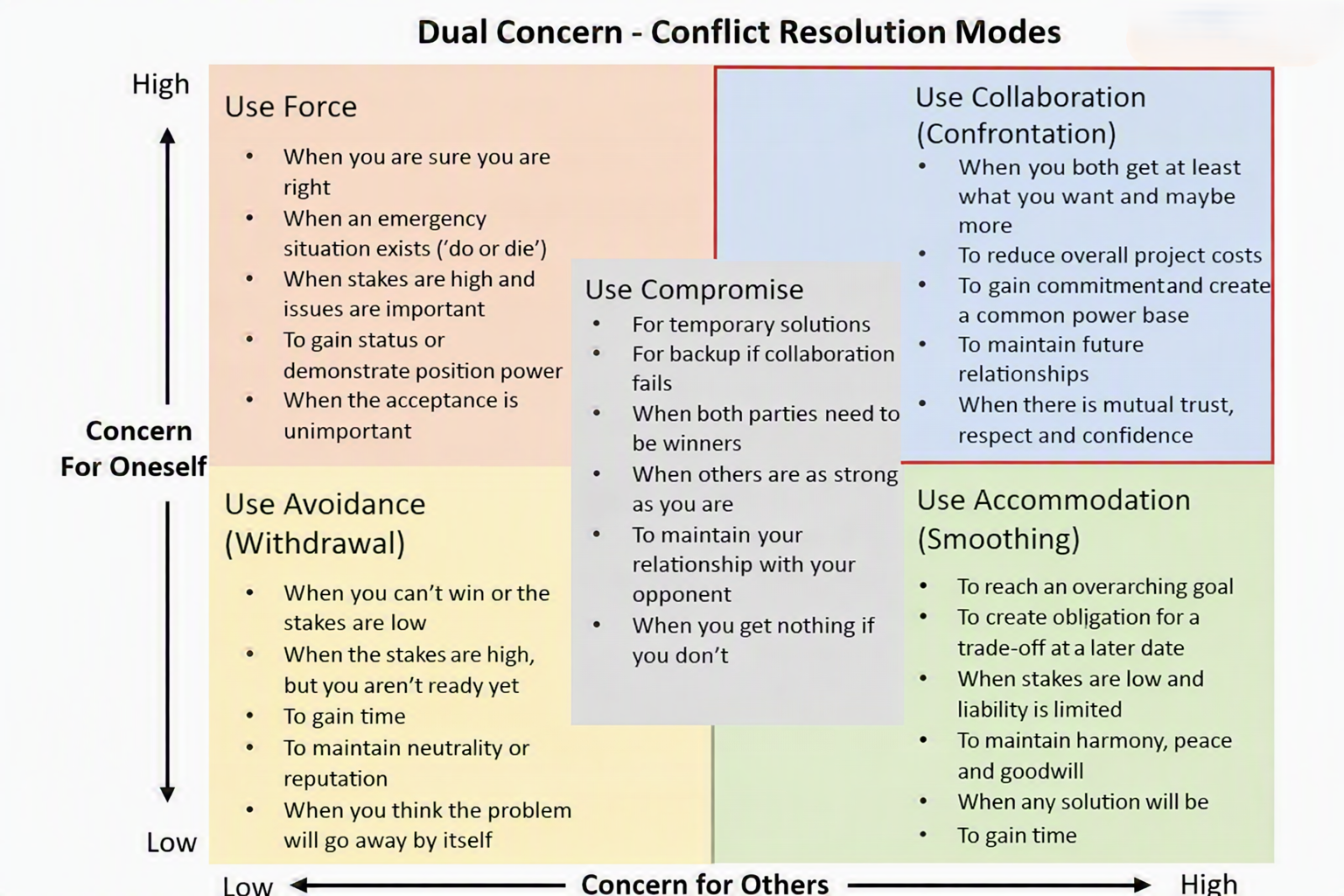
Conflicts arise due to a mismatch in opinions between you and someone else. Thomas Kilmann’s Conflict Model focuses on two parameters: Concern For Oneself/Assertiveness (achievement of own interest, need for justice, value of issue) vs Concern for the Relationship with the Other Side/Cooperativeness (response to other’s interest, importance places on mercy, value of relationship). Based on these concerns, 5 styles of conflict management emerge:
- Competing (Using force, directing): If you are mainly concerned with your position
- When you are sure you are right
- When an emergency situation exists (‘do or die’)
- When stakes are high and issues are important
- To gain status or demonstrate position power
- When the acceptance is unimportant
- Quick, decisive action needed
- Important but unpopular issues are at stake and where there isn’t ‘right’ way
- Accommodating (Smoothing, harmonising): If you can forego your concern to build a relationship
- To reach an overarching goal
- To create obligation for a trade-off at a later date
- When stakes are low and liability is limited
- To maintain harmony, peace and goodwill
- When any solution will be adequate
- To gain time
- Issue much more important to other party
- To limit damage of continued conflict
- To bank favors
- When in the wrong
- Collaboration (Confrontation): If both sides are concerned and cannot let go
- When you both get at least what you want and maybe more
- To reduce overall project costs
- To gain commitment and create a common power base
- To maintain future relationships
- When there is mutual trust, respect and confidence
- Both sets of concerns too important to be compromised
- Needs insights from different perspectives
- Increases others’ commitment to solutions
- Long-term major issues
- Avoidance (Withdrawal): If both sides can let go
- When you can’t win or the stakes are low
- When the stakes are high, but you aren’t ready yet
- To gain time
- To maintain neutrality or reputation
- When you think the problem will go away by itself
- Trivial issues
- No chance of getting what you want
- Potential risk of confrontation outweigh benefits of resolution
- Other better places to resolve the issue
- Compromising: If both have a medium level of concern, so a compromise is possible.
- For temporary solutions
- For backup if collaboration fails
- When both parties need to be winners
- When others are as strong as you are
- To maintain your relationship with your opponent
- When you get nothing if you don’t
- Moderately important goals but not worth potential disruption of more assertive modes
- Two equally strong parties committed to mutually exclusive goals
- Expediency
- Back up competing/collaborating
Negotiating to Resolve Conflict
Negotiation is communication back and forth for the purpose of making a joint decision. Negotiation balances politics and self-interest with trust and fairness. Negotiation can be:
- Hard (controlling): Hard bargaining is adversarial—you assume that your opponent is your enemy and the only way you can win is if he or she loses. So you bargain in a very aggressive, competitive way.
- Soft (giving in): Soft bargaining is just the opposite. Your relationship with your opponent is so important that you concede much more easily than you should. You get taken advantage of in your effort •to please, and while agreement is reached easily, it is seldom a wise one.
While negotiating, it is important to:
- Separate the people from the problem
- Give preference to logic and objective criteria
- Focus on interests not positions
- Control your emotions and biases
- Address other party’s emotions
- Generate options for mutual gain before choosing
- Decide based on objective criteria
- Know their BATNA (Best Alternative to Negotiated Agreement)
Good negotiations consist of a relentless search for the Third Alternative: We humans are presently conditioned to expect our relationships to be win/lose. View most situations from an “either/or” point of view: either I win or I lose. A third alternative may be harder to find, but there almost always exists a third way of doing things where no one loses or at worst are assured that the loss has been minimized and fairly shared. This is the win-win way—this is synergy. The third alternative fits within the zone of possible agreement, which is the overlap between the BATNA for the two sides.
Differences between Successful and Average Negotiations Based on data reported in N. J. Adler and A. Gunderson, International Dimensions of Organizational Behavior 5th edition (Mason, OH: Cengage Learning, 2008), pp. 165-181.
| Stage | Negotiation Behavior | Skilled Negotiators | Average Negotiators |
|---|---|---|---|
| Before Negotiation | Number of options considered per issue | 5.1 | 2.6 |
| Before Negotiation | Portion of time spent focusing on anticipated areas of agreement instead of conflict | 39% | 11% |
| During Negotiation | Portion of time spent asking questions of opponent | 21% | 10% |
| During Negotiation | Portion of time spent in active listening | 10% | 4% |
| During Negotiation | Portion of time spent attacking opponent | 1% | 6% |
To resolve conflict:
- Understand the conflict: Conflicts arise for a variety of different reasons. It is important for you to define clearly your own position and interests in the conflict, and to understand those of your opponent. Make sure to focus on interests not positions people are taking. You should focus on understanding:
- Interests of each side
- Possible Outcomes
- Legitimacy
- Communicate with the other side:
- Listen actively
- Let everyone participate who want to
- Talk about your strong emotions
- Don’t react to emotional outbursts
- Be concrete but flexible
- Avoid early judgments
- Avoid escalating tensions with threats and provocative moves
- Don’t tell the opposition “Its up to you to solve your problems”
- Look beneath the surface to identify deeper issues
- Overcome an “us versus them” mentality
- Brainstorm possible resolutions: Look at all of the interests you have listed, for you and for your opponents, and look for common interests. Use that to build potential solutions.
- Choose the best resolution: Set a time to discuss the options and determine which idea is the best.
- Use a third-party mediator: You may want to use a third party mediator: a person who is not from your group or your opponent’s group, but whom you both trust to be fair. Your mediator can help both sides agree upon a standard by which you’ll judge your resolution. Standards are a way to measure your agreement. They include expert opinions, law, precedent (the way things have been done in the past), and accepted principles.
Role of Leadership
Three major types of influence may play a role when facing a conflict: Power, Authority, Leadership.
Power within an organization can be a source of conflict, and a tool to help resolve conflict. Based of power include:
- Reward: The ability to give.
- Expertise: The power of knowledge based on your experience and education.
- Referrent: The power bestowed upon you by others thanks to their relationship with you, or their admiration.
- Coercion: The ability to take away.
- Legitimate: The power bestowed upon you due to your position.
- Informational: The power of being able to share insights or have access to information.
These bases of power can be used to control behaviour. Typically, employees and team members would react differently depending on which base of power is used:
- Coercion is usually faced with resistance
- Reward and legitimate power usually lead to compliance
- Expert and referrent power can build commitment
Some tips on how to use these powers:
| Power | Guideline for Use |
|---|---|
| Reward Power | Verify compliance. Make feasible, reasonable requests. Make only ethical requests. Offer rewards desired by subordinates. Offer only credible rewards. |
| Expert power | Maintain credibility. Act confident and decisive. Keep informed. Recognize employee concerns. Avoid threatening subordinates’ self-esteem. |
| Referent power | Treat subordinates fairly. Defend subordinates’ interests. Be sensitive to subordinates’ needs and feelings. Select subordinates similar to oneself. Engage in role modeling. |
| Coercive power | Inform subordinates of rules and penalties. Warn before punishing. Administer punishment consistently and uniformly. Understand the situation before acting. Maintain credibility. Fit punishment to the infraction. Punish in private. |
| Legitimate power | Be cordial and polite. Be confident. Be clear and follow up to verify understanding. Make sure request is appropriate. Explain reasons for request. Follow proper channels. Exercise power consistently. Enforce compliance. Be sensitive to subordinates’ concerns. |
| Influence Tactic | How to Use the Tactic |
|---|---|
| Rational persuasion | Use logical arguments and factual evidence. |
| Inspirational appeal | Arouse enthusiasm by appealing to values, ideals, aspirations. |
| Consultation | Involve others in planning or formulating an idea or strategy. |
| Ingratiation | Use praise, flattery, or friendly behaviour before making a request. |
| Personal appeal | Appeal to feelings of loyalty or friendship. |
| Exchange | Indicate willingness to reciprocate or share benefits. |
| Coalition tactics | Note the support of others in attempting to persuade. |
| Legitimizing tactics | Appeal to an agreed-upon authority such as a vision, mission, or goal. |
| Pressure | Introduce or suggest threats or negative consequences. |
Source: Adapted from Yukl, G. (2013, p. 202). Leadership in Organizations. (8th ed.). Upper Saddle River, NJ: Prentice Hall.
Summary
Bibliography
- Team conflict: understanding types of conflict and how to manage them sustainably - CQ Net - Management skills for everyone (ckju.net)
- What are the 5 styles of conflict management? - Sustaining Community (wordpress.com)
- How To Respond To Conflict: 5 Common Approaches – Lowry Group
- Negotiating for success: are you prepared
- From Conflict to Collaboration