ProjectManagementOER
Development Life Cycles: Predictive vs. Adaptive Project Management
Based on the “Frequency of Delivery” and the “Degree of Change”, project life cycles and project management is characterized as:
- Predictive: Low Frequency of Delivery and low Degree of Change). This approach is based on defining the scope at the beginning, creating a plan and then implementing the plan. It works well for projects where the scope is clear, the environment is predictable, and there is low uncertainty. Predictive projects do not typically deliver business value until the end of the project. If the predictive project encounters changes or disagreements with the requirements, or if the technological solution is no longer straightforward, the predictive project will incur unanticipated costs. The waterfall development approach is the most extreme form of predictive project management.
- Adaptive: When the scope is unclear, environment is unpredictable or there is high uncertainty and complexity, it makes more sense to rely on feedback during implementation. Adaptive approaches rely on feedback loops based on observation of and inspection from stakeholders alongside incremental planing and implementation in iterations. The most extreme adaptive approaches are agile.
- Iterative: Low Frequency of Delivery and high Degree of Change. Iterative life cycles improve the product or result through successive prototypes or proofs of concept, adding some level of flexibility and adaptability to project delivery. Projects benefit from iterative life cycles when complexity is high, when the project incurs frequent changes, or when the scope is subject to differing stakeholders’ views of the desired final product. Iterative life cycles may take longer because they are optimized for learning rather than speed of delivery.
- Incremental: High Frequency of Delivery and low Degree of Change. Incremental life cycles optimize work for delivering value to sponsors or customers more often than a single, final product. Usually in these cases, customers are willing to receive a subset of the overall solution early. Multiple deliveries means that the customer can provide feedback and the team can act on it, adding some more flexibility to implementation.
- Agile: High Frequency of Delivery and high Degree of Change). Agile is about customer-based delivery on a frequent basis. When teams use agile approaches, they expect requirements to change and iterate over the product to create finished deliverables. In agile projects, incremental delivery uncovers hidden or misunderstood requirements which the team can integrate into their next delivery. Agile techniques typically fall into two groups:
- In iteration-based agile, the team works in iterations (timeboxes of equal duration) to deliver completed features. The team works on the most important feature first, collaborating as a team to finish it. Then the team works on the next most important feature and finishes it. The team may decide to work on a few features at a time, but the team does not address all of the work for the iteration at once (i.e., does not address all of the requirements, followed by all of the analyses, etc.).
- In flow-based agile, the team pulls features from the backlog based on its capacity to start work rather than on an iteration-based schedule. The team defines its workflow with columns on a task board and manages the work in progress for each column. Each feature may take a different amount of time to finish. Teams keep work-in-progress sizes small to better identify issues early and reduce rework should changes be required. Without iterations to define planning and review points, the team and business stakeholders determine the most appropriate schedule for planning, product reviews, and retrospectives.
Iterative and incremental approaches are integrated into predictive project management to make it more adaptable, while agile inherently includes iterative and incremental development.
| Approach | Predictive | Iterative | Incremental | Agile |
|---|---|---|---|---|
| Requirements | Fixed | Dynamic | Dynamic | Dynamic |
| Activities | Performed once for the entire project | Repeated until correct | Performed once for a given increment | Repeated until correct |
| Delivery | Single delivery | Single delivery | Frequent smaller deliveries | Frequent small deliveries |
| Goal | Manage cost | Correctness of solution | Speed | Customer value via frequent deliveries and feedback |
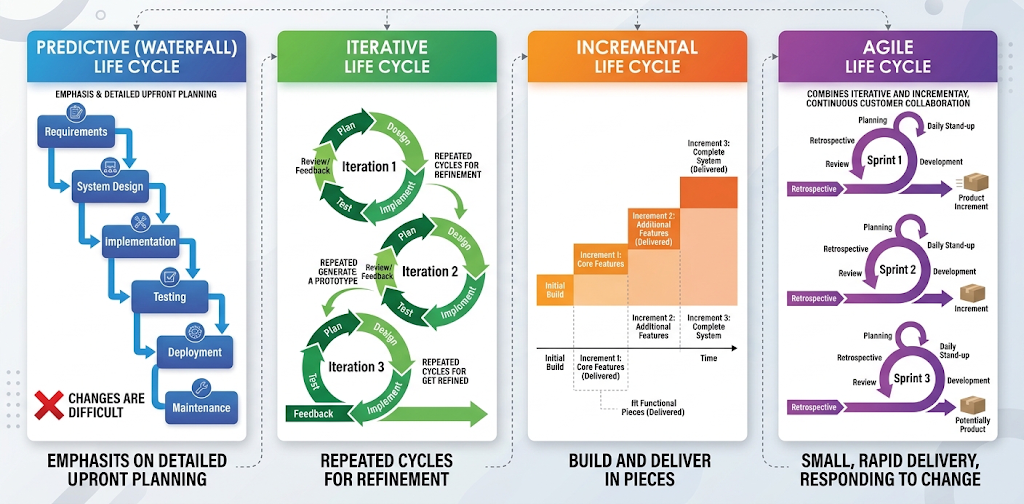
History of Development Approaches
- Waterfall Model
- Proposed in 1970 by W. W. Royce
- Development flows through steps: Requirements analysis -> Architectural design -> Detailed design -> Coding, debugging and unit testing -> Integration and system testing ->Deployment, operation and maintenance
- Pros: Track progress easily due to clear stages - Easily identifiable milestones and deliverables
- Cons: Inflexible: difficult to respond to changing requirements - Design and coding discover requirements inconsistencies - Some problems not discovered until system testing
- Spiral Model
- Defined in 1986 by Barry Boehm
- Modified waterfall: Software is developed in a series of incremental releases. Early releases are prototypes while later releases become increasingly complete. At each release you get feedback and as such can improve.
- Pros: Systematic and stepwise, but in an iterative framework - Estimates get more realistic as work progresses - Some ability to cope with changing requirements
- Cons: Time-intensive process and as such, not extensively used
- Rapid Application Development (RAD)
- Uses minimal planning in favour of rapid prototyping and iterative development
- Pros: Promotes strong collaboration during requirements gathering - Business owner actively participates in prototyping
- Cons: Dependency on strong cohesive teams and individual commitment to the project.
- RAD Spin-offs (1980s)
- Joint Application Development
- Rapid Systems Development
- New Development Rhythm
- Rapid Application Development
- Participatory Design
- Synch-n-Stabilize
- Internet Time
- Judo Strategy
- Rational Unified Process (RUP)
- Defined in 1997 by Grady Booch, Ivar Jacobson and James Rumbaugh
- General framework to describe specific development processes, designed to be tailored for a given software project with consideration for its size and type
- Recognized to be particularly applicable to large projects with large teams
- 4 project life cycle phases
- Inception: Shared understanding of the system with the customer
- Elaboration: Architecture to build the system
- Construction: Developing the system
- Transition: Customer takes ownership of system
- Identified 6 best practices in software development
- Develop Iteratively with risk as the primary driver: This allows us to deal with changing requirement and address high risk items as the highest priority tasks at each iteration. Ideally, each iteration has an executable release
- Manage Requirements: Document functionality, constraints, design decisions, business requirements and define use cases and scenarios
- Employ a Component-based architecture: This allows extension of capabilities and reusability
- Model software Visually (using tools like UML)
- Continuously verify Quality: Plan quality control and assessment involving all team members
- Control Changes: Use secure workspaces
- Cons: ‘High ceremony methodology’ - Bureaucratic: process for everything - Slow: must follow process to comply - Excessive overhead: rationale, justification, documentation, reporting, meetings, permission
- Agile methods (2000 and onward)
What is Agility?
Agility as a word means quickness, lightness, ease of movement, and nimbleness. In the context of business, agility is the ability to create and respond to change in order to profit in a turbulent business environment. Agile businesses can reprioritize quickly in response to shifting requirements, knowledge and technology or customer feedback. They use adaptable and evolutionary development styles to promote rapid customer responsiveness, while relying on cross-functional collaboration, teamwork, iterations, and flexibility throughout development.
The Agile Manifesto
In 2001, a group of software professionals came together and drafted the Manifesto for Agile Software Development as a representation of better ways of developing software. Overtime, these principles have been adopted by others using adaptive approaches for project management. The agile manifesto emphasizes 4 values:
- High-Performance Teams: Individuals and interactions over processes and tools
- Iterative Development: Working software over comprehensive documentation
- Customer Interaction: Customer collaboration over contract negotiation
- Adaptability or Flexibility: Responding to change over following a plan
The manifesto also emphasizes 12 principles based on these values:
- Our highest priority is to satisfy the customer through early and continuous delivery of valuable software.
- Welcome changing requirements, even late in development. Agile processes harness change for the customer’s competitive advantage.
- Deliver working software frequently, from a couple of weeks to a couple of months, with a preference to the shorter timescale.
- Business people and developers must work together daily throughout the project.
- Build projects around motivated individuals. Give them the environment and support they need, and trust them to get the job done.
- The most efficient and effective method of conveying information to and within a development team is face-to-face conversation.
- Working software is the primary measure of progress. 8. Agile processes promote sustainable development. The sponsors, developers, and users should be able to maintain a constant pace indefinitely.
- Continuous attention to technical excellence and good design enhances agility.
- Simplicity - the art of maximizing the amount of work not done. - is essential.
- The best architectures, requirements, and designs emerge from self-organizing teams.
- At regular intervals, the team reflects on how to become more effective, then tunes and adjusts its behavior accordingly These values and principles form the cornerstone of the agile mindset.
An agile approach is any approach that embodies this mindset. They are usually characterized by the following features:
- Rolling wave planning: Only close-term activities are planned in detail
- Iterative and incremental delivery
- Rapid and flexible responses to change
- Open communication between teams, stakeholders, and customers
- Self-managing empowered teams
- Early and continuous delivery of valuable products
- Documented just enough, right size and just-in-time
Many agile methods have roots in other areas such as lean management. Some of the common agile development approached include:
- Kanban
- Scrum
- Crystal methods
- ScrumBan
- Lean Software Development (LSD)
- Extreme Programming (XP)
- Feature-Driven-Development (FDD)
- Test-Driven Development (TDD)
- Dynamic Systems Development Method (DSDM)
- Agile Unified Process (AUP)
- Adaptive Software Development (ASD)
- Large Scale Scrum (LeSS)
- Disciplined Agile
- Scaled Agile Framework (SAFe)
Agile frameworks accept that complex problems cannot be fully defined in advance so they use the scientifically validated empirical process control approach—transparency, inspection, and adaptation—to focus the team on quickly delivering results that move through the cone of uncertainty toward a solution in the midst of emerging requirements.
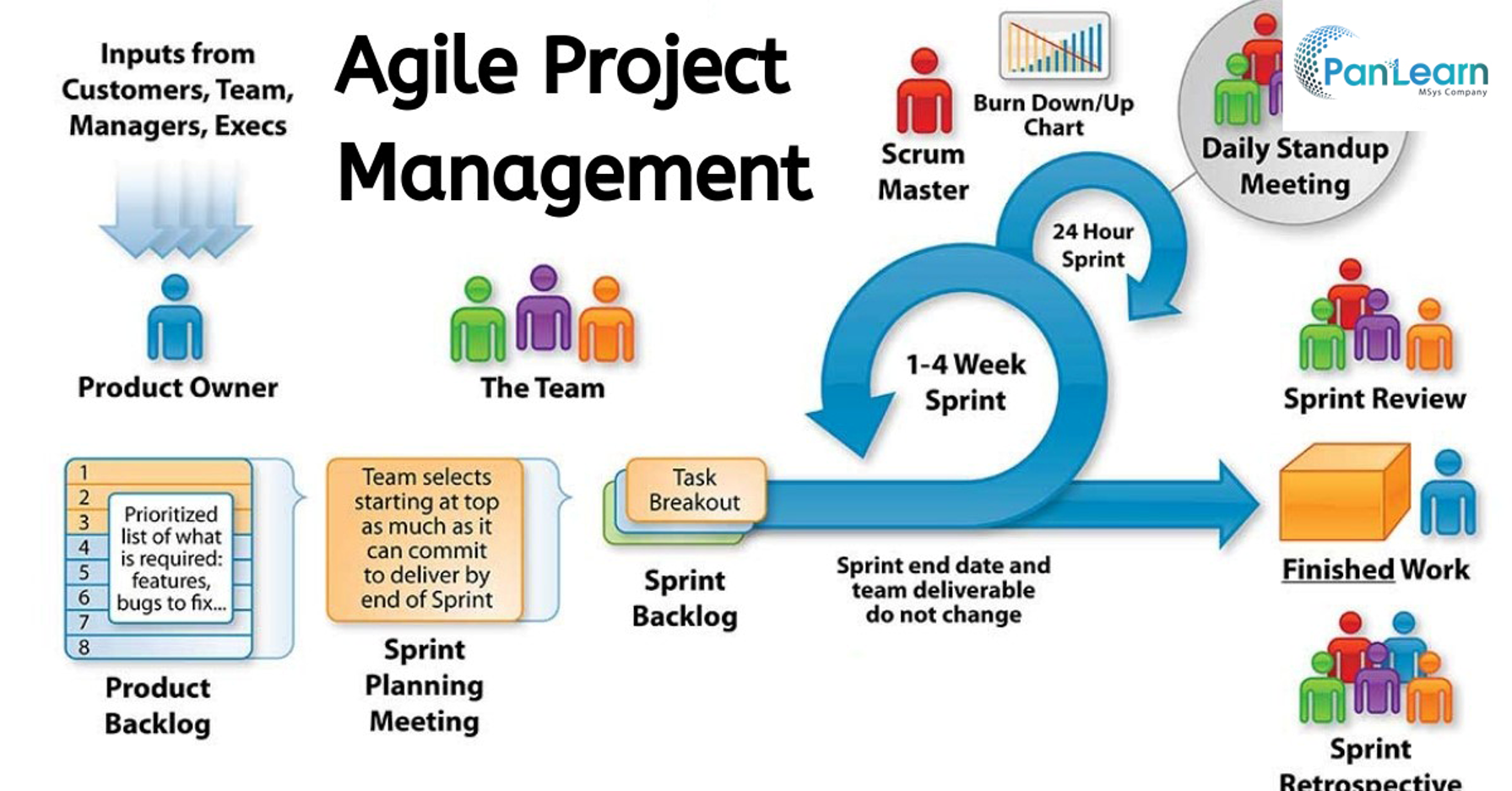 Source: Agile Project Management (panlearn.com)
Agile Events and Artifacts
In predictive project management, most artifacts of project management take the form of plans and reports. In agile approaches, we are trying to avoid unnecessary meetings and documentation. As such, we start observing some other events and artifacts. While these to an extent depend on the specific agile approach in use, common artifacts include:
- Events
- Sprint: An agile sprint is a short, fixed-length period (typically 1-4 weeks) during which a development team works to complete a specific set of tasks and deliver a working piece of software.
- Sprint planning: A collaborative event during which the entire team defines the work that needs to be completed in the sprint and how the work will be accomplished.
- Daily stand-up: A 15-minute time-boxed event for the development team to sync activities and update progress towards sprint goal. During the stand-up, typically three questions are answered: what did you do yesterday? what will you do today? Is there any impediments preventing you from completing the work?
- Sprint review: A meeting at the end oḟthe sprint to demonstrate the completed work to stakeholders, discuss progress and gather feedback.
- Sprint retrospective: A meeting at the end of a sprint where the team inspects its processes to identify what went well, what didn’t work, and how to improve for the next sprint.
- Artifacts
- Project charter: An agile project charter answers these questions:Why are we doing this project? (project vision) - Who benefits and how? (project vision and/or project purpose) - What does done mean for the project? (project’s release criteria) - How are we going to work together? (intended flow of work)
- User story: A short, simple description of a feature from a user’s perspective. Scope in agile is usually delineated using user stories.
- Story points: A relative unit of measure used to estimate the effort, complexity, and uncertainty involved in completing that story. Story points are equivalent to time, cost and risk from predictive project management.
- Product backlog: A prioritized, dynamic list of all the work needed to create or improve a product.
- Sprint backlog: A subset of the product backlog that the team has selected for completion during the sprint.
- Increments: The sum of all completed product backlog items during the sprint, plus the sum of all increments from previous sprints.
- Information Radiators: A publicly posted display that gives the team and stakeholders an at-a-glance view of project status, progress and performance without the need to ask questions. Examples of information radiators include Kanban or task boards, burn-up and burn-down charts, velocity charts, risk board or other dashboard that focus on issues or metrics.
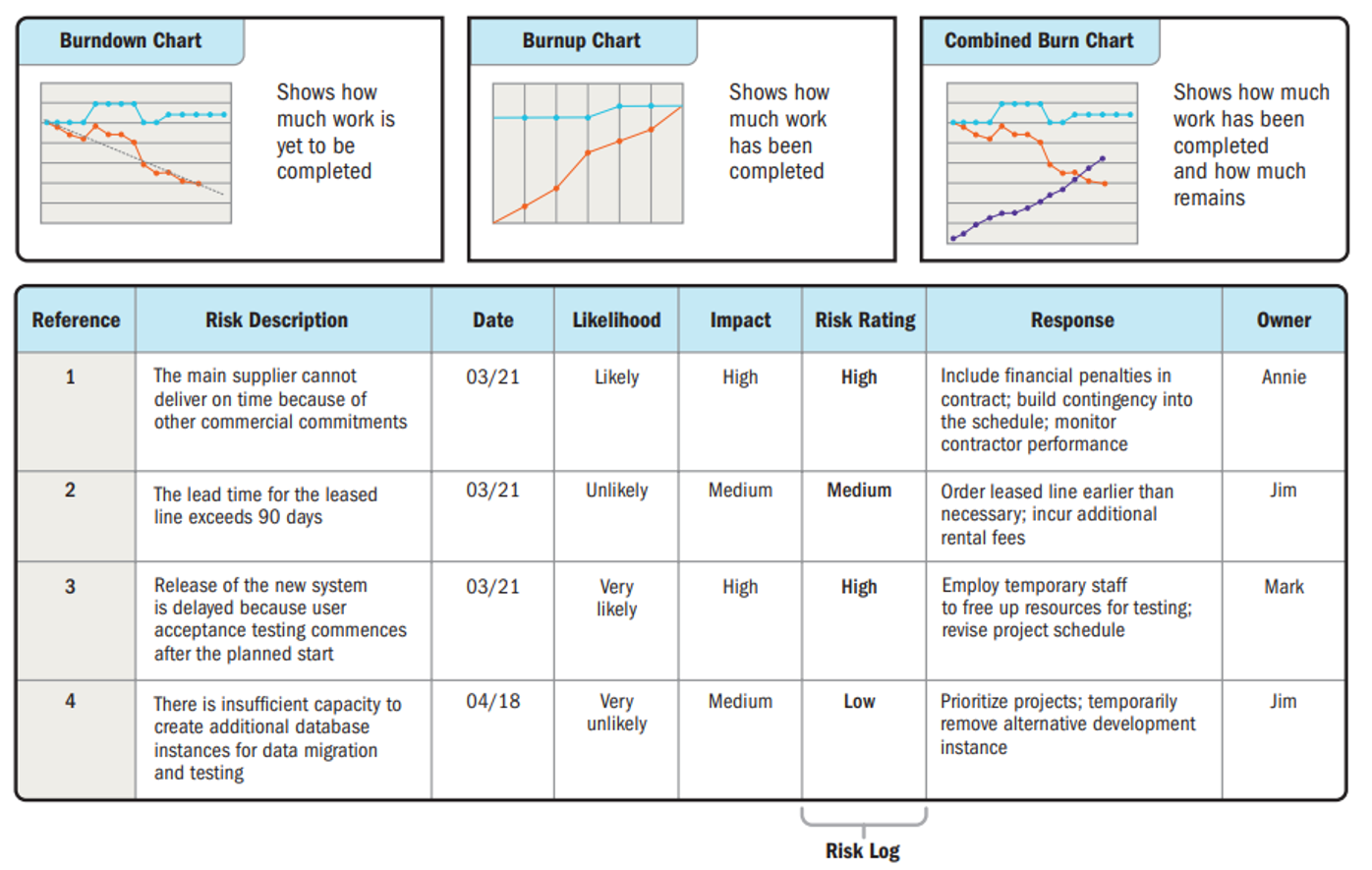 Source: PMBOK Guide 7th ed.
- Tools
- Pre-mortem: A proactive risk management technique where the team imagines a project has already failed and works backward to identify potential causes of failure before they happen.
- Post-mortem: A detailed, comprehensive review of a completed project or incident to identify root causes of what went wrong and what went well.
- Spike: A time-boxed research task that helps teams gain knowledge to reduce uncertainty before starting work on a user story. Spikes can focus on architecture, risk or other aspects of the work.
- Relative estimation: Unlike predictive project management where estimation focuses on absolute values, agile practitioners use relative estimation. Here, teams estimate work not by absolute time (like hours), but by comparing the size, complexity, and effort of tasks to one another. Popular methods include planning poker, T-shirt sizing, Fibonacci sequence for story points, affinity mapping/bucket system or analogy.
- Pair programming: Two team members work together at a single workstation, with one acting as the “driver” who does the work and the other as the “navigator” who reviews and provides high-level guidance.
- Swarm: The team temporarily pools its resources to focus intensely on a single, high-priority task or problem.
Agile Roles
While some agile methods have a “project manager” role, others distribute project management duties among the team or in other roles.
Agile relies on a cross-functional development/delivery team with team members with all the skills necessary to produce a working product. In software development, these may be designers, developers, testers, etc. Typically, the team has 3-9 members, collocated in the same team space, 100% dedicated to the team and self-managed (team members decide who will perform the work within the next period’s defined scope. Some attributes of an agile team include:
- Dedicated people: The team only works on a single project. the goal is to leverage increased focus and productivity, and maintain a small team, fewer than ten people.
- Cross-functional: The team can develop and deliver often, deliver finished value as an independent team, integrate all the work activities to deliver finished work amd provide feedback from inside the team and from others, such as the product owner.
- Collocation or ability to manage any location challenges: Collocation will lead to better communication, improved team dynamics, knowledge sharing, reduced cost of learning and ability to commit to working with each other.
- Mixed team of generalists and specialists: Specialists provide dedicated expertise and generalists provide flexibility of who does what. The team brings their specialist capabilities and often become generalizing specialists, with a focus specialty plus breadth of experience across multiple skills
- Stable work environment: This will allow the team to depend on each other to deliver, agree on approach to the work, simplify team cost calculations (run rate) and preserve and expand intellectual capital.
The role of the team is to:
- Build product increments, using agile practices and processes
- Write acceptance tests for product increments
- Test product increments until they pass acceptance test
- Demonstrate completed product increment to Product Owner/Sponsor/Stakeholders (in iteration review)
- Self-organize and self-direct their working process
- Share progress with each other in daily stand-up meetings
- Regularly update information radiators to share progress with stakeholders
- Hold iteration retrospectives to reflect on their process and continually improve it
- Perform release and iteration planning, including estimating stories and tasks.
Most agile methods also rely on a product owner, who represents the perspectives of the customer. They often have a business background and bring significant subject matter expertise to decision-making. Product owners work with their teams daily by providing product feedback and setting direction on the next piece of functionality to be developed/delivered. This role:
- Guides the direction of the product
- Prioritizes the work based on its business value
- Creates the backlog for delivering the highest value
- Chooses and prioritizes product features
- Works with stakeholders, customers, and the team to define the product direction
- Manages product backlog, making sure it is accurate, up to date, and prioritized
- Makes sure team has a shared understanding of backlog items
- Provides acceptance criteria that the delivery team will use to prepare acceptance test
- Determines whether each completed product increment is working as intended, and either accepts it or requests changes
- Request changes to product features and their priority as needed
- Facilitates engagement of external project stakeholders and manages their expectations
- Provides duration for the project and/or its releases
- Attends planning meetings, reviews, and retrospectives.
Agile teams also rely on a team facilitator, who helps ensure that the team can work smoothly towards the goals set by the product owner. Depending on the method, this role may be called a agile project manager, Scrum Master, project team-lead, team coach or team facilitator. From a leadership perspective, this is a ‘Servant Leader’, with the aim to:
- Shield the team from interruptions
- Remove impediments to progress
- Communicate (and re-communicate) the project vision
- Carry food and water
The agile facilitator:
- Facilitates communication within delivery team and with other project stakeholders
- Makes sure team’s plan and progress are visible to project stakeholders
- Helps product owner communicate project vision, goals, and backlog to team
- Facilitates meetings (planning, reviews, and retrospectives)
- Follows up on stand-up meetings remove impediments so team can stay on track
- Helps product owner manage product backlog
- Acts as servant leader to delivery team
- Supports and guides the team’s efforts to self-govern and self-organize
- Acts as coach and mentor to delivery team
- Guides team’s agile process and practices.
Of course, the project sponsor, stakeholders and subject matter experts may also interact with the team and need to be informed about the development approach.
Agile Metrics
| Agile | Traditional |
|---|---|
| High-Performance Teams: * Team skills * Team motivation * Team cooperation * Team trust * Team cohesion * Team communications |
Processes: * Standards compliance * Process Maturity Level * Manufacturing practices * Documentation (document standard, lifecycle/phase reviews, quality assurance audits) |
| Iterative Development: * Iteration size * Iteration number * Iteration frequency * Productivity * Defect density * Software reliability |
Contracts: * Fixed-fee contracts * Engineering changes * Contract change orders |
| Customer Interaction: * Interaction frequency * Communication quality * Strength of Relationship * Customer trust * Customer loyalty * Customer satisfaction |
Project Plans: * Cost Compliance * Scope Compliance * Schedule Compliance |
| Adaptability or Flexibility: * Organizational flexibility * Management flexibility * Developer flexibility * Process flexibility * Design flexibility * Technology flexibility |
Project Plans: * Cost compliance * Scope compliance * Schedule compliance |
Source: Rico, D. F. (2009). Metrics for Agile Methods.
Agile Pain Points and Troubleshooting Possibilities
- Unclear purpose or mission for the team: Agile chartering for purpose-vision, mission, and mission tests
- Unclear working agreements for the team: Agile chartering for alignment-values, principles, and working agreements.
- Unclear team context: Agile chartering for context-boundaries, committed assets, and prospective analysis.
- Unclear requirements: Help sponsors and stakeholders craft a product vision. Consider building a product roadmap using specification by example, user story mapping, and impact mapping. Bring the team and product owner together to clarify the expectations and value of a requirement. Progressively decompose roadmap into backlog of smaller, concrete requirements.
- Poor user experience: User experience design practices included in the development team involve users early and often.
- Inaccurate estimation: Reduce story size by splitting stories. Use relative estimation with the entire team to estimate. Consider agile modeling or spiking to understand what the story is.
- Unclear work assignments or work progress: Help the team learn that they self-manage their work. Consider kanban boards to see the flow of work. Consider a daily standup to walk the board and see what work is where.
- Team struggles with obstacles: A servant leader can help clear these obstacles. If the team doesn’t know the options they have, consider a coach. Sometimes, the team needs to escalate obstacles (or roadblocks) the team or servant leader has not been able to remove.
- Work delays/overruns due to insufficiently refined product backlog items: Product owner and team workshop stories together. Create a definition of ready for the stories. Consider splitting stories to use smaller stories.
- Defects: Consider the technical practices that work for the environment. Some possibilities are: pair work, collective product ownership, pervasive testing (test driven and automated testing approaches) and a robust definition of done.
- Work is not complete: Team defines definition of done for stories including acceptance criteria. Also add release criteria for projects.
- Technical debt (degraded code quality): Refactoring, agile modeling, pervasive testing, automated code quality analysis, definition of done.
- Too much product complexity: For software and non software encourage the team always to be thinking “What is the simplest thing that would work?” and apply the agile principle of “Simplicity-the art of maximizing the amount of work not done”. These help reduce complexity.
- Slow or no improvement in the teamwork process: Capture no more than three items to improve at each retrospective. Ask the servant leader to help the team learn how to integrate those items.
- Too much upfront work leading to rework: Instead of much upfront work, consider team spikes to learn. In addition, measure the WIP during the beginning of the project and see what the team’s options are to deliver value instead of designs. Shorten iterations and create a robust definition of done.
- False starts, wasted efforts: Ask the product owner to become an integral part of the team.
- Inefficiently ordered product backlog items: Rank with value including cost of delay divided by duration (CD3) and other value models.
- Rush/wait uneven flow of work: Plan to the team’s capacity and not more. Ask people to stop multitasking and be dedicated to one team. Ask the team to work as pairs, a swarm, or mob to even out the capabilities across the entire team.
- Impossible stakeholder demands: Servant leadership to work with this stakeholder (and possibly product owner).
- Unexpected or unforeseen delays: Ask the team to check in more often, use kanban boards to see the flow of work and work in progress limits to understand the impact of the demands on the team or product. Also track impediments and impediment removal on an impediment board.
- Siloed teams, instead of cross-functional teams: Ask the people who are part of projects to self-organize as cross-functional teams. Use servant leadership skills to help the managers understand why agile needs cross-functional teams.
Summary
Bibliography
The following sources were also consulted in creating this resource:
- Agile Practice Guide, PMI, 2017.
- Rico, D.F., Sayani, H.H., & Field, R.F. (2008). History of computers, electronic commerce, and agile methods. In M.V. Zelkowitz (Ed.), Advances in computers: Emerging technologies, Vol. 73, San Diego, CA: Elsevier.
- Agile Manifesto
- Agile Essentials
- Agile versus Waterfall approach is right for my ERP project?