ProjectManagementOER
Change Management
Change is an inevitable aspect of organizational development. As organizations grow and evolve, there is a need to adapt and change by changing technology, creating new structures, changing physical attributes, adjusting business models or changing people. Organizational change refers to the actions in which a company or business alters a major component of its organization, such as its culture, the underlying technologies or infrastructure it uses to operate, or its internal processes.
Almost all these changes are implemented in the form of projects: the change itself is a temporary endeavor which, when fully implemented, becomes part of the organizations operations.Change can be characterized in a couple of different ways:
- Based on scope
- Incremental/adaptive: small, incremental changes organizations adopt to address needs that evolve over time.
- Transformational: Larger in scale and scope, involving major shifts in mission, strategy, structure, performance, and processes.
- Based on intentionality: Planned vs unplanned
- Based on source: Innovative vs imitative
- Based on order of change
- First-order: Procedural modifications of how things are done. These can be implements with minor difficulty, quickly and can easily be reversed.
- Second-order: Policy changes resulting in significant change. They are of moderate difficulty, can be implemented in medium term and are usually irreversible.
- Third-order: Changes in governing values. These are very difficult, long-term changes that are usually irreversible. The PMI defined change management as: a comprehensive, cyclic, and structured approach for transitioning individuals, groups, and organizations from a current state to a future state with intended business benefits. Several key words should be noted in this definition.
Levels of Strategic Change and Change Management
According to Managing Change in Organizations: A Practice Guide, PMI, 2013., one can map change based on the level of organizational change and strategic change:
- Extensive Strategic Change and Organizational Change Management - Bet the Company: provide the highest return on investment, but also are likely to be the highest risk. Example: An aircraft company undertakes a new aircraft development program requiring change management and strategic change. The change management focuses on outsourcing design of major components which has never been done before. The strategic change is to build the aircraft out of composite materials.
- Extensive change management with minimal strategic change - Enhance Capabilities: Example: A decision is made to implement a project management office (PMO) across a geographically dispersed organization.
- Extensive strategic change requiring minimal change management - Comfortable Innovation: Example: A decision is made to enter a significant new market. The existing organization is capable of supporting this new market initiative.
- Minimal change management and minimal strategic change - Business As Usual Organizations need to balance change: you cannot change everything at all time; some items should stay business as usual, while others may need extensive change.
Readiness for Change vs Urgency
- Urgent change with high readiness: The organization is fully prepared to act, likely with extensive planning.
- Urgent change but low readiness: The organization needs to quickly organize to act; contingency plans may help.
- None urgent change but readiness for change: Continuously sustained action, seen in organizations with a focus on continuous improvement.
- None urgent change without readiness for change: Require deliberate capacity building to implement change.
Creating readiness for change requires integrating change management into all aspects of the organization (strategy, portfolio, programs and project and operations). Particularly, business impact analysis within programs and projects informs portfolio reviews and adjustments, which take the form of change. Calue performance analysis from operations also informs business strategy, which may result in additional organizational changes.
Changes to Organization Culture
Organizational culture describes the set of values, beliefs, attitudes, systems, and rules that outline and influence employee behavior within an organization. The culture reflects how employees, customers, vendors, and stakeholders experience the organization and its brand. Organizational culture affects all aspects of a business, from punctuality and tone to contract terms and employee benefits. When workplace culture aligns with your employees, they’re more likely to feel more comfortable, supported, and valued. Culture is a key advantage when it comes to attracting talent and outperforming the competition.
When a change is focused on the organization’s culture, it is important to consider the following:
- Match strategy and culture
- Focus on a few critical shifts in behavior (as opposed to fixing everything in one go)
- Honor the strengths of your existing culture
- Integrate formal and informal interventions
- Measure and monitor cultural evolution
Why Managers Fail to Get Results During Change?
| Top 10 Causes | Percent Citing the Cause | Consequences |
|---|---|---|
| Ineffective communication skills/practices | 80% | Leaves employees uncertain and stressed, making it difficult to make informed business decisions |
| Poor work relationships and interpersonal skills | 79% | Isolates managers from the informal network of knowledge that is necessary to cope with change |
| Person-job mismatch/skills gap | 69% | Puts managers in positions in which they are ill equipped to deliver results |
| Failing to set clear direction/clarify performance expectations | 61% | Hinders planning, saps motivation, and, ultimately, immobilizes staff |
| Delegation and empowerment breakdowns | 56% | Contributes to confusion and frustration |
| Failing to break old habits and adapt | 54% | Perpetuates behaviors and actions that no longer add value in the new work environment |
| Inability to develop cooperation/teamwork | 51% | Destroys collective performance |
| Lack of personal integrity and trustworthiness | 49% | Destroys a leader’s credibility with the people who are essential to getting results |
| Inability to lead/motivate others | 45% | Leads to minimal performance at a time when change requires extra effort |
| Poor planning practices/reactionary behavior | 44% | Creates disruptive crises that damage performance and morale |
The Eight Constants of Change
- Organizations change when the people within them change
- Resistance is inevitable
- Commitment to the past hinders change in the future
- Connecting to the head and the heart builds commitment
- A leader’s actions speak louder than words
- Effective communication demands quality and quantity
- People support what they help create
- Sustaining change takes support and reinforcement
On the matter of resistance to change, this usually arises from:
- Broken promises
- Threat to identity
- Uncertain plans
- Cultural differences
Increasing Commitment to Change
Improving commitment takes time. One needs to raise awareness, understanding and belief in the change before there is action. Commitment to change is somewhat correlated with three factors:
- The individual team member’s confidence in their own ability: Leaders can help by:
- clarifying expectations
- providing training
- planning for early success
- Team member’s confidence in organizational leaders: Leaders should:
- exhibit appropriate skills
- lead by example
- demonstrate credibility
- be well prepared and not overreact
- Members attitudes toward change: Leaders should:
- communicate intrinsic benefits
- link to extrinsic rewards
- select or promote for positive attitudes
Change Management Roles
Initiating Sponsor(s)
This is the person that has the power to initiate and authorize the change for all those affected.
Sustaining Sponsor(s)
The sustaining sponsor is the one with political and supervisory proximity to targets. Their role is to:
- Communicate change priorities and resource allocations
- Clarify roles in the change process
- Establish commitment and educate change agents
- Ensure the use of synergistic approaches in order to support and implement change effectively
- Provide the appropriate resources – logistical, financial and political – necessary to carry out a change project
- Assess and plan for the level of resistance and support expected from those affected by the change
- Use and reinforce effective change management skills throughout the change process
Change Agent
Change agents can help navigate resistance to change, communication of a change and its sustainment. A change agent, or agent of change, is someone who is responsible for implementing change. To achieve change management objectives, a change agent assumes responsibilities that start once leadership decides to undertake an initiative. An effective change agent serves a distinct role within a change initiative as a proponent of the change, as well as a conduit between leadership and the rest of the organization. Their role is to:
- Clarify and develop role responsibilities with key players
- Assess own skills and abilities as a change agent on an ongoing basis. Use this information to talk with sponsor(s) about your role and to further develop your skills.
- Assess the change project and, later, prepare an implementation plan. Be sure that they have communicated this plan to your sponsor(s) and that it has been agreed upon ahead of time.
- Implement and follow through on plan
- Educate and gain commitment from Impacted Stakeholders
- Facilitate ongoing feedback from Impacted Stakeholders and sponsors regarding progress and potential or real problems related to the change effort
- Provide all necessary resources and support
- Identify and manage resistance
There are three main types of change agents:
- People-centric: These change agents help boost employee morale and motivation. They help employees through a change and assist with goal setting, training and upskilling.
- Structure-centric: These agents focus on changing an organization’s infrastructure. They research and implement new technologies and perform systems analysis.
- Process-centric: These change agents focus on implementing new change processes and facilitating communication and cooperation among teams.
Advocate(s)
Advocates want to achieve change but need to enroll sponsors and change agents to achieve results. They need to:
- Define what they want to change and create criteria to measure success
- Identify key Impacted Stakeholders who must accommodate the change
- Clarify own role and the desired roles of others
- Identify and educate others who must support the change and gain their commitment
- Evaluate the required and the current skill level for managing change for each of the key players or groups
- Provide appropriate resources and support
- Utilize synergy and effective change management skills
Impacted Stakeholder/Target
This is the person that has to change something they do. They need to:
- Find out the reasons for change
- Discuss questions or concerns about the change with appropriate advocate(s), agent(s) and sponsor(s)
- Gain clarity about what is expected of them, how the change may affect their role(s), and any consequent management structure that may affect them
- How will the dynamics be affected by the change? Will they be able to influence change? How can they contribute to a synergistic process?
- Control their attitude – look at the glass as half full
- Look for the opportunities the change presents for them
- Take some ownership of the change
Models of Change in Organizations
Several frameworks have been developed to describe changes in organizations.
Kurt Lewin’s Model of Change
In this model, first the need for change is recognized. This happens usually as a result of issues and problems in operations or performance. Lewin describes that change happens in 3 phases:
- Unfreeze
- Recognize the need for change
- Determine what needs to change
- Encourage the replacement of old behaviors and attitudes
- Ensure there is strong support from management
- Manage and understand the doubts and concerns
- Change
- Plan the changes
- Implement the changes
- Help employees to learn new concept or points of view.
- Refreeze
- Reinforce and stabilize changes
- Integrate changes into the normal way of doing things
- Develop ways to sustain the change
- Celebrate success
Of course, organizations are continuously undergoing changes. While this model conceptually helps us navigate a specific change, it assumes that only one change is happening at a time.
Kotter’s 8 Step Change Approach
Kotter proposed an 8 step approach to change:
- Establish a sense of urgency
- Build a powerful guiding coalition
- Develop a vision for change
- Communicate the vision
- Remove obstacles
- Generate short-term wins
- Consolidate improvements
- Embed changes into culture
These steps are very similar to Lewin’s model:
- 1,2,3 → unfreeze
- 4,5,6 –> Move
- 7,8 –> Refreeze
Appreciative Inquiry (AI) Model of Change
This model focuses on discovering the organization’s strengths and leveraging those to collaboratively design a positive future. After the purpose of the analysis is defined, a 4D cycle is followed:
- Discovery: Identifying what works well right now: strengths, successes, peak experiences.
- Dream: What could happend in the future? What is the future state we want?
- Design: What structures and systems are needed for the desired future? What should the organization look like? and How do we get there? (the plan)
- Destiny/Delivery: Implement the plan and create the envisioned future.
The Change Management 101 Model
This model has 3 main steps:
- Plan
- Assess needs
- Develop plan
- Do
- Launch communications
- Transition work
- Sustain
- Align structures
- Optimize results
Kübler-Ross Model (Response to Change)
This model, also known as five stages of grief, focuses on the pattern of emotional response of an individual to change. It describes the response in 5 chronological steps:
- Denial: The first reaction is often shock and disbelief, as the individual may refuse to accept the reality of the situation.
- Anger: Once denial fades, anger can surface, often directed at others, oneself, or the world.
- Bargaining: This stage involves a need to regain control by making deals or promises, typically with a higher power, in an attempt to postpone the inevitable.
- Depression: The reality of the change becomes more apparent, leading to feelings of sadness, hopelessness, and withdrawal.
- Acceptance: This is the final stage where the individual comes to terms with the loss, not necessarily happily, but with a sense of peace and understanding. It is important to understand that the level of activity of an individual fluctuates throughout this process, with lower activity during the denial stage, a comparative increase during anger and bargaining, following by the lowest level of activity during depression, and an increase back to normal in acceptance.
Prosci Change Triangle (PCT) Model
This model proposes a 3-phase process for organizational change:
- Phase 1: Prepare Approach: Defines the change management strategy, evaluates project readiness, and secures leadership sponsorship.
- Phase 2: Manage Change: Develops specific plans (e.g., communication, training, sponsorship) and executes them to guide employees through the ADKAR journey.
- Phase 3: Sustain Outcomes: Implements feedback systems, measures adoption, and establishes reinforcement mechanisms to make the change stick.
The Prosci ADKAR Model represents the five building blocks an individual must achieve for a change to be successful:
- Awareness: Understanding the need for change.
- Announce the change to employees well ahead of time.
- Explain your reasoning behind the change, including current pain points and potential ROI of the new solution.
- Give employees an opportunity to ask questions and make suggestions.
- Form: Town hall, meeting with staff impacted
- Desire: Making the personal choice to support and participate in the change.
- Gauge employees’ reactions to the change.
- Identify champions.
- If employees are resistant or indifferent, address their concerns and show them how the change benefits them personally.
- Form: Incentives and bonuses to implement change
- Knowledge: Understanding how to change.
- Provide training or coaching to show what employees need to do after the change takes place.
- Address any skill gaps.
- Offer resources, such as process flowcharts, that employees can reference later on.
- Form: Training, demos
- Ability: Implementing the required skills and behaviors.
- Schedule practice runs before the change is fully implemented.
- Monitor performance immediately following the change and provide constructive feedback.
- Set reasonable goals and metrics at the start.
- Adjust processes as necessary.
- Form: Coaching, mentoring
- Reinforcement: Sustaining the change over the long term.
- Monitor the change over time to ensure it fulfills your desired outcome.
- Use positive feedback, rewards, and recognition to encourage employees to keep following the new process.
- Form: Performance monitoring, reporting on KPIs
The first three steps (ADK) form the enablement zone, where the team is inspired and empowered for the change. The last two steps (AR) form the engagement zone, which enshrine the change and ensure it continues to be followed.
Example: Applying ADKAR
Let’s consider the implementation of a new online course registration system at Valley College. Switching front‑desk staff from paper forms to an online system requires deliberate change management:
- Awareness: Communicate why the change is needed (student experience, error reduction, efficiency).
- Desire: Address concerns and show how the new system will reduce workload and errors. You may involve the team in creating the system, and show how functionalities they need are implemented.
- Knowledge: Provide training sessions and practical guides for staff.
- Ability: Offer coaching and support during early registration cycles.
- Reinforcement: Recognize successful adoption and incorporate feedback into system improvements.
The Change Life Cycle Framework
This is the model used by PMI to describe the life cycle of the change. Remember, change is about going from a current stage to a future state based on your organizational business strategy. The PMI describes this through a series of process groups:
- Formulate change
- Identify/clarify the need for change
- Assess readiness for change
- Delineate scope of change
- Plan change
- Define he change approach
- Plan stakeholder engagement
- Plan transition and integration
- Implement change
- Prepare organization for change
- Mobilize stakeholders
- Deliver project outputs
- Manage transition
- Transition outputs into business
- Measure adoption rate and outcomes/benefits
- Adjust plan to address discrepancies
- Sustain change
- Ongoing communication, consultation and representation of stakeholders
- Conduct sensemaking activities
- Measure benefits realization Usually transformational change follows these full processes, while adaptive change happens through feedback during a transformational change.
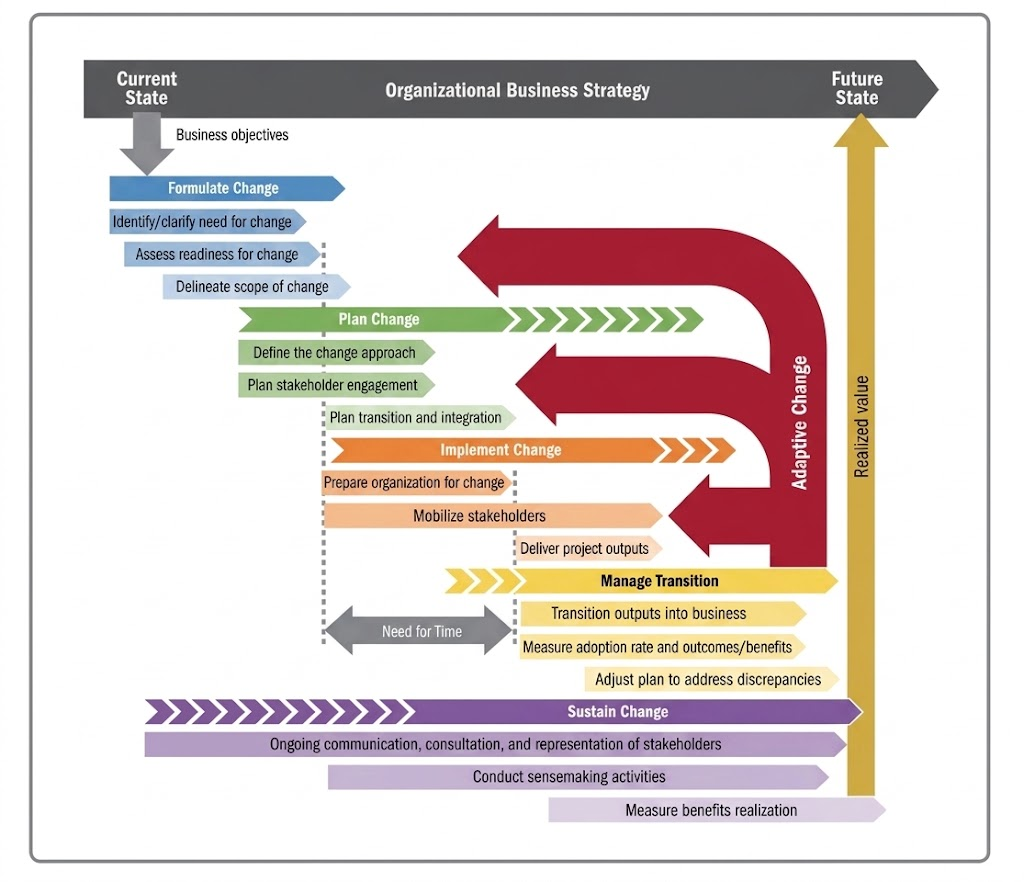 Adapted from: Managing Change in Organizations: A Practice Guide, PMI, 2013.
Summary
Bibliography
The following sources were also consulted in creating this resource:
- Chapter 16, OpenStax Organizational Behaviour
- Managing Change in Organizations: A Practice Guide, Project Management Institute, 2013
- What Is Organizational Change Management?
- What is a change agent (agent of change)?
- Change management: understanding the human dynamics of change
- Integrated change management
- What is organizational culture and how do you build it?
- Cultural change that sticks
- 7 Reasons Why Change Management Strategies Fail and How to Avoid Them
- Change Management Toolkit
- Improving outcomes through change management
- Organizational change management and projects
- Reactive project change management
- Managing change in organizations
- Culturally intelligent change management