ProjectManagementOER
Team Development and Leadership: From Individual to High Performing Team
Leadership and team development are linked hand in hand. In this section, we will review how project teams develop, and the role of leadership in guiding the team to success.
Understanding Your Team
Projects usually involve a team of individuals, contributing to the completion of the project over a period of time. Some people stay on the project long term while others may join the team for a short time to contribute to specific tasks. What is key is motivating anyone on the team, and integrating them with the team.
Motivation
Motivation is the internal or external force that energizes and directs behavior toward a goal. There are several elements that go into motivation:
- Arousal: The starter - the energy behind our actions and what compels a person to do something in the first place
- Direction: Where will you focus your effort - purpose and specific goals that behavior wishes to achieve
- Intensity: level of effort
- Persistence or duration: How long do you work at a task - continuing or sustaining engagement in a behavior over time
Various theories are used to describe motivation in individuals and teams. Each of these theories covers some aspects while neglecting others. While none are complete, overall they can help a person better understand how individuals are motivated.
Content Theories of Motivation
These theories focus on the internal needs, drives, and desires that individuals seek to fulfill.
Maslow’s Hierarchy of Needs
Developed in 1943, this model sees needs as a hierarchy, where higher level needs cannot be fulfilled without first fulfilling lower level needs. The order of hierarchy from low level to high is:
- Physiological: air, water, food, shelter, sleep, clothing, reproduction
- Safety and security: personal security, employment, resources, health, property
- Love and belonging: friendship, intimacy, family, sense of connection
- Esteem: respect, self-esteem, status, recognition, strength, freedom
- Self-actualization: desire to become the most that one can be What motivates a person is fulfilling these needs. Higher needs in the hierarchy begin to emerge when people feel they have sufficiently satisfied the previous need.
Alderfer’s modified hierarchy of needs (ERG)
Developed in 1967, the ERG model Groups Maslow’s needs into 3 levels:
- Existence (E): Physiological + Safety and security
- Relatedness (R): Love and belonging + social self-esteem
- Growth (G): Internal self-esteem + Self-actualization Satisfaction at one level leads to progression to the next level, while dissatisfaction at one level drives regression to the previous one.
With this in mind, one can design the work environment to provide opportunities with respect to each need:
- Existence Opportunities: Heat, Lighting, Base salary, Insurance, Retirement, Air conditioning, Restrooms, Cafeteria, Job security, Health programs, Clean air, Drinking water, Safe conditions, No layoffs, Time off
- Relatedness Opportunities: Friendship, Interpersonal security, Athletic teams, Social recognition, Quality supervision, Work teams, Social events, Merit pay
- Growth Opportunities: Challenging job, Creativity, Organizational advancement, Responsibility, Autonomy, Interesting work, Achievement, Participation
Herzberg’s two-factor theory
Developed in 1959, this model distinguishes between factors preventing dissatisfaction and affecting motivation: the hygiene and the motivation factors. Hygiene factors are needed to ensure an employee is not dissatisfied. Motivation factors are needed to motivate one to higher performance.
- Job Satisfaction is influenced by motivation factors: Achievement, Recognition, Responsibility, The work itself. Advancement, Personal growth\
- Job Dissatisfaction is influenced by hygiene factors: Working conditions, Coworker relations, Policies and rules, Supervisor quality, Base wage, salary
Improving motivation factors will increase job satisfaction, while improving hygiene factors decreased job dissatisfaction.
Murray’s System of Needs
Developed in 1943, this model categorizes needs into three groups:
- Needs Associated with Inanimate Objects: Acquisition, Conservancy, Order, Retention, Construction
- Needs Reflecting Ambition, Power, Accomplishment, and Prestige: Superiority, Achievement, Recognition, Exhibition, Infavoidance
- Needs Connected with Human Power: Dominance, Deference, Similance, Abasement, Contrariance
- Sado-Masochistic Needs: Aggression, Abasement
- Needs Concerned with Affection between People: Affiliation, Rejection, Nurturance, Succorance, Play
- Needs Concerned with Social Intercourse: Cognizance, Exposition Depending on the need, there may be a positive or negative action associated with the motivating factor with a directional force and a specific behaviour.
McClelland’s Achievement Motivation Theory
This model breaks down needs into:
- Need for achievement (seeking individual power and a share in power)
- Need for power (seeking personal accomplishment and significance)
- Need for affiliation (seeking relationships and community)
- Need for fairness (seeking equity and justice)
Mcgregor’s Theory X and Theory Y
This theory focuses on linking management behaviour to needs.
- Theory X
- Employees dislike work and will avoid it if possible. They must be coerced, controlled, or threatened with punishment to achieve their goals.
- Management should be authoritarian and controlling, focusing on micromanagement, strict supervision, tight controls, and a “carrot and stick” approach to motivation.
- Can be effective in situations requiring crisis control or for inexperienced workers, but can lead to low morale and creativity.
- Theory Y
- Employees do not inherently dislike work, are self-directed, and can be motivated by opportunities for growth and responsibility.
- Management should be participative and empowering, encouraging initiative, open communication, continuous improvement, and employee involvement in decision-making.
- Better suited for modern workplaces and skilled teams, fostering higher productivity, creativity, and job satisfaction
Process Theories of Motivation
Process theories of motivation explain how individuals are motivated by outlining the cognitive and behavioral processes involved in decision-making, goal-setting, and action.
Equity theory
Developed in 1963, this theory posits that motivation is influenced by the sense of “fairness” that workers possess, after comparing their efforts and rewards ratio with others, which are in the same situation. This is about balancing inputs and outputs:
- Inputs - What I put into my job (the qualifications, effort and competence): time, effort, ability, loyalty, tolerance, flexibility, integrity, commitment, reliability, heart and soul, personal sacrifice, etc
- Outputs - What I get from my job (the pay, prospects, benefits and recognition): pay, bonus, perks, benefits, security, recognition, interest, development, reputation, praise, responsibility, enjoyment, etc People become demotivated, reduce input and/or seek change/improvement whenever they feel their inputs are not being fairly rewarded. Fairness is based on perceived market norms.
Expectancy theory
Developed in 1964, this model sees motivation as the product of an individual’s “expectancy” that a certain effort will lead to the intended performance, the “instrumentality” of this performance to achieve a certain result and “valence” which is the desirability to achieve that result. In other words:
- Effort - Expectancy: Will the effort result in goals being met or an acceptable outcome? Can I achieve the goal?
- Performance - Instrumentality: Will the acceptable outcome lead to some sort of reward for the given effort? Will I get something for achieving the goal?
- Reward - Valence: Is the reward valued by those producing the effort? Is the reward worth the effort? Do I value what I get? Motivation is essentially the multiple of the three: motivation = Expectancy x instrumentality x valence
Job characteristics
Developed in 1980, this theory is based on the assumption that a job’s characteristics are independent of individuals - employees. These key job characteristics that are likely to influence the motivating potential of a job are: skill variety, task identity, task significance, autonomy and feedback.
Goal-Setting Theory
Developed in 1984, this theory posits that individuals are motivated to achieve specific goals. How we set goals plays a role in driving behaviour and performance. The model requires that:
- Core Elements
- Clarity/Specificity: Goals should be specific and unambiguous, leaving no room for misinterpretation. Clear goals provide a precise direction for action.
- Challenge/Difficulty: Goals should be challenging but attainable. Setting overly easy goals does not stimulate motivation, while excessively difficult goals may lead to frustration.
- Moderators
- Commitment: Individuals should be committed to their goals. When people are invested in their objectives, they are more likely to put in the effort required to achieve them. 4.Importance: The goal should be of relevant importance to the organization. the need and impact should be clear.
- Self-efficacy: The person should believe that they can succeed in completing the goal. Individual goals must be realistic and mutually agreed.
- Feedback: Regular feedback and progress monitoring are essential for goal achievement. Feedback helps individuals make necessary adjustments to stay on track.
- Task Complexity: The complexity of a task can influence the effectiveness of goal setting. For simpler tasks, setting specific goals is more effective, while complex tasks may benefit from setting learning or process goals.
Operand Conditioning Theory of Motivation
The Operand conditioning theory of motivation states that voluntary behaviors are modified by their consequences, meaning actions followed by reinforcement are more likely to be repeated, while those followed by punishment are less likely. So motivation is determined by the stimulus, its consequences, and the response to the consequence. This theory is the basis for much of our HR processes: Work behavior is followed by possible supervisory actions leading to behavioral change.
General Operand Model: Stimulus (S) → Response (R) → Consequence (C)
Ways to Strengthen the S → R Link - Increase behaviour
- S → R → C+ (Positive Reinforcement - add a pleasant stimulus as consequence)
- S → R → C– (Negative Reinforcement - remove an unpleasant stimulus as consequence)
- S → R → (no C–) (Avoidance Learning - give a warning to provide oportunity to avoid negative consequence)
Ways to Weaken the S → R Link - Decrease behaviour
- S → R → (no C) (Nonreinforcement)
- S → R → C– (Punishment - add an unpleasant stimulus as a consequence)
Relevance to Leadership in Projects
The project manager needs to design the project to motivate people to be part of it. This may involve using elements from some of these theories. Think of why people want to work at Google: the environment, the big goals, the impact. The project manager understand the project in an out. If they see some element of motivation is missing, then they can look for others to still motivate the contributors to join and do their best.
Models of Team Development
There are various models developed to describe how teams develop. We will look at a few in this section.
Tuckman’s Model of Team Development
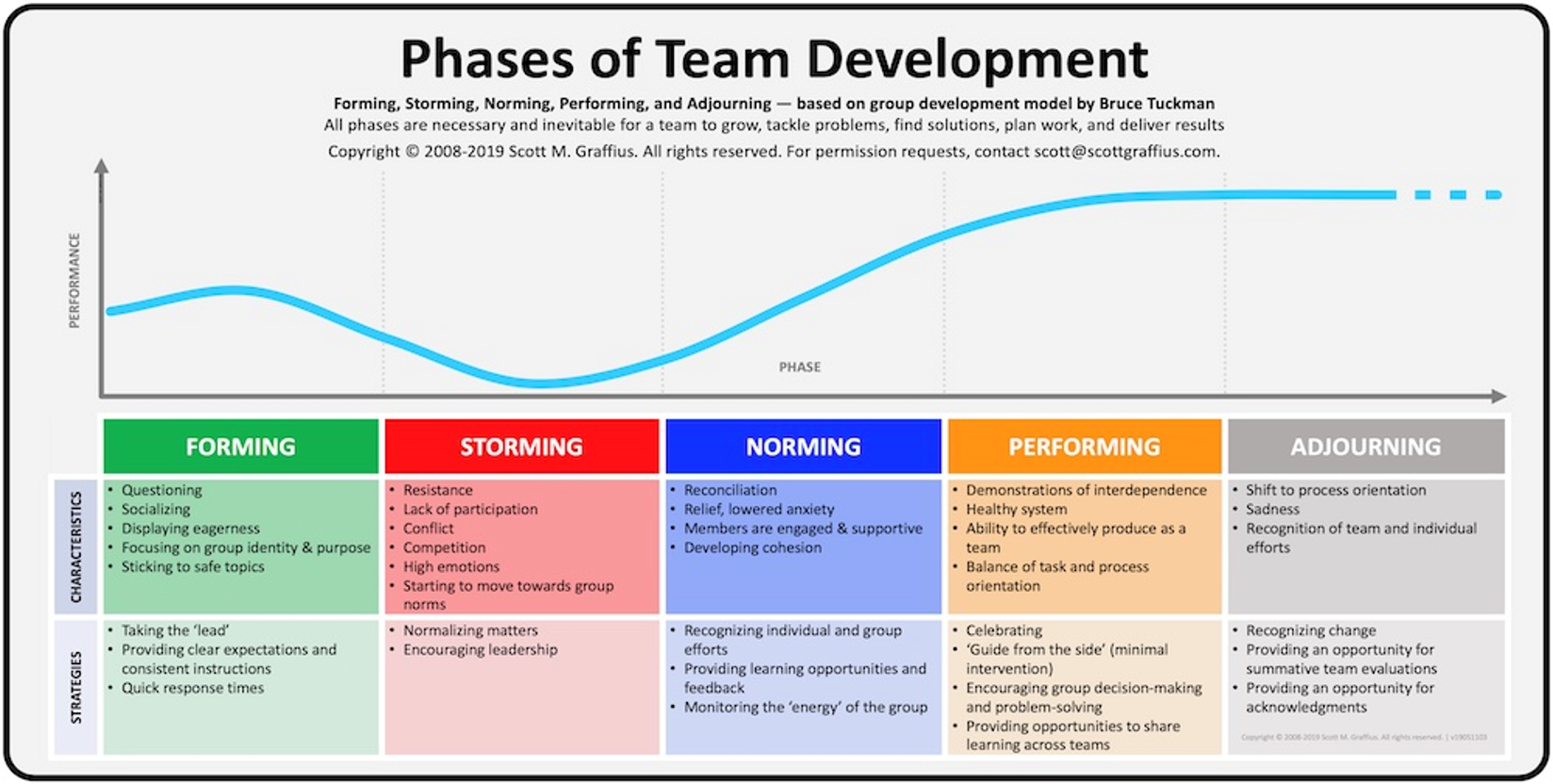
This is one of the most simple models of team development. Developed in 1965, this model assumes that teams go through a series of ordered developmental stages, during which they show specific features and behaviours:
- Forming
- Observable behaviors: Members are polite, and tentative and try to avoid conflict. They focus on understanding the team’s purpose and getting to know one another.
- Feelings and thoughts: Excitement, anticipation, and optimism are common, but also anxiety and uncertainty about roles, responsibilities, and how they will fit in.
- Team needs: A clear vision, mission, and objectives are needed, along with defined roles, ground rules, and expectations.
- Leadership requirements: A directive leader is needed to provide clear structure, guidance, and direction. The leader should also encourage members to get acquainted and create an atmosphere of confidence.
- Moving from forming to storming: Foster open communication, Clarify roles and responsibilities, Encourage problem-solving
- Storming
- Observable behaviors: Conflict arises over roles, power, and methods. Members may vie for influence, and progress may be slow. Disagreements and resistance to tasks are common.
- Feelings and thoughts: Members can feel defensive, competitive, and uncertain about their influence. Jealousy and confusion can increase, and some may question the team’s mission.
- Team needs: Improved interpersonal relationships and conflict resolution skills are crucial. The team needs to clarify its purpose and understand personal differences.
- Leadership requirements: The leader must guide conflict resolution, teach effective communication, and facilitate the transition towards shared leadership. Providing support and praise is also important.
- Moving from storming to norming: Facilitate conflict resolution, Establish shared ground rules, Encourage peer feedback
- Norming
- Observable behaviors: The team agrees on processes and procedures, and relationships become more comfortable. Conflict is handled constructively, and a balance of influence emerges. The team’s energy shifts toward the task.
- Feelings and thoughts: A sense of belonging, acceptance, and trust grows among members. Morale and confidence are high, and members feel free to express ideas and criticism constructively.
- Team needs: The team needs to develop shared problem-solving and decision-making processes. All members should contribute, and resources should be utilized to support the team effort.
- Leadership requirements: The leader should shift from directing to facilitating. The leader encourages team interaction, asks for contributions from all members, and promotes strong relationships.
- Moving from norming to performing: Delegate and empower, Remove obstacles, Sustain motivation
- Performing
- Observable behaviors: The team is highly productive, autonomous, and functional. Roles are clear and flexible, and members can work independently or collaboratively. The team solves problems independently.
- Feelings and thoughts: There is high commitment, empathy, and a strong sense of satisfaction in accomplishments. Members enjoy their work and feel a collaborative work ethic.
- Team needs: The team must focus on maintaining its flexibility, celebrating success, and reinforcing high performance. It operates with a high degree of trust and creativity.
- Leadership requirements: The leader can now delegate tasks and empower the team. Leadership is often shared, with the leader acting more as a coach, observer, and resource.
- Moving from performing to adjourning: Celebrate achievements, Conduct a retrospective, Support transitions
- Adjourning
- Observable behaviors: Momentum and productivity may decrease as the project nears completion. Members may shift focus from tasks to relationships, exhibiting restlessness or anxiety.
- Feelings and thoughts: There is a mix of accomplishment and sadness. Members may feel relief that the project is over, but also a sense of loss and uncertainty about the future.
- Team needs: The team needs to formally evaluate its efforts and tie up any loose ends. Acknowledgment and celebration of the team’s hard work are important.
- Leadership requirements: The leader should facilitate reflection on accomplishments and lessons learned. The leader also helps members transition to new roles and celebrates the team’s successes.
The transition between the stages of Tuckman’s model is not always a linear process, and a team can move back and forth between stages. While this model is fundamental, it is hard to apply to teams who change. Project teams have people added and removed regularly during the execution phase, and the complications from these additions and removals are not captured in this model.
 Use Tuckman’s Model of Team Dynamics | Agile Scrum Guide | Book | Blog
Punctuated Equilibrium Model
This model is particularly focused on teams with a deadline. It posits that these teams experience long periods of stability and inertia, followed by brief but intense bursts of change.
- Phase 1: Inertia
- Duration: Lasts from the team’s first meeting until the midpoint of its allotted time.
- Initial direction: The team’s direction, norms, and behavioral patterns are established in the very first meeting.
- Low productivity: For the first half of the project, the team experiences inertia, showing little tangible progress toward its goals. Members follow the initial approach without reevaluating it, even if it’s ineffective.
- Midpoint Transition
- Timing: A major transition occurs precisely at the halfway point of the project’s lifespan, regardless of its total duration.
- Catalyst for change: This transition acts like an alarm clock, creating a sense of urgency. The team recognizes that time is running out and its current strategy is not working.
- Critical shift: The team drops its old norms and behaviors and adopts new, more effective approaches. This is a powerful, compressed period of change and learning.
- Phase 2: Accelerated inertia
- Revised direction: The team executes the plans and new strategies developed during the midpoint transition.
- Increased focus: The team experiences a new, more productive period of inertia, focusing intently on completing the task. Work progresses much more quickly and effectively than in Phase 1.
- Final Meeting
- Completion focus: As the final deadline approaches, the team engages in a final burst of activity to complete the project.
- Closure: The project concludes, and the team disbands.
Models of Team Effectiveness
Hackman’s model of team effectiveness
This model identifies five key conditions that are crucial for enabling team performance over time:
- A real team: A cohesive, bounded unit, not just a group of people
- Clear boundaries: It must be clear to everyone, both inside and outside the team, who is and is not a member.
- Interdependence: The members must be reliant on each other to accomplish their shared goals. If tasks can be performed independently, a team is not necessary.
- Stability: The team’s membership should be stable for a long enough period for trust, norms, and psychological safety to develop.
- A compelling direction: The team’s purpose or goal must be clearly defined and motivating to its members. A compelling direction helps to orient, engage, and energize the team.
- Clarity: The goal should be well-defined so that team members can visualize what success looks like.
- Challenge: The task should be difficult enough to feel meaningful and stretch the team’s capabilities.
- Consequence: The team’s work must have a significant impact and feel important to the organization.
- An enabling structure: The team’s internal design must facilitate collaboration rather than hinder it.
- Task design: The work itself should be meaningful, challenging, and provide team members with a sense of autonomy and control.
- Team composition: The team needs the right mix of skills and diverse perspectives to solve complex problems effectively. This includes both task and teamwork skills.
- Core norms of conduct: The team should establish and enforce clear rules of behavior that promote productive collaboration, such as how to communicate, make decisions, and resolve conflicts.
- A supportive context: The larger organization must provide the resources and support the team needs to succeed.
- Reward system: A reward system should recognize and reinforce great team performance, not just individual contributions.
- Information system: The team needs access to the information and data necessary to do its work.
- Educational system: The organization should provide training and development opportunities for team members to build their skills.
- Material resources: The team must be given the tools, equipment, and other resources it requires.
- Expert coaching: An effective leader or coach is available to help the team navigate challenges and improve its performance over time.
- Timely intervention: Coaching should happen at moments when the team is most receptive to guidance, such as at the beginning, midpoint, or end of a project.
- Process focus: Expert coaches focus on helping the team improve its strategy and group processes, not on taking over the team’s work.
- Psychological support: The coach also helps maintain a psychologically safe environment where members feel comfortable offering feedback and learning from mistakes. You can assess whether a team is effective or not by reviewing:
- The output: The team’s final product must meet or exceed the quantity and quality standards of its clients.
- The process: The internal social processes of the team should enhance the group’s ability to work together in the future.
- The experience: The team experience should satisfy, not frustrate, the personal needs of its members.
GRPI Model of Team Effectiveness
Developed in 1972, this model posits that to have an effective team one needs to align four key elements in the order of importance below:
- Goals: This is the foundational and most critical element.
- Is the team’s purpose clear?
- Do all team members understand and agree on the specific objectives and priorities?
- Are the goals measurable, achievable, and time-bound (e.g., SMART goals)?
- Do any conflicts exist between the team’s goals and individual or organizational goals?
- Roles: Once the goals are clear, the next step is to define the roles and responsibilities required to achieve them.
- Are the roles and responsibilities clearly defined for each team member?
- Do team members understand their own duties and the duties of others?
- Is there clarity on who has authority over specific decisions?
- Does the team have the right mix of skills to achieve its goals?
- Processes: With clear goals and roles, a team needs to establish effective processes and procedures for how it will operate, and “how” it works.
- Does the team have clear processes for decision-making and problem-solving?
- How does the team communicate with each other and with stakeholders?
- What are the procedures for managing and resolving conflict?
- Are meetings run efficiently and effectively?
- Interpersonal Relationships: The final element focuses on the team’s dynamics, culture, and social interactions. While often the source of perceived problems, relationship issues are often a symptom of unclear goals, roles, or processes.
- Is there a climate of mutual trust, open communication, and respect?
- How does the team handle conflict and provide constructive feedback?
- Do team members support and encourage one another?
- Are team norms for positive behavior established and followed?
Leadership
Leadership is the process of guiding and motivating others to achieve common goals through a combination of influence, vision, and collaboration. Essentially leadership enables the team to successfully go through the different stages of team development and form an effective team.
Management vs Leadership
Leadership and management are two important and interrelated skills. A manager generally should have good leadership skills, but not every manager is a good leader. Moreover, none-managers may possess good leadership competencies which, if leveraged, can help a project. Generally speaking:
- Leadership is focused on producing change and movement by
- Establishing direction: Create a vision, clarify the big picture, and sets strategies
- Align people: Communicate goals, seek commitment, and build teams, coalitions and alliances
- Motivate and inspire: Energize, empower subordinates and colleagues, and satisfy unmet needs
- Management is focused on producing order and consistency by
- Planning and budgeting: Establish agendas, set timetable and allocate resources
- Organizing and staffing: Provide structure, make job placements, and establish rules and procedures
- Controlling and problem solving: Develop incentives, generate creative solutions, and take corrective action.
Identifying Leaders
The traits theory of leadership can be used to identify good leaders. 6 eky traits are:
- Ambition and Energy
- Desire to Lead
- Honesty and Integrity
- Self-Confidence
- Intelligence
- Job-Relevant Knowledge
Personality traits commonly identified in leaders include:
- Extraversion
- Cognitive abilities
- Conscientiousness
- Emotional stability
- Openness
- Agreeableness
- Motivation
- Social intelligence
- Self-monitoring
- Emotional intelligence
- Problem-solving
- Honesty
- Being forward-looking
- Being inspirational
- Supportiveness
- Broad-mindedness
- Dependability
Tannenbaum and Schmidt’s Leadership Continuum
 Leadership Style (theintactone.com)
Leadership Approaches
There are various terms used to discuss leaderhip approaches. Here we will review a few theories and the nomenclature used.
Based on Power Orientation
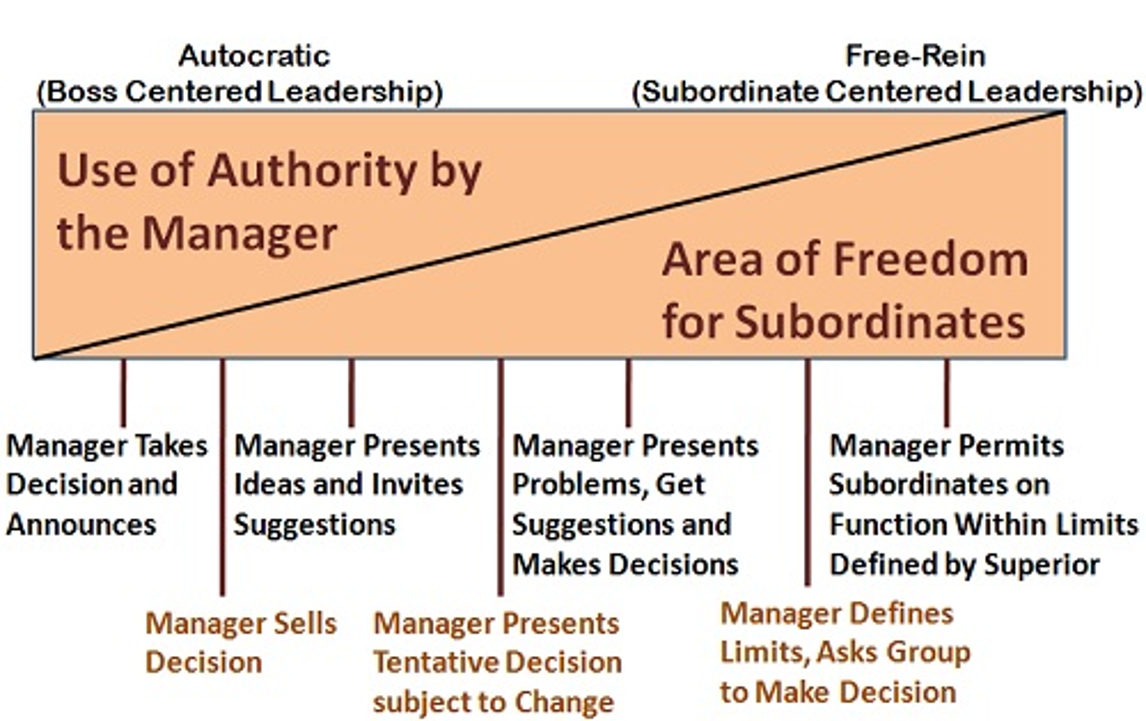
A continuum of leadership can be defined based on authority of the leader (Autocratic/Boss Centered Leadership) vs freedom of followers (Free-Rein/Subordinate Centered Leadership). From higher leader authority to lower we have:
- Leader Takes Decision and Announces
- Leader Sells Decision
- Leader Presents Ideas and Invites Suggestions
- Leader Presents Tentative Decision subject to Change
- Leader Presents Problems, Get Suggestions and Makes Decisions
- Leader Defines Limits, Asks Group to Make Decision
- Leader Permits Subordinates on Function Within Limits Defined by Superior
Directive Leadership
This approach focuses on the degree of participation of followers in decision making vs amount of leader direction:
- High-High: Directive democrat
- Low-Low: Permissive Autocrat
- Low-High: Directive Autocrat
- High-Low: Permissive Democrat
Which Power-base is Leveraged
French and Raven’s bases of power are used by leaders to motivate change.
- Positional Power
- Legitimate Power ‘The Boss’
- Reward Power ‘Bribery’
- Coercive Power ‘Protection Racket’
- Resource Power ‘Controlling Access’
- Personal Power
- Referent Power ‘We like you’
- Expert Power ‘Special abilities’
- Information Power ‘It’s what you know’
- Connection Power ‘… and who you know’
Goleman’s Six Leadership Styles
- Visionary: Mobilizes people toward a vision - “Come with me” - Self-confidence, empathy, change catalyst
- Affiliative: Creates harmony and builds emotional bonds - “People come first” - Empathy, building relationships, communication
- Democratic: Forges consensus through participation - “What do you think?” - Collaboration, team leadership, communication
- Pacesetting: Sets high standards for performance - “Do as I do, now” - Conscientiousness, drive to achieve, initiative
- Coaching: Develops people for the future - “Try this” - Developing others, empathy, self-awareness
- Commanding: Demands immediate compliance - “Do what I tell you” - Drive to achieve, initiative, self-control
Blake and Mouton’s Managerial Grid
This model looks at concern for results vs concern for people:
- High-high: Team Management, contribute and commite. I support team action in a way that invites involvement and commitment. I explore all facts and alternative views to reach a shared understanding of the best solution.
- High-Low Produce or Perish Management, direct and dominate. I expect results and take control by clearly stating a course of action. I enforce rules that sustain high results and do not permit deviation.
- Low-High: Country Club Management, yield and comply. I support results that establish and reinforce harmony. I generate enthusiasm by focusing on positive and pleasing aspects of work.
- Low-Low: Impoverished Management, evade and elude. I distance myself from taking active responsibility for results to avoid getting entangled in problems. If forced, I take a passive or supportive position.
- Somewhere in between: Middle-of-the-road management, balance and compromise, I endorse results that are popular but caution against taking unnecessary risk. I test my opinions with others involved to assure ongoing acceptability.
Situational Leadership
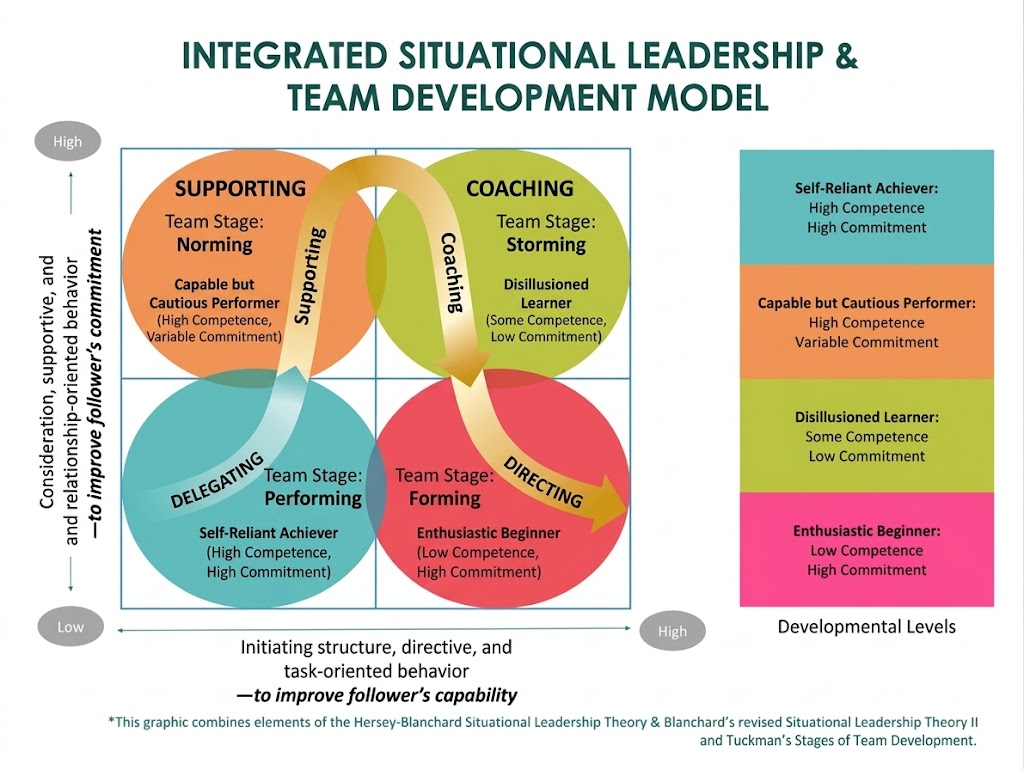
The idea of situational leadership (also known as Hersey-Blanchard Situational Leadership Theories) is that the leader should adapt their approach to leadership based on the situation. This is done by balancing directive and supportive behaviour. These are 4 leadership styles:
- Directing: The leader is shows high directive and low supportive behaviour. This is used to leader enthusiastic beginners with low competence and high commitment (such as a team in the forming stage), and in major crisis where fast decisions and focus are needed.
- Coaching: Here the leader shows high directive and supportive behaviour. This is useful to lead a dissillusioned learner with some competence but low commiutment, during structural reorganization or ina team in the storming stage.
- Supporting: Here the leader is highly supporting but showing low directive behaviour. This is useful for leading capable but autious performers with high competence but variable commitment, in situations of interpersonal conflict and a team in the norming or adjourning phase.
- Delegating: The leader shows low supportive and directive behaviour. This is useful for leafing self-reliant achievers with high competence and commitment, teams in the performing stage and situations of innovative change.
Leadership Styles Comparison
| Need for Support | Need for Direction | Conventional Leading Style | Description (Conventional) | Sustainable Leading Style | Description (Sustainable) |
|---|---|---|---|---|---|
| Low | High | Directing | Telling followers what their job is and how to complete tasks efficiently. Used when followers lack capability. Goal: Improve immediate productive capability. | Enabling | Emphasizing learning, providing general information, and allowing experimentation without performance pressure. Used when followers lack capability. Goal: Improve learning capability. |
| High | High | Coaching | Providing training and specific feedback. Used when followers lack both capability and commitment. Goal: Address weaknesses and develop capability. | Equipping | Creating an environment for continuous learning. Used when followers lack both capability and commitment. Goal: Develop strengths and group capability. |
| High | Low | Supporting | Motivating through praise and extrinsic motivators. Used when followers are capable but lack commitment or confidence. Goal: Enhance productivity. | Engaging | Appealing to intrinsic motivators and a sense of community. Used when followers are capable but lack commitment or confidence. Goal: Enhance meaning and affiliation. |
| Low | Low | Delegating | Assigning tasks and responsibilities. Used when followers are capable and committed. Goal: Facilitate efficient division of labour. | Empowering | Freeing people to be responsible. Used when followers are capable and committed. Goal: Facilitate ownership and responsiveness. |
Other Leadership Approaches
- Transactional leadership: Uses a system of rewards and punishments to motivate
- Transformational leadership: inspires and motivates followers to achieve a shared vision, fostering innovation, individual growth, and positive change
- Charismatic leadership: a style where leaders inspire and motivate followers through their charm, confidence, and compelling vision
- Authentic leadership: a style of leadership that involves leading from a place of self-awareness, integrity, and strong personal values
- Servant leadership: a philosophy where the leader’s main goal is to serve their team, prioritizing the growth and well-being of their subordinates and the community over personal power
- Democratic Leadership: Decisions based on input
- Autocratic Leadership: Decisions from a single source
- Laissez-Faire Leadership: Decisions come from individual employees
- Strategic Leadership: Decisions based on strategy and goals
- Coaching Leadership: Leader nurtures individuals
- Bureaucratic Leadership: Decisions come from company policy
- Visionary Leadership: Energetic focus on the future
- Pacesetting Leadership: Leaders sets ambitious goals
- Situational Leadership: Decisions and leadership styles vary by situation
Why Does Leadership Matter?
The path-goal theory of leadership answers this question. A team members attitudes and behaviour (job satisfaction, acceptance of leader and effort) are determined by 3 factors:
- The leader’s behaviour (style of leadership)
- Two contingency factors
- The team members personality and competence (locus of control, ability, personality traits, experience, personal goals)
- Environmental factors (the work, formal authority system, organizational structure and culture)
This theory strongly supports a situational approach to leadership, where leaders adapt their behaviour based on the team and its members.
Leadership and Ethical, legal, and social responsibilities
Project leaders set the tone for the rest of the team. As such, they are expected to act ethically, particularly if certified by PMI in which case they should follow the PMI code of ethics. This means they should act:
- with integrity and honesty (ie transparency)
- with fairness and equity (ie avoid favortism)
- with confidentiality and respecting privacy (ie patient medical history)
- in compliance with laws and regulations (ie Labour Laws, patent law, etc)
- in compliance with contractual obligations (ie SOW, ratecards)
- in compliance with • Legal Risk Management (ie copyrights, permits)
- considering stakeholder & community engagement (ie First Nations)
- considering environmental sustainability (ie New Pipeline/Refinery)
- considering corporate social responsibility (ie Supporting Social Cause, JEDI)
- to promote equity, diversity, and inclusion
To ensure this, always ask the following questions when making a decision:
- What is the action or inaction that is the cause for concern?
- Who or what may be affected?
- How will they be affected? (i.e., what are the possible consequences?)
- Are there any laws, regulations written or unwritten that may apply?
- What actions might be taken and what would the consequences of these actions be?
- On the decision maker (egoism), and their duties and care towards others
- On everyone potentially involved (utilitarianism) and their rights
- The fundamental principles (deontology), justice, common good and virtues
- Can anything be done to prevent this from reoccurring or to minimize the severity of the consequences?
A common ethical situation is a conflict of interest: When one is in a position of making a decision that impacts two or more opposing interests, one of which could corrupt the motivation. Example: You own a company being considered for a contract, and you have authority to decide who the contract goes to. In the face of a conflict of interest, one can:
- Remove – remove one of the opposing interests
- Disclose – Make sure everyone is aware of the conflict
- Recuse or self-disqualify – step down from the decision-making role
- switch to a 3rd party – hire an independent third party to make decisions
Summary
Bibliography
- PSYCH484 (psu.edu)
- Kakkos, N. and Trivellas, P., 2011, July. Investigating the link between motivation, work stress and job performance. Evidence from the banking industry. In 8th international conference on enterprise systems, accounting and logistics (pp. 408-428).
- Maslow’s Hierarchy of Needs Explained (thoughtco.com)
- The Awakener: Types and Systems of Need (richaprof.blogspot.com)
- Herzberg’s Two-Factor Theory, Organizational Behavior and Human Relations (lumenlearning.com)
- Equity Theory - Motivation (weebly.com)
- McGregor’s Theory X and Theory Y of Motivation, by The Enterprise World Magazine, The Enterprise Diary, Medium
- Using the Stages of Team Development
- Tuckman’s Stages of Group Development
- Punctuated Equilibrium Model
- Does your team have the five factors of team effectiveness?
- The GRPI Model of Team Effectiveness: Explained
- Katzenbach and Smith
- Leadership vs. Management, The Nelson Touch Blog (wordpress.com)
- Leadership vs Management, Tom Geraghty
- Leadership vs Management (linkedin.com)
- Trait Theory of Leadership - Expert Program Management
- Trait Theory of Leadership: Predict Leadership Effectiveness (iedunote.com)
- Leadership Style (theintactone.com)
- The Case for Directive Leadership, Academy of Management Perspectives (aom.org)
- Power Bases in Your Project: Who has the Power to Make Things Happen? (onlinepmcourses.com)
- Goleman’s Research On 6 Leadership Styles Shows You Can Be A Caring Leader Who Gets Business Results. Here’s My Take. — Mounica Veggalam
- Leadership Styles: The 11 Most Common & How to Find Your Style [Quiz] (hubspot.com)
- The Gunter Group - SITUATIONAL LEADERSHIP
- What is Fiedler’s Contingency Theory of Leadership - Pareto Labs
- Path-Goal Theory of Leadership (nwlink.com)
- Why Ethical Leadership is Important at Work & Training That Helps (symondsresearch.com)
- General Guidelines for Ethical Decision Making webguru (northeastern.edu)
- A Framework for Ethical Decision Making - Markkula Center for Applied Ethics (scu.edu)