ProjectManagementOER
Project Maturity
Projects at close can be considered:
- Successful: delivered on time, on budget, with required features and functions
- Challenged: late, over budget, and/or with less than the required features and functions
- Failed: canceled prior to completion or delivered and never used
The Standish Group’s CHAOS Report which reviewed IT project success identified that 31.1% of projects failed, with only 16.2% being successful. Top 10 reasons for project failure include:
- Inadequately trained or inexperienced project managers
- Failure to set and manage expectations
- Poor leadership at any and all levels
- Failure to adequately identify, document and track requirements
- Poor plans and planning processes
- Poor effort estimation
- Cultural and ethical misalignment
- Misalignment between the project team and the business or other organization it serves
- Inadequate or misused methods
- Inadequate communication, including progress tracking and reporting
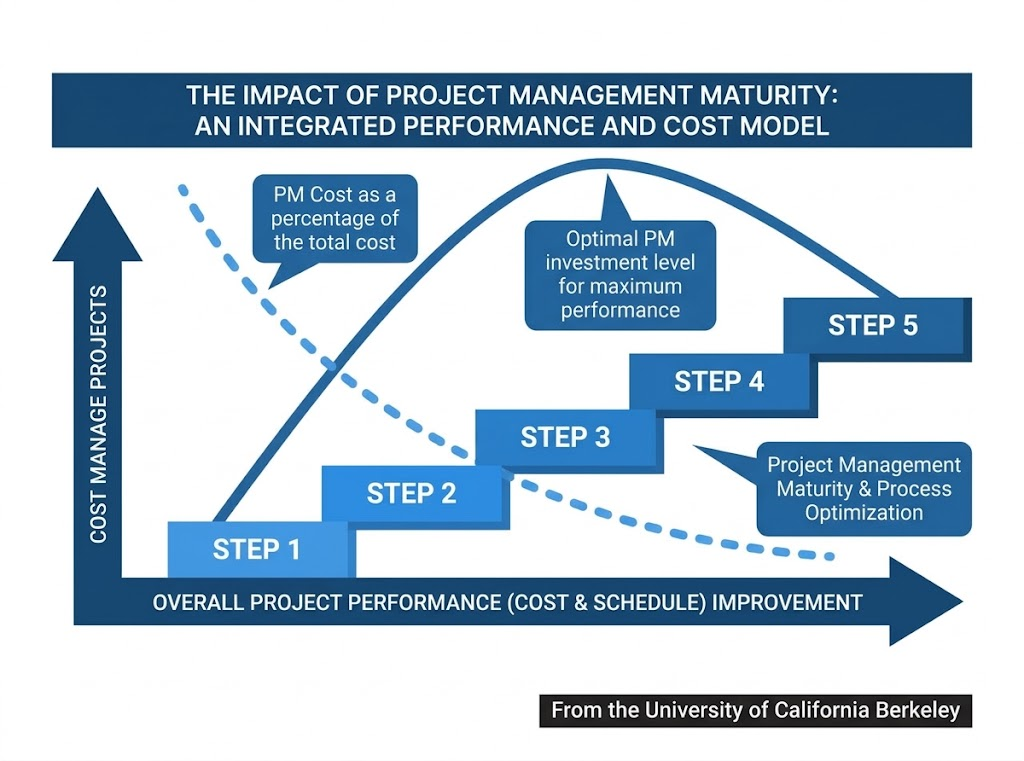 Source: Project Management Maturity for Future Success - Uruk
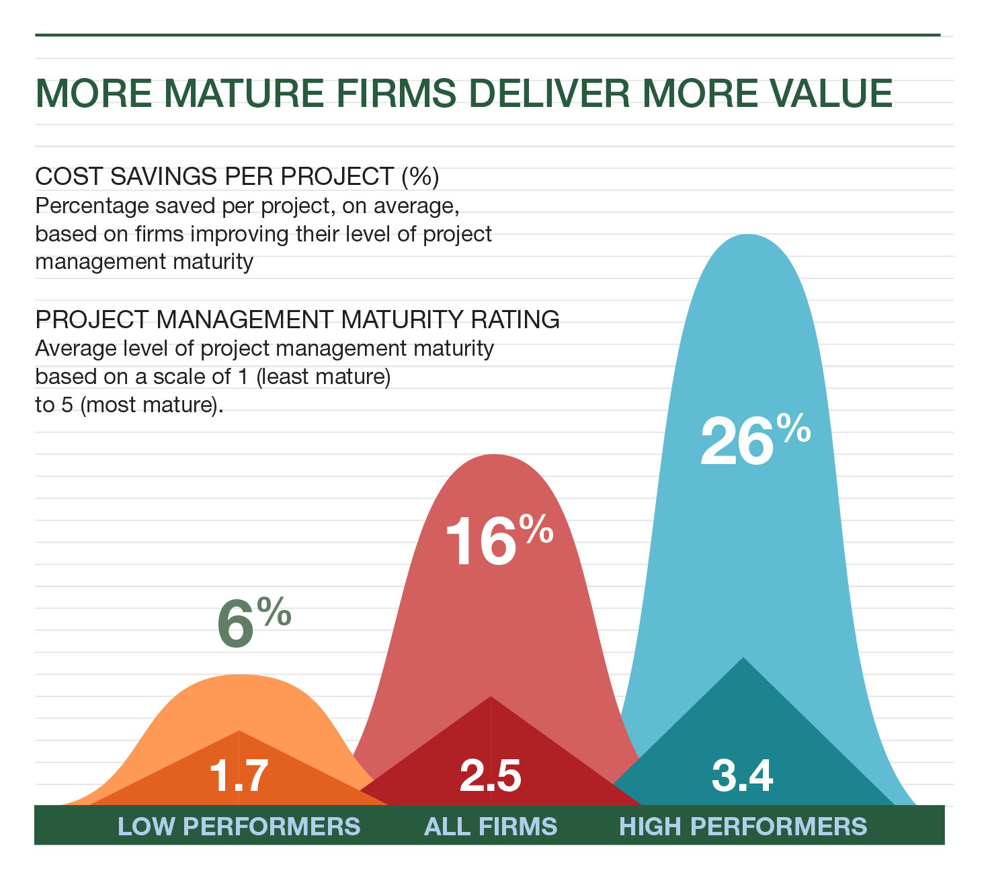 Benchmark Study Shows Higher Project Management Maturity = Stronger Performance | PM Solutions
This strongly aligns with how mature the organization’s project management is. Project Management maturity describes the effectiveness of project management in an organization measured by two separate but related maturity variables:
- Process maturity level: The assessment of this maturity is based on an evaluation of the standardized and documented methodology for managing projects in place in the organization. The assessed maturity level will be a point estimate.
- Practice maturity level: The second variable is the maturity level of the practice of the process as evidenced by ongoing projects. This assessment will be done on projects recently completed and will be repeated at set intervals.
Possible scenarios based on this model include:
- Process Maturity Exceeds Practice Maturity: This situation will occur when the organization has a process in place that has not yet been fully integrated into practice. The process may not have been successfully deployed into the organization, may not be sufficiently documented, or may not be appropriately defined and has therefore been dismissed as not useful or misused by project teams. In such a situation, process training may not be effective.
- Process Maturity Equals Practice Maturity: This suggests a healthy alignment between the process and how it is being practiced. Not all projects will have verified a practice equal to the process maturity level. Rather, some will be above and some will be below that level. In the aggregate, however, a reasonable person would conclude that the practice maturity mirrors the process maturity.
- Process Maturity Less Than Practice Maturity: This would seem to be an anomaly but it really is not. It can happen if the process has not been documented and several project managers have taken it upon themselves to practice at a maturity level that is called for. Or one or more members of project teams have brought practices with them from other organizations that exceed the process maturity level on one or more processes.
The Capability Maturity Model is a structured framework created by the Software Engineering Institute at Carnegie Mellon University in 1986 to help organizations assess and improve their operational and software development processes. It is the basis for many other maturity models we will discuss. It defines maturity at 5 levels:
- Level 1: Initial - Heroic efforts
- Processes are unpredictable, poorly controlled, and reactive.
- Success depends on individual effort rather than organizational capability.
- Work products and outcomes vary widely.
- Little to no documentation or standardization.
- Frequent schedule, cost, and quality issues.
- Level 2: Managed
- Basic project management processes are established.
- Work is planned, tracked, and controlled at the project level.
- Commitments are made based on past experience.
- Processes may differ across projects but are repeatable within each project.
- Performance is more stable but still varies between teams.
- Level 3: Defined - Process standardization
- Processes are documented, standardized, and integrated across the organization.
- A common organizational process framework is used.
- Tailoring guidelines exist for adapting processes to specific projects.
- Training and organizational support structures are established.
- Work is more consistent across teams and departments.
- Level 4: Quantitatively Managed
- Processes are measured and controlled using quantitative data.
- Statistical and analytical techniques are used to manage variation.
- Performance baselines and capability models are established.
- Predictability improves significantly for cost, schedule, and quality.
- Decisions are data‑driven rather than intuition‑driven.
- Level 5: Optimizing - Continuous Process Improvement
- Focus on continuous process improvement.
- Root‑cause analysis is used
As the level of maturity increases, productivity and quality increase, while risk and waste decrease. The model applies accross different categories:
- Process Management
- Organizational Process Focus
- Organizational Process Definition + IPPD
- Organizational Training
- Organizational Process Performance
- Organizational Innovation and Deployment
- Project Management
- Project Planning
- Project Monitoring and Control
- Supplier Agreement Management
- Integrated Project Management + IPPD
- Risk Management
- Quantitative Project Management
- Engineering
- Requirements Management
- Requirements Development
- Technical Solution
- Product Integration
- Verification
- Validation
- Support
- Configuration Management
- Process and Product Quality Assurance
- Measurement and Analysis
- Causal Analysis and Resolution
- Decision Analysis and Resolution
The Project Management Maturity Model developed by PM Solutions defines 5 levels of project management maturity:
- Level 1: Initial Process - Common Language
- There is no defined and documented process in place.
- Project managers and teams act in an ad hoc manner when process activities are needed.
- Processes and practices may be taken from prior experiences or knowledge possessed by one of the team members.
- Level 2: Structured Process - Common Processes
- There are defined and documented processes in place for team use.
- Project managers and teams use the defined processes at their discretion.
- Critical mission projects are often required to use the documented processes.
- Level 3: Institutionalized Process - Singular Methodology
- There is a comprehensive defined and documented process in place that is used by all projects.
- There is support available to teams needing help with the standard processes.
- There is a monitoring and control function in place to assure compliance with standard processes.
- Level 4: Managed Process - Benchmarking
- The process is integrated into other business processes and practices.
- Management decisions on individual projects have an organizational perspective.
- Lessons learned and best practices are captured and made available to other projects
- Level 5: Optimizing Process - Continuous Improvement
- Project performance is collected and used to identify areas for improvement initiatives.
- There is a program in place to continuously collect and analyze process performance data and use it to improve the process.
- Lessons learned and best practices are used to improve the process.
These are assessed across 9 knowledge areas (each broken down further into components):
- Project Integration Management
- Scope Management
- Time Management
- Cost Management
- Quality Management
- Project Human Resource Management
- Communications Management
- Risk Management
- Procurement Management
A project management maturity assessment can help us gauge what level of maturity we have with respect to specific processes in the organization.
PMI’s Organizational Project Management Maturity Model (OPM3) is focused on improving project management maturity through a process improvement cycle of: standardize, measure, control, continuously improve. To this end, organizations perform an assessment to understand their degree of maturity in project management. This assessment focuses on:
- Best Practices in organizational project management
- the constituent Capabilities that are necessary for the existence or attainment of Best Practices
- observable Outcomes signifying the existence or attainment of each relevant Capability
- Key Performance Indicators, which are the means of measuring each Outcome
- model context, including the Organizational Project Management Process and the stages of process improvement
- the pathways that identify the Capabilities aggregating to Best Practices being reviewed including both intra-relationships or capability dependencies within one Best Practice and inter-relationships or capability dependencies across Best Practices. From this assessment, areas of improvement in best practices and capabilities are identified and implemented.
The model defines 4 standard levels applicable accross projects, programs and portfolios:
Selected Maturity Components
- Level 1: Standardize
- Project: Basic process exists to identify and initiate project opportunities
- Program:
- Analysis and reporting processes include cost and schedule variances
- Go/No‑Go decisions and corrective actions implemented
- Portfolio:
- Process exists to create portfolio review boards
- Board relates projects to strategies
- Level 2: Measure
- Project: Organization‑wide complete process followed to identify, track, and communicate new projects
- Program:
- Project metrics regularly analyzed according to defined process
- Use of program analysis tools
- Portfolio:
- Process exists to coordinate activities of multiple boards
- Alignment criteria established and maintained
- Level 3: Control
- Project: Post‑implementation review process introduced to compare estimates vs. actuals
- Program:
- Trends reported at multiple levels
- Controlled investment actions taken
- Portfolio: Groups deliberate, define priorities, and provide direction on maximizing strategic objectives
- Level 4: Continuously Improve
- Project:
- Baseline data collected and benchmarked
- PM engaged in proactive identification of projects
- Program:
- Baseline data collected and benchmarked
- Program analysis process integrated into management decision process
- Portfolio:
- Optimized process to manage multiple boards and portfolios
- Baseline data collected and benchmarked
- Project:
The Portfolio, Program and Project Management Maturity Model (PM3M) includes 3 sub-models (portfolio management, program management, and project management) and covers 7 processes for each sub-model: organizational governance, management control, benefits management, risk management, stakeholder management, finance management, and resource management. Maturity-levels are then defined as:
- Level 1 – Initial Process – Awareness of process
- Project: Does the organisation recognise projects and run them differently from its ongoing business? (Projects may be run informally with no standards.)
- Programme: Does the organisation recognise programmes and run them differently from projects? (They may be run informally with no standards or system.)
- Portfolio: Does the organisation’s Board recognise programmes/projects and run an informal list of its investments? (There may be no formal tracking and reporting process.)
- Level 2 – Repeatable Process
- Project: Does the organisation ensure that each project is run with its own processes and procedures to a minimum specified standard? (There may be limited consistency or coordination between projects.)
- Programme: Does the organisation ensure that each programme is run with its own processes and procedures to a minimum specified standard? (There may be limited consistency or coordination between programmes.)
- Portfolio: Does the organisation ensure that each programme and/or project in its portfolio is run with its own processes and procedures to a minimum specified standard? (There may be limited consistency or coordination.)
- Level 3 – Defined Process
- Project: Does the organisation have its own centrally controlled project processes, and can individual projects flex within these processes to suit the particular project?
- Programme: Does the organisation have its own centrally controlled programme processes, and can individual programmes flex within these processes?
- Portfolio: As Project & Programmes + does the organisation have its own portfolio management process?
- Level 4 – Managed Process
- Project: Does the organisation obtain and retain specific measurements on its project management performance and run a quality management organisation to better predict future performance?
- Programme: Does the organisation obtain and retain specific measurements on its programme management performance and run a quality management organisation to better predict future programme outcomes?
- Portfolio: As Project & Programmes + does the organisation assess its capacity to manage programmes and projects and prioritise them accordingly?
- Level 5 – Optimised Process
- Project: Does the organisation run continuous process improvement with proactive problem and technology management for projects to improve its ability to optimise processes?
- Programme: Does the organisation run continuous process improvement with proactive problem and technology management for programmes to improve its ability to optimise processes?
- Portfolio: Does the organisation run continuous process improvement with proactive problem and technology management for the portfolio to improve its ability to optimise processes?
Another model for assessing project management success is the International Project Management Association (IPMA) Project Excellence Baseline (PEB). This approach assesses projects based in three areas:
- People and Purpose (Foundation for Excellence)
- Leadership & Values
- Objectives & Strategy
- Project Team, Partners & Suppliers
- Processes and Resources (Reinforcement of Excellence)
- Project Management Processes & Resources
- Management of Other Key Processes & Resources
- Project Results (Proof of Excellence)
- Customer Satisfaction
- Project Team Satisfaction
- Other Stakeholder Satisfaction
- Project Results and Impact on the Environment
A new model is Management Maturity Model (MMM) which is based on 6 KPIs of successful project delivery (value, efficiency, speed, innovation, complication, and impact) as well as 4 success factors (scope, cost, time, and risk). The model involves the use of the PDCA (Plan-Do-Check-Act) cycle for continuous improvement.
Summary
Bibliography
- The Standish Group’s CHAOS Report
- Project management maturity: an industry-wide assessment
- The IPMA Project Excellence Model
- OPM3’s knowledge foundation and implementation of OPM3
- Project Management Maturity Models: A Basis for Reaching Your Organization’s Business Success * A Management Maturity Model (MMM) for project-based organisational performance assessment * Build organizational capability to improve strategy implementation: enterprise change management (ECM) and organizational project management (OPM)
- Portfolio, Programme and Project Management Maturity Model (P3M3)
- Improvement of project quality through Project Excellence Preparation (PEP)