ProjectManagementOER
Portfolio
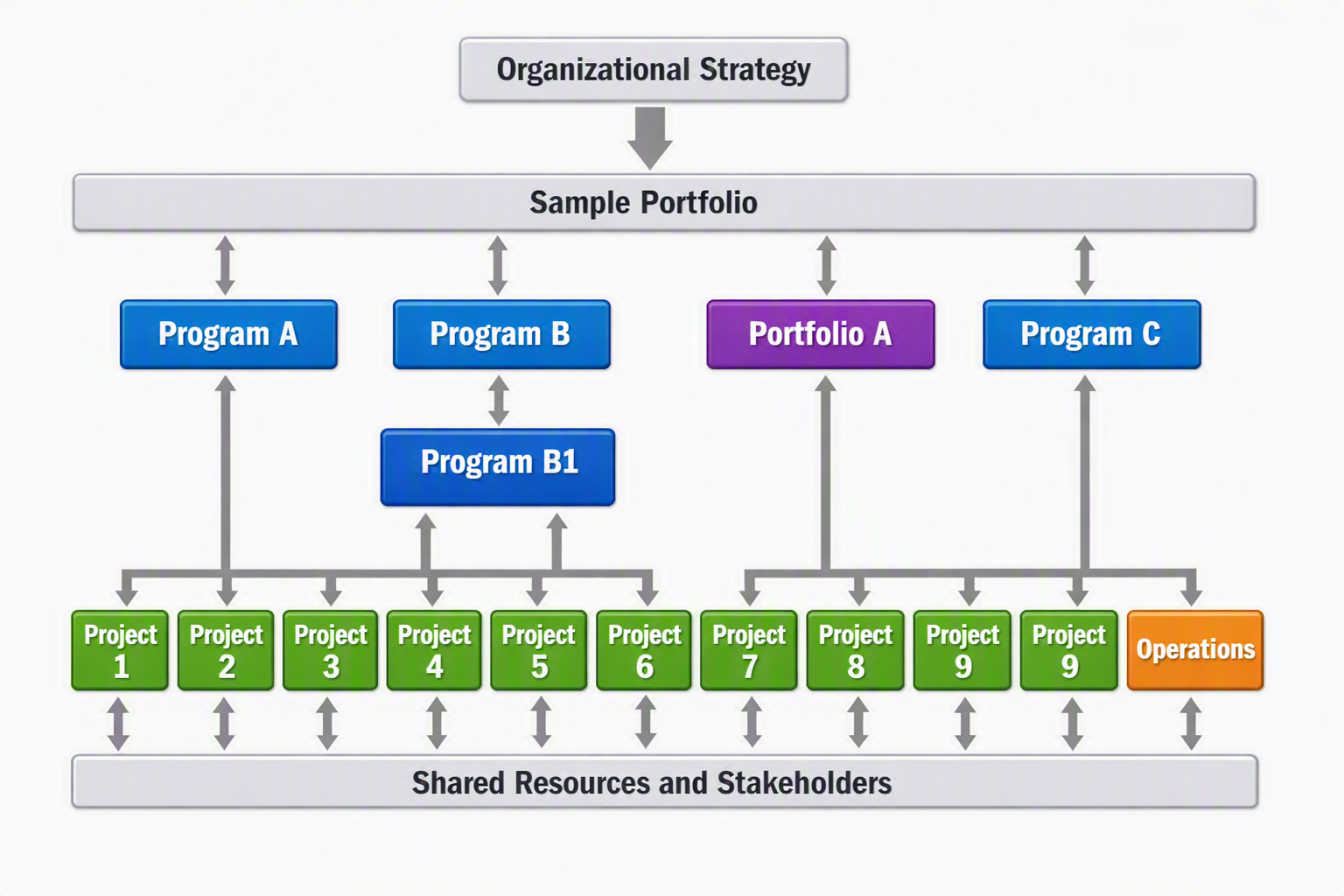
According to the Standard for Portfolio management, “a portfolio is a collection of projects, programs, subsidiary portfolios, and operations managed as a group to achieve strategic objectives.” A portfolio exists to achieve organization and business unit strategies and goals and may consist of current and future components.
The aim of creating portfolios is to use the synergies between the activities to increase efficiencies:
- Strategic goals and objectives: portfolios usually focus on a specific part of the organization’s strategic goals.
- Organization’s investment priorities: Projects and programs are usually grouped based on the nature of the work, resources they require, stakeholders they engage and their relationship with the goals.
- Management and governance of allocating and sharing resources (human, financial, intellectual, etc.): sharing resources would be easier in projects and programs that have similar nature.
- Ability to be quantifiable so that they can be evaluated, measured, ranked and prioritized: Portfolios define the key performance indicators (KPIs) used to measure performance. These KPIs could be better defined for a specific area of focus.
Portfolio Management
Portfolio management is the centralized process of managing one or more portfolios to achieve strategic objectives. It involved the following steps:
- Identify projects, programs, and non-project activities
- Categorize the activities: Locate project at the right place (program, portfolio) for better coordination
- Evaluate and prioritize items in a portfolio
- Limit no. projects for focus and fit
- Identify co-dependent projects
- Eliminate high risk low return items
- Eliminate items that skip the formal selection process
- Balance the portfolio
- Prevent overloading the organization
- To balance the resources with needs
- To balance returns
- To balance short-, medium-, and long-term returns
- Authorize projects
In essence:
- Doing projects right is project management
- Leveraging interdependencies in projects to maximize benefit realization from them is program management
- Doing the right projects is project portfolio management. For more on how projects, programs and portfolios are related, see Introduction to Projects and Their Context.
Portfolio management:
- Builds discipline into project selection process
- Links project selection to strategic metrics
- Prioritizes project proposals across a common set of criteria, rather than on politics or emotion
- Allocates resources to projects that align with strategic direction
- Balances risk across all projects
- Justifies killing projects that do not support organization strategy
- Improves communication and supports agreement on project goals
The core principles in the Standard for Portfolio management are:
- Strive to achieve excellence in strategic execution;
- Enhance transparency, responsibility, accountability, sustainability, and fairness;
- Balance portfolio value against overall risks;
- Ensure that investments in portfolio components are aligned with the organization’s strategy;
- Obtain and maintain the sponsorship and engagement of senior management and key stakeholders;
- Exercise active and decisive leadership for the optimization of resource utilization;
- Foster a culture that embraces change and risk; and
- Navigate complexity to enable successful outcomes.
Portfolio Management Life-cycle
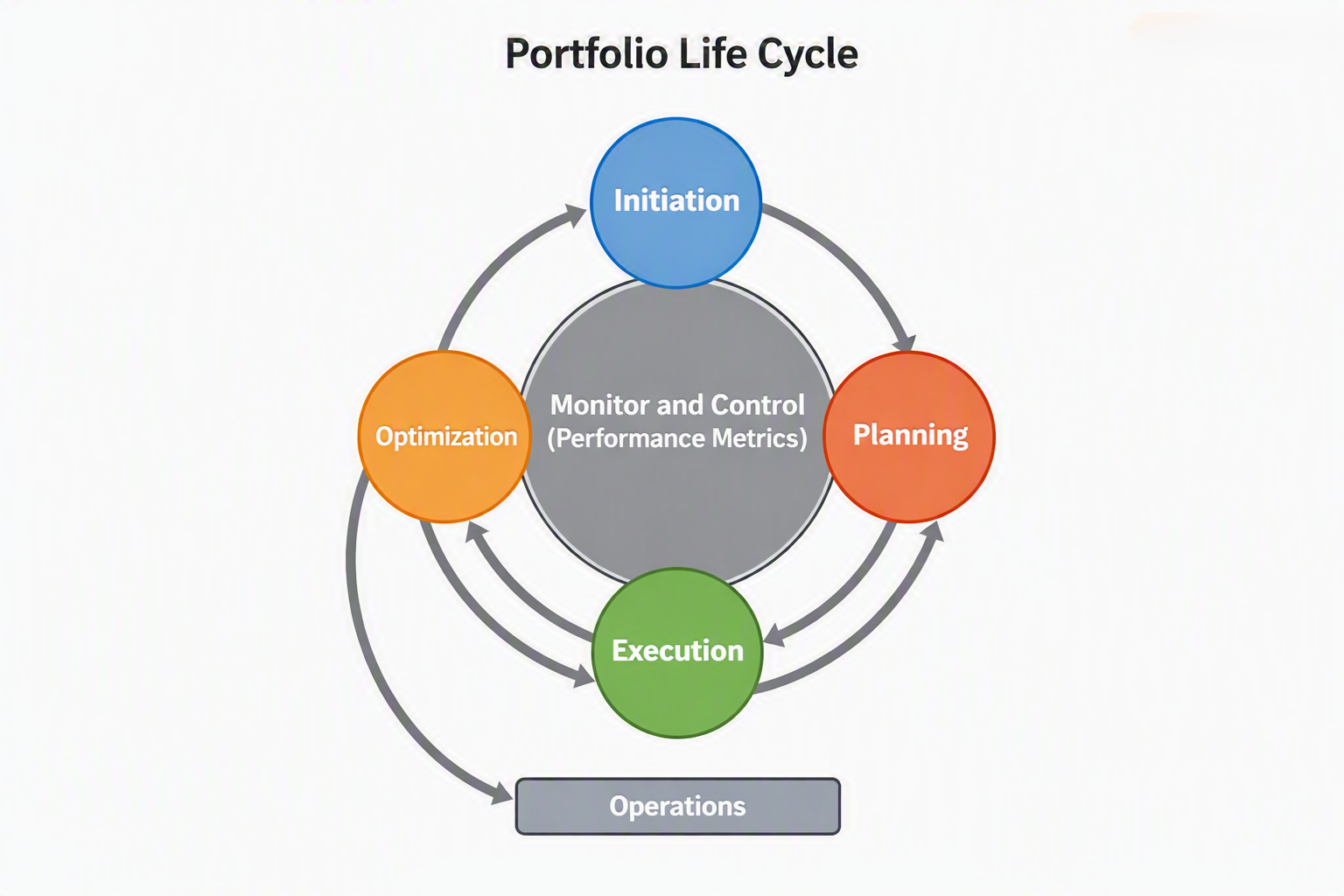
Portfolios (like projects) go through a series of life phases:
- Initiation: Through strategic planning, organizational objectives and goals are defined, and a long-term roadmap is developed for the organization.
- Planning: A management plan is created to manage budget, identify interdependencies and risks, resourcing and prioritization and confirmation of governance body and performance metrics
- Execution: The portfolio components are delivered and reprioritized as required.
- Optimization: Make the portfolio as effective as possible by maximizing available conditions, constraints and resources. Throughout this life cycle, monitoring and controlling is used to monitor benefits realization and portfolio resource utilization, and take actions to correct performance.
This table provides an example of some of the major activities duringthe portfolio life cycle.
| Level | Stage | Major Activities |
|---|---|---|
| Portfolio Level | Initiation (Each Portfolio) | - Portfolio strategy and management plans created - Portfolio management process (vision, governance, and stakeholders) - Governance and communication planning defined - Ideation process defined - Portfolio selection and prioritization criteria defined - Portfolio charter defined - Value metrics defined (financial and nonfinancial) - Portfolio roadmap |
| Portfolio Level | Planning | - Yearly goals/objectives set - Revisit governance structure - Capacity and capability planning - Portfolio strategic alignment updated - Portfolio metrics refined - Optimization/transition of portfolio - Portfolio roadmap refined - Adaptive—portfolio continuously realigned to strategy-based changes to strategy, business, and technology factors - Time frame—yearly and recurring - Portfolio plans revised |
| Portfolio Level | Execution | - Optimization/transition of portfolio - Portfolio health reported—status and metrics - Demand and resource capacity planning adjustments - Governance decisions via change management (portfolio) - Adaptive—portfolio continuously realigned to strategy-based changes to strategy, business, and technology factors |
| Portfolio Level | Optimization | - Reoptimization of portfolio - Lessons learned (portfolio level) - Portfolio closed - Demand and resource capacity planning adjustments - Governance documents revisited - Value metrics revisited - Adaptive—portfolio realigned to strategy based on adjusted business factors |
| Component Level | Initiation (Each Portfolio) | - Initial component lists created - Component lists reviewed based on alignment to strategy and prioritization criteria - Component list validation feedback incorporated into revised planning |
| Component Level | Planning | - Feasibility reviews and POCs - Portfolio component list reviews (iterative) and finalization - New programs/projects solicited via ideation process - Review new components and authorize - Adaptive—portfolio components updated based on changes to customer values, strategy, products, and services |
| Component Level | Execution | - Governance decisions via change management (components) - New programs/projects solicited via ideation process - Review new components/authorize - Feasibility reviews and proof of concepts - Pilots launched in support of proof of concepts - Governance decisions via change management (component) - Exception-based components authorized |
| Component Level | Optimization | - Revisit business cases for adjustments - Output of pilot component successes and proof of concepts - Portfolio components closed - Lessons learned (component level) - Benefits accountability defined (migrate to operations) - Artifacts archived for components |
Creating a Portfolio
Similar to projects, portfolios also need to be initiated. Usually a portfolio charter is set in place, which formally authorizes the portfolio manager to use resources towards the goals of the portfolio.
This document is developed based on the strategic plans of the organization, its process assets and enterprise environmental factors and will includes information on:
- Relevant organizational strategic objectives
- Portfolio objectives
- Portfolio justification
- Portfolio sponsor(s)
- Portfolio management roles and responsibilities
- The portfolio structure (hierarchy of projects, programs, portfolios and operations that fit within it)
- Key and major stakeholders
- Stakeholder expectations and requirements
- Communication requirements
- High-level scope
- Benefits
- Critical success criteria
- Resources
- High-level timeline or roadmap (including forecasts on how and when the portfolio delivers value to the organization)
- Assumptions, constraints, and dependencies,
- Risks, and related
Portfolio Governance
Portfolios should be governed to ensure transparency, responsibility, accountability, fairness and sustainability. The approach to governance needs to take into account the legislative and regulatory environment, and decision-making hierarchy of the company. It should be aligned with how the organization governs its other activities, and its culture.
Example
- A college creates a “Digital Transformation Portfolio” including:
- Online registration system.
- Learning analytics initiative.
- Finance and HR system upgrades. Portfolio KPIs might include:
- % of portfolio budget allocated to student‑facing projects.
- Aggregate NPV of approved digital projects.
- % of projects on track for benefits realization and strategic objectives.
- Resource utilization across critical skill sets (e.g., integration specialists).
- A city’s infrastructure portfolio includes:
- Multiple bike lane corridors.
- Road resurfacing projects.
- Bridge maintenance and replacement projects. Portfolio management:
- Categorizes projects by strategic goal (safety, climate, mobility).
- Balances short‑term “bread‑and‑butter” maintenance with long‑term transformative projects.
- Uses governance processes to prioritize and sometimes stop projects that no longer support strategy.
Portfolio Capacity and Capability Management
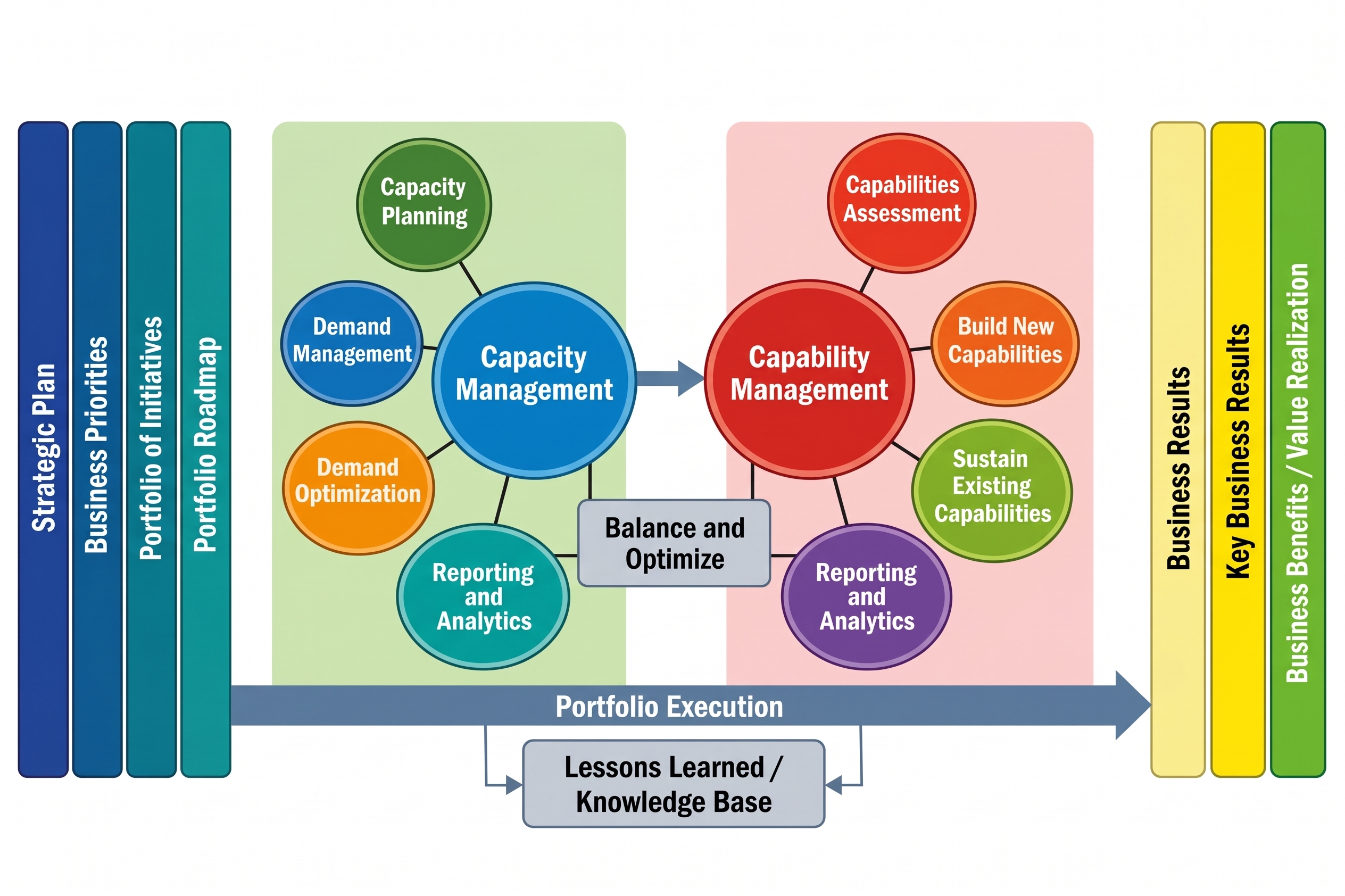
An important element of portfolio management is maximizing resource utilization. This is done through capacity and capability management:
- Capacity is how much the organization can do now, at present time
- Capability refers to the potential of the organization, the ability of an organization through its people, processes, and systems to execute an entire portfolio of initiatives for delivering good and services. Capabilities create competences that provide a competitive advantage.
Capacity Management
Capacity management focuses on what types of resources are needed, how many are needed, and when resources are needed to support portfolios. In essence, it addresses the overall resource demands of portfolios.
There are 4 major categories of resources to consider:
- Human capital: availability of human resources to support the portfolio
- Financial capital: availability of funds to support the portfolio
- Assets: availability of physical assets, such as machinery, office space, factory sites, etc.
- Intellectual capital: availability of patents, copyrights, etc.
Elements of capacity management include:
- Capacity planning: Forecasting resource demands and the available supply of resources for portfolio execution based on the available information in the portfolio roadmap, strategic plans, historical data, etc.
- Supply and demand management: Analysis and resource allocations for portfolio components to balance supply and demand.
- Demand optimization: Ongoing measurements and the monitoring of resources for needed course corrections and adjustments during portfolio execution
- Reporting and analytics: Identifying and capturing data and associated analysis for trends and patterns to aid with portfolio decision-making
Capability Management
Capability Management elaborates what aspects of resource capacity are available and addresses the attributes, competences, and skills associated with resources and organization support for portfolios. Capability Management involved:
- Capability assessment: An internal analysis regarding what the organization has or does not have and what it can or cannot do. It helps identify existing capabilities, any gaps in existing capabilities and the organization’s strengths and weaknesses.
- Capability development: Capabilities are not static and gaps in existing capabilities need to be filled through acquisition of talent or technology, definition of new processes or integration of existing capabilities.
- Sustaining existing capabilities: Organizations need to regularly take action (be it through training, R&D or other activities) to maintain their capabilities
- Reporting and analytics: Identifying, capturing, and distributing data and associated analysis for progress updates, trends, and patterns to aid with portfolio decision-making
Challenges with developing capability may include:
- Organizational culture
- Customer demands
- Long-term shifting markets and trends
- Response to an urgent external or internal event
Balancing Capacity and Capability
There is a direct link between capacity and capability. Say, if your company has a capability owing to the talent it has, then the number of people with that expertise becomes an important capacity factor. This limited capacity can impact how many projects or programs using this capability can be undertaken by your organization.