ProjectManagementOER
Cost Management
Learning Objectives
By the end of this unit, you should be able to:
- Distinguish different kinds of costs associated with a project
- Create a high-level budget for a project
Cost Management Processes
In this section, we will review the planning process group elements that have to do with cost. These processes are used to create the initial cost estimates and plan, and to update this information as the project progresses.
Plan Cost Management
The goal of this process is to create the cost management plan, a description of how you will be managing costs. Some of the information here include the accuracy of the estimates, the estimation methods used, and the categories of costs.
The process has the following elements:
- Inputs
- Project charter
- Project management plan (schedule management plan, risk management plan)
- Enterprise environmental factors
- Organizational process assets
- Tools & Techniques
- Expert judgment
- Data analysis (alternatives analysis)
- Meetings
- Outputs
- Cost management plan
Estimate Costs
The goal of this process is to estimate the cost of each work package. The process has the following elements:
- Inputs
- Project management plan (cost management plan, quality management plan, scope baseline)
- Project documents (lessons learned register, project schedule, resource requirements, risk register)
- Enterprise environmental factors
- Organizational process assets
- Tools & Techniques
- Expert judgment
- Analogous estimating
- Parametric estimating
- Bottom-up estimating
- Three-point estimating
- Data analysis (alternatives analysis, reserve analysis, cost of quality)
- Project management information system
- Decision-making (voting)
- Outputs
- Cost estimates
- Basis of estimates
- Project documents updates (assumption log, lessons learned register, risk register)
Determine Budget
The goal of this process is to estimate the total cost of the project. The process has the following elements:
- Inputs
- Project management plan (cost management plan, resource management plan, scope baseline)
- Project documents (basis of estimates, cost estimates, project schedule, risk register)
- Business documents (business case, benefits management plan)
- Agreements
- Enterprise environmental factors
- Organizational process assets
- Tools & Techniques
- Expert judgment
- Cost aggregation
- Data analysis (reserve analysis)
- Historical information review
- Funding limit reconciliation
- Financing
- Outputs
- Cost baseline
- Project funding requirements
- Project documents updates (cost estimates, project schedule, risk register)
The Budget
Budgeting is forecasting:
- The resources the project will need
- Their quantities
- When they will be needed
- How much they will cost This process starts after we have identified the activities needed (through the WBS) and have estimated the duration of activities and created a preliminary schedule. It is important here to distinguish between the effort for each activity (total hours of work required to complete a task), and the duration (time over which a task is completed). The latter may include wait times and other parameters, while effort is more closely related to the costs of the project.
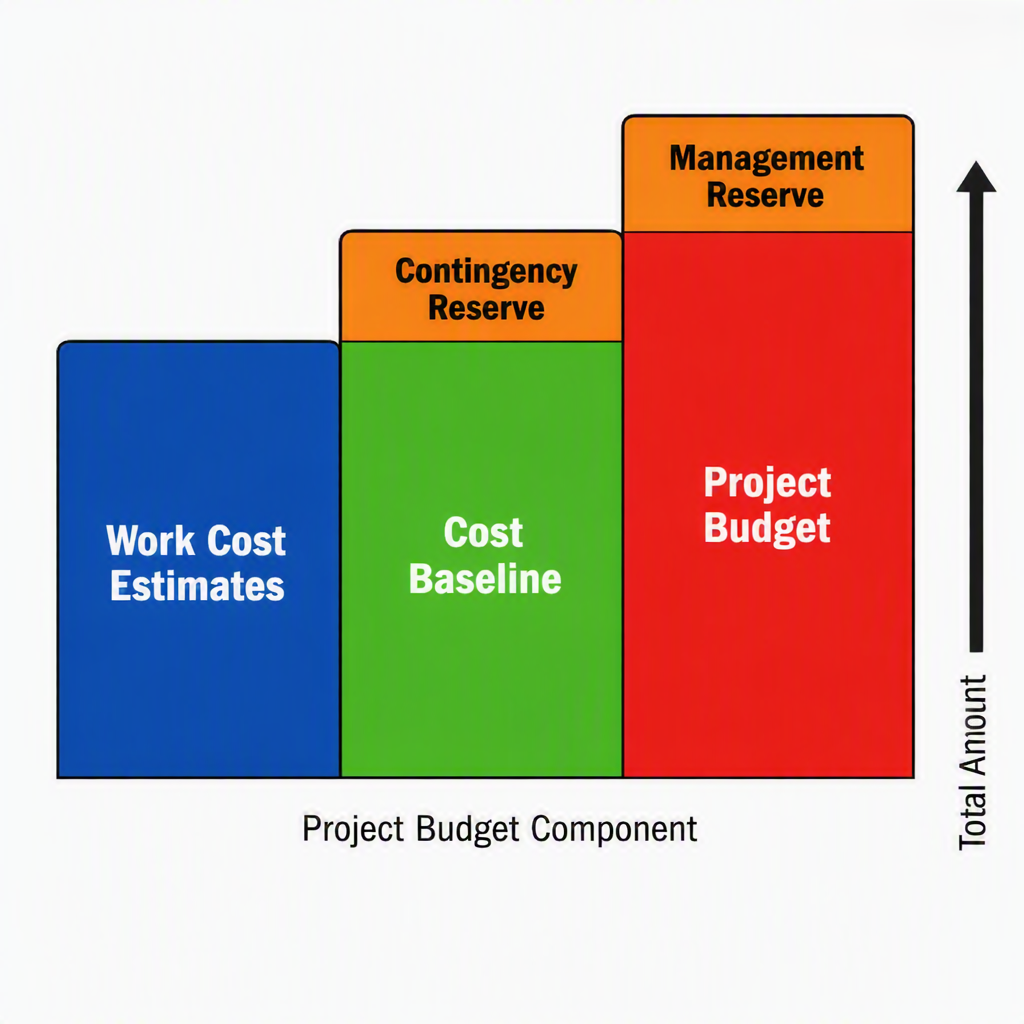
Creating the budget involves 3 elements:
- Estimate the cost of all work on the project (also called the cost baseline)
- Determine the project budget which is the cost baseline plus any contingency reserves determined from risk assessment
- Determine total assigned funding which includes the project budget and any management reserves needed for unforeseen issues
A study of 258 projects in 20 countries showed that nine out of ten projects experience cost overruns, and sometimes by over 100 percent! According to one expert in project management, due to natural optimism at project start, most PMs underestimate their projects’ costs by 30 percent or more
Budgeting Considerations
Categorizing Costs
By this time in your studies, you may be familiar with different approaches to classifying costs:
- Based on behaviour: variable, fixed, semi-fixed
- Based on traceability: Direct vs indirect
- Based on controllability: controllable vs uncontrollable
- Based on manufacturing cost: product cost
- Based on timing: period cost
While all these elements are important, project management cost estimation mainly focuses on identifying direct costs, and from there any additional charges that are indirect.
Direct Costs
At work package level, cost estimates focus on direct costs related to work defined in the scope. Direct costs are directly attributable to the project work (a specific cost center or cost object such as a department, process, or product). They directly go into producing goods or providing services. In most cases these costs are based on a per hour or per unit rate.
Some examples of direct costs for a work package include:
- Direct labour
- Direct materials
- Direct travel
- Manufacturing supplies
- Equipment rent
- Installation costs
- Training costs
- Setup costs (ex site preparation)
- Warranty, inspections, follow-up
- Disposal
- Taxes & duties
- Shipping When estimating these, one should consider fluctuations in costs of each of these (material and equipment costs may go up over time due to inflation or supply issues). You should also consider waste and spillage, and team member turnover.
To determine the cost of each workpackage:
- Determine resource requirements of each workpackage
- Resources: people, equipment, places, money, or anything else that you need in order to do the activities
- Need to consider the availability of resources: what resources you can use on your project, when they’re available to you, and the conditions of their availability
- Calculate costs for each work package
- Fixed costs
- Labor time and labor rate
- Equipment time and equipment rate
- General, sales, and administrative
- Overhead: Direct resource costs such as for materials and machinery needed solely for a particular project are usually charged to the project without an overhead add-on Note that these calculations are done using effort (the actual time when resource is used), not duration. This will allow us to differentiate between elapsed and “hands-on” time, with no multiple allocations.
Some organizations may use forms like this to capture the resource needs of each work package:
| Resources | Person to Contact | How Many/Much Needed | When Needed | Check (✓) If Available | |
|---|---|---|---|---|---|
| People | |||||
| Managers, supervisors | |||||
| Professional & Technical | |||||
| Nontechnical | |||||
| Money | |||||
| Materials | |||||
| Facilities | |||||
| Equipment | |||||
| Tools | |||||
| Power | |||||
| Space | |||||
| Special Services | |||||
| Research & Test | |||||
| Typing/clerical | |||||
| Reproduction | |||||
| Others |
Indirect Costs
Indirect costs are general business expenses needed to keep you operating. They can include:
- Direct project overhead costs: Costs that are directly tied to specific resources in the organization that are being used in the project (lighting, heating, cleaning etc). These may be estimated like direct costs, or presented as a percentage of direct costs.
- General and Administrative overheads: indirect costs of running a business like IT, accounting, marketing: Calculated as % of direct costs by management on an annual basis.
- Facilities and Administrative: indirect costs of running a business relating to facilities (rent, heating, etc) Each organization tends to have a policy on calculation of indirect costs and their inclusion in budgets.
Contingencies and Reserves
During the project, mistakes may be made: you may order the wrong part, make an error in your calculation. Moreover, there are risk events that may take effect, some of these you may be able to predict and prevent (a worker may be injured during an activity), while others are hard to predict (a global pandemic).
Your budget must include adequate money to navigate such issues. There are two types of reserves set aside for projects:
- Contingency reserves: These reserves are money set aside for unexpected expenses that arise during the project: “Known-unknowns”, errors, omissions, and other uncertainties. They are usually controlled by the project manager, are expected to be spent and the amount needed is determined through risk analysis.
- Management reserves: These reserves are set aside for unknown-unknowns (natural disaster, global pandemic) and also customer requests (scope change). They are controlled by management and usually require a more formal procedure to be accessed. The idea is that they are not part of the project baseline, and as such are not supposed to be spent.
Reserves are usually estimated as a percentage of the total cost. They can be calculated more accurately using Mote Carlo and other probabilistic methods for contingency reserves, based on the firmness of the scope description, and therefore the riskiness of the estimates.
There are several different ways to include contingencies in your costs and budget:
- Bottom-line contingency: One line added at the end of the budget and centrally managed by the project manager (can be 20-30% of total cost). The issue with this approach is management may not understand why this amount is needed, as the risk of the whole project is shown in one line.
- One contingency associated with each task: We add a contingency to each workpackage
- Within areas or milestones: contingencies are added to each deliverable, milestone or cost category (labor, equipment, etc)
- Hide with dummy item: You include a fake task with cost associated with it
- Two budgets: You show a version of the budget without contingencies to your team, and another version with contingencies to executives for approval. This way your team is less likely to rely on contingencies.
| Aspect | Contingency Reserve | Management Reserve |
|---|---|---|
| Purpose | Covers known unknowns — identified risks in the risk register | Covers unknown unknowns — unforeseen scope or events |
| Location in Budget | Inside the project budget / cost baseline | Above the project budget / outside the baseline |
| Who Controls It | Project Manager | Sponsor / Client / Change-Control Board |
| How It’s Used | Drawn down as risks materialize; no formal change request needed | Released only through formal change control |
| Sizing Method | Quantitative risk analysis (e.g., EMV, Monte Carlo) | Sponsor policy (often % of total budget) |
| Visibility in EVMS | Included in performance measurement baseline | Not included in baseline; not visible in EV calculations |
Cash Flow
In most contracts, funds are released incrementally. As a result, the organization needs to know when funds are made available, and when they are used by the project. This is usually done by using the project schedule to map costs on a timeline, creating a cash flow chart for the project. Your project burn rate is then the amount of money you use in a specific period ($ per month).
| Task | Estimate ($) | January | February | March | April | May | June | July | August |
|---|---|---|---|---|---|---|---|---|---|
| A | 7,000 | 5,600 | 1,400 | ||||||
| B | 9,000 | 3,857 | 5,143 | ||||||
| C | 10,000 | 3,750 | 5,000 | 1,250 | |||||
| D | 6,000 | 3,600 | 2,400 | ||||||
| E | 12,000 | 4,800 | 4,800 | 2,400 | |||||
| F | 3,000 | 3,000 | |||||||
| G | 9,000 | 2,571 | 5,143 | 1,286 | |||||
| H | 5,000 | 3,750 | 1,250 | ||||||
| I | 8,000 | 2,667 | 5,333 | ||||||
| J | 6,000 | 6,000 | |||||||
| Total | 75,000 | 5,600 | 12,607 | 15,114 | 14,193 | 9,836 | 6,317 | 5,333 | 6,000 |
Example: Vallye College Online Registration
Sample Work package: “Develop web frontend” (for the Valley College Online Registration System).
Resource Costs:
- Developer: 160 hours @ CAD 60/hour → CAD 9,600.
- UX designer: 40 hours @ CAD 70/hour → CAD 2,800.
- Software licenses: CAD 1,000.
Direct costs: CAD 13,400.
Direct project overhead (e.g., workspace utilities) might be estimated at 10% of direct labour as per company policy → ≈ CAD 1,240.
General and administrative overhead could be 15% of total direct costs as per company policy → ≈ CAD 2,010.
Total estimated cost for this work package ≈ CAD 16,650.
We may do this calculation for all workpackages. Perhaps we end up with:
- Cost baseline (sum of estimated direct and indirect costs) = CAD 250,000.
- Contingency reserves (for known‑unknowns such as minor scope changes and rework) = CAD 25,000.
- Management reserves (for unknown‑unknowns and major change requests) = CAD 25,000.
Total assigned funding = CAD 300,000.
Our planned cash flow may look like this:
- Months 1–2: CAD 40,000 (requirements and design).
- Months 3–5: CAD 120,000 (build and integration).
- Months 6–7: CAD 60,000 (testing and training).
- Month 8: CAD 30,000 (deployment and closing).
- Total: CAD 250,000.
Average burn rate ≈ CAD 31,250/month, with a peak of CAD 40,000/month during build and integration. Monitoring actual cash flow against this plan helps detect early cost overruns.
Cumulative Cost
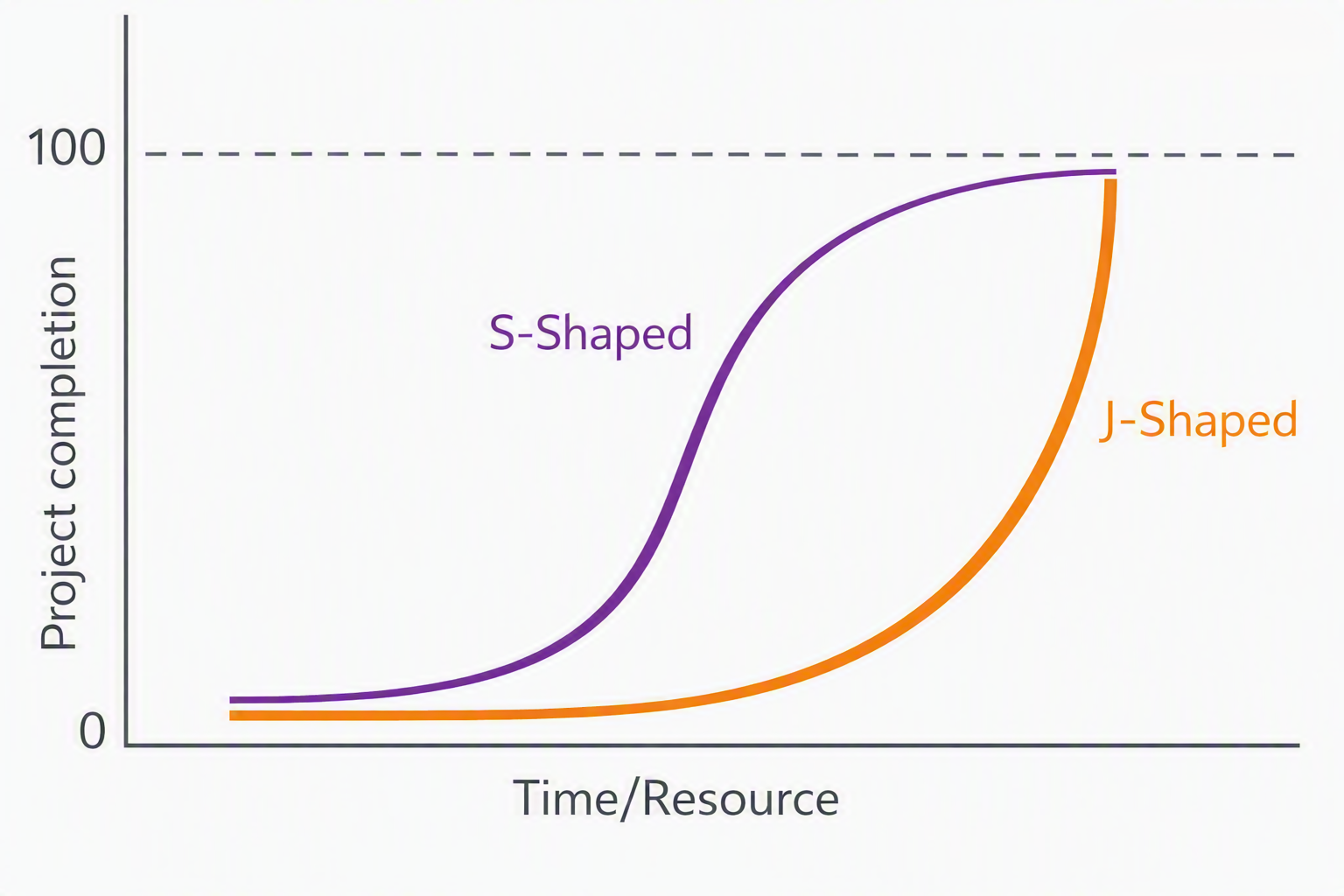
From a cumulative cost perspective, projects follow two patterns:
- S-shaped: Most projects follow this trend. They start using funds slowly, with a sudden increase in fund use near the middle of the project, and the use of funds slowing down as you approach the end of the project.
- J-shaped: Some projects may follow a trend of starting slow, and then experience a rapid and steep use of funds with an abrupt end. Common examples include projects a strong front-loaded design/planning phase followed by a short execution phase, such as projects that introduce a new system, process or methodology.
Presenting the Budget: Activity/Category Versus Program Budgeting
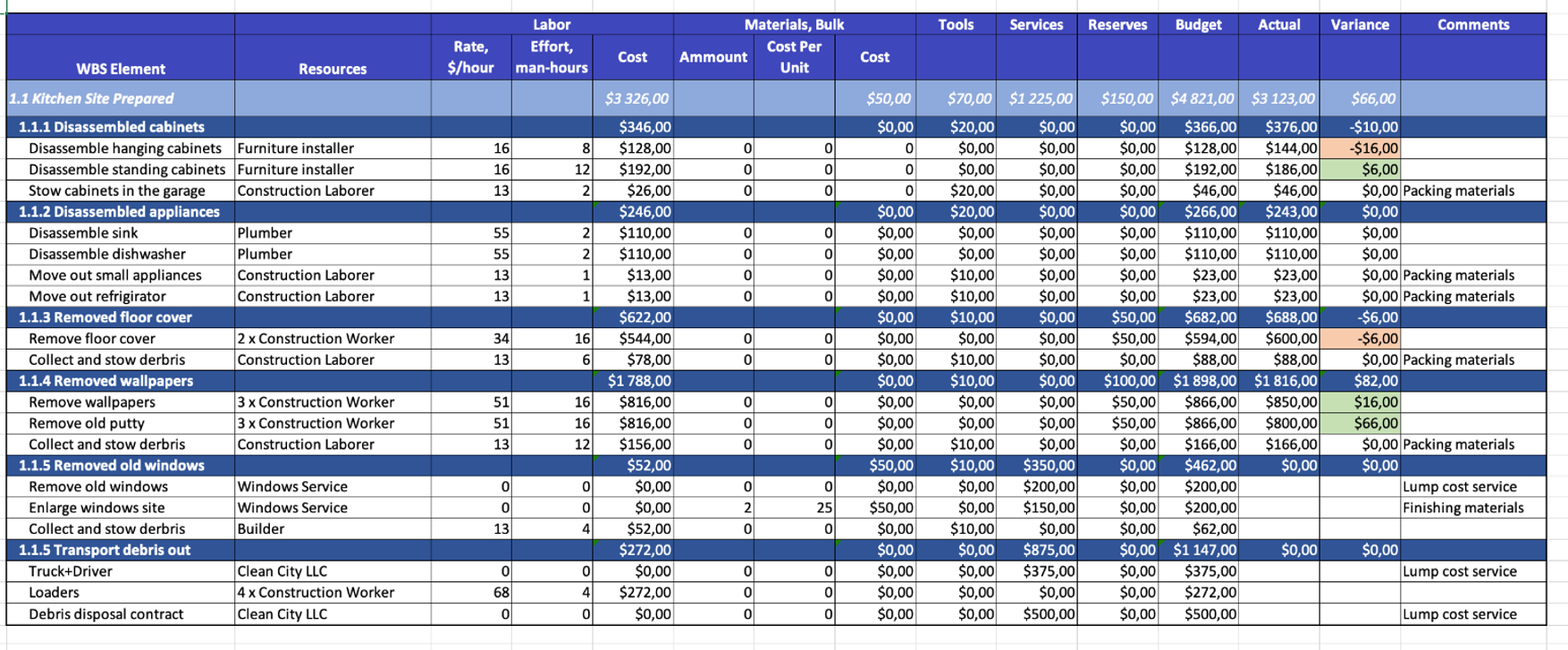
Most organizations use an accounting system with specific cost categories to keep track of their expenses. This cost categorization is usually activity oriented: Expenses are assigned to standard budget lines (labour, travel, etc) and these liners are aggregated and reported by each organizational unit. Management is used to seeing budget information broken down this way.
However, project and program budgets are focused on specific work package activities and time periods for aggregation across the project. In fact, different projects may use different categories to report costs.
While project managers estimate and use costs using the latter method, they need to report information using the former approach for ease of understanding by management.
 Creating an Accurate Project Budget: Step-by-step Guide for Project Managers (itpmschool.com)
Creating the Budget
- Estimate the direct cost of each activity on the WBS
- Include all of the resources for all of the time for the project
- Differentiate between elapsed & “hands-on” time, with no multiple allocations
- Consider taxes, duties and shipping
- Allow for breakage, “stealing”, and damaged parts
- Allow for long shipping times
- Allow for mistakes
- Add up the estimates to get estimates for higher levels of the WBS (this can become the cost breakdown structure)
- Estimate indirect costs as per your organization’s policy
- Add contingency reserves
- Create an activity-based budget for external reporting
- Spread the cost over the schedule to determine cash flow
- Submit for approval
Summary
Bibliography
The following sources were also consulted in creating this resource: