ProjectManagementOER
Project Estimation
Learning Objectives
By the end of this unit, you should be able to:
- Describe the methods, uses, and advantages and disadvantages of top-down and bottom-up estimating methods
- Understand the challenge of estimating mega projects and describe steps that lead to better informed decisions
- Use estimating methods to estimate project times and costs in order to create a project plan
Estimating
Estimating is the process of forecasting or approximating. In planning a project, we need to estimate various parameters including the duration of activities, the effort needed for activities, the costs of activities, contingency reserves, and impact of risk. This information in turn will form the basis to finalize the plan including schedule the work, create a budget and cash flow information. This plan is what is used to monitor the progress of the project and make decisions. Hence, estimating is a key skill for a project manager.
When working with estimates, we need to know:
- The basis of the estimate (how it was developed)
- The accuracy of the estimate
- Any assumptions made
Estimates are updated throughout the life of the project at specific points to increase accuracy of future estimates. One should avoid gold-plating here: your estimate should truly be what you expect to happen, and your aim during execution is to meet the estimate.
Estimation Approaches: Bottom-Up vs Top-Down Estimates
There are two general approaches to estimate information in the project
- Top-Down Estimates: The idea here is to generate an estimate for the project as a whole, then flow that down through the levels of the WBS, allocating the part of the total estimate to each work package. For example, higher management or a program may force this estimate onto a project even before a WBS is developed (by defining an end date, specific milestones or a budget). This form of estimate is usually based on experience, and history of past projects. While this method can at times lead to accurate estimates, there is a risk that details of key tasks are not considered (specially if the project involved new technology or approaches to work), leading to inaccurate estimates. Moreover, in most cases the estimate represents an external view of the project, as the project team has not been involved in developing it.
- Bottom-Up Estimates: In this case one would start by estimating information for the lowest level activities in the WBS, and then add the information together to determine values for higher levels of the WBS. The key here is having a proper WBS that represents the full scope of the project. This approach will be more accurate and representative of the actual capabilities of the team. However, if the WBS is not developed correctly, there is a chance that information is missed. This approach is common in organization with a participative management philosophy and leads to better morale, greater acceptance of the resulting budget, and heightened commitment by the project team.
| Top-Down Estimates | Bottom-Up Estimates | |
|---|---|---|
| Intended Use | Strategic decision making | Detailed planning |
| Feasibility/conceptual phase | Detailed budgeting | |
| Rough time/cost estimate | Detailed scheduling | |
| Funding requirements | Resource requirements | |
| Resource capacity planning | Timing of funds | |
| Internal/small project | Customer wants details | |
| Unstable scope or high uncertainty | Well-defined scope with time and cost as main constraints | |
| Preparation Cost | 0.1-0.3% of total project cost | 0.3-1% of total project cost |
| Accuracy | -20% to +60% | -10% to +30% |
Phase Estimating
Top-down and bottom-up estimates may be used together. Say you are completing a project with 5 phases. You may do a top-down estimate for the phases (allocating specific amounts of the budget to each phase), and a bottom-up estimate for the phase you are immediately working on (to ensure the project is feasible and identify where the expenses are).
Near the end of the current phase, you may update the top-down estimates for future phases, and perform a bottom-up estimate for the next immediate phase. This hybrid approach means you always have the big picture in mind, and detailed information for the immediate next phase, a rolling wave approach to planning.
Methods for Estimating
Historical data
This approach can be useful for bottom-up approach (to estimate cost of components or specific tasks) or top down. The aim is to rely your estimate on historical/statistical information. This can be information about the cost of parts, equipment or material you can find online. You can also look at how much people have charged for a specific task, the wages for human resources, the amount of time a task has taken in the past and similar information.
Sources of this information can be:
- Online databases for wages, parts and materials
- Human resource department for wages
- Past work packages with similar activities: Most organizations archive information regarding their past project as part of the closing process group, with the aim of providing input data for this form of estimation.
Similarity to Other Projects
There are several methods you can use which all rely on similarity to other projects. These methods always involve some extrapolation, but can be used to find areas for improvement.
- Analogous Estimate (somewhat like …): You can find a similar project or task and assume the cost will be the same or similar. The more experience the estimator has, the better this approach will work. You also tend to neglect the learning gained from each project in this approach. In most cases this approach is used for a top-down estimate. You would need the previous projects to be very similar to the current project, and you need to know the actual cost of those past projects.
- Cost-breakdown (apportion method): You use how cost was broken down in completed projects to estimate costs in new projects. Say if in the past 10% of all costs were related to project management, this can help you come up with a budget for the project management component. This approach is helpful for top-down or program-level estimates.
- Parametric Estimate (this is a fraction of the other): You identify a measurable characteristic that is directly linked to cost and use this as a basis of your estimate. For example, your construction company which has completed buildings before may know the construction cost per square feet. It can use this to estimate the cost of a new construction based on the number of square feet. Or in software development, you may know the cost per feature. This method requires good database of past costs.
- Factored estimate: This is an approach for projects where scope is not well-defined. You can estimate the cost of a key project component by multiplying the cost of a component by a factor. Say if the project is to set-up some equipment in a factory, you may estimate the cost of the installation process by multiplying the cost of the equipment a factor (based on past experience). To use this method, you need a good estimate (or a firm quote) for the main deliverable (in our example the equipment you are installing).
Making Estimates Better: Expert Advice
While the project manager can estimate information, consulting the people who will actually do the work and those with experience completing the work will lead to better estimates. Ideally ask the owner of the work package or task for an estimate or involve those with expertise in the specific task or work package. Sometimes this means going outside your organization to get specialized advice, or talking to potential vendors (one reason to develop a good relationship with them on one project is that they will be willing to help you on your estimate for the next project).
Making Estimates Better: Accounting for Learning
Human performance usually improves when a task is repeated. This happens by a fixed percentage (the learning rate) each time the production doubles until it plateaus. This can be calculated as
\[T_n = T_1 n^r\]where T_n is the time it takes to complete the nth repetition, T_1 is the time for the first unit, n is the number of units, and
\[r=\frac{log(rate)}{log2}\]The total time needed to complete the n repetitions is:
\[T_{tot} = T_1 \sum_{n=1}^{N} n^r\]Making Estimates Better: Delphi Technique
The idea behind the delphi technique is to use multiple estimates from a panel of experts, and moving those experts towards consensus.
Ideally you want to do this in a meeting of peers, with experts in the same task, in the form of a group activity.
- Each member is asked for their best estimate. The response can be shared either anonymously (panel members share their estimates privately so the panel members do not affect each other’s opinions) or in a meeting format.
- The results are shared with the group.
- Panel members with the highest and lowest estimates are asked to explain their reason for their estimate.
- The group is asked for a second estimate based on the discussion of the highs and lows.
- If there is still a range of estimates, you can either continue this until consensus is reaches, or use the average of estimates when they are close enough.
Making Estimates Better: Range Estimating (3-point estimate)
The methods we saw to this point rely on developing an absolute estimate, a single number. Nothing is that deterministic in the real world; they are probabilistic with a range of possible results.
To take into account uncertainty of the prediction using a probability distribution, we can instead develop 3 estimates:
- Optimistic or best-case estimate = O
- Pessimistic, safe or worst-case estimate = P
- Most likely estimate (expected) = M
If the most likely estimate is the average of the optimistic and pessimistic estimate, then you can use the most likely value directly. Otherwise, we can use the value calculated from a probability distribution (or a weighted average). There are various versions of this, but the most common is using the beta distribution, where the estimate (E) can be calculated as:
\[E = \frac{O+4M+P}{6}\]Now we can also calculate the standard deviation, which tells us how spread out the estimates are and gives us a sense of uncertainty:
\[\sigma = \frac{P - O}{6}\]There is close to 68% likelihood you end up completing the project within the standard deviation.
Example: A Three-Point Estimating Technique: PERT - Project Management Academy Resources
Estimation Example
Let’s look at a few examples of estimates during the new Online Registration System project for Valley College.
Top-Down vs Bottom-Up Estimation
- Senior management may set a cap of CAD 250,000 and 8 months based on similar projects at other institutions. This is a top-down estimate. High‑level allocations might be CAD 80,000 for requirements and design, CAD 120,000 for build and integration, and CAD 50,000 for testing and training.
- The team estimates resource needs for each work package (e.g., hours for developers, analysts, testers, licenses). These detailed estimates are aggregated to derive the total cost and duration. This gives us the bottom up estimate.
Three-Point Estimation
The team may define an activity for the project as “Configure registration rules.” Within the team, we ask those working on this task for an optimistive, pessimistic and most-likely duration for completing the work:
- Optimistic (O) = 3 days.
- Most likely (M) = 5 days.
- Pessimistic (P) = 9 days.
When planning, we use the expected duration: \(E = \frac{O + 4M + P}{6} = \frac{3 + 20 + 9}{6} \approx 5.3 \text{ days}\) \(\sigma = \frac{P - O}{6}=\frac{9 - 3}{6} = 1\)
This three‑point estimating incorporates uncertainty into duration estimates. If we had not used it, we would have assigned only 5 days for this task. Now we know that the project is 68% likely to complete in 4-6 days (within one standard deviation), and 99% likely to complete in 2-9 days (within 3 standard deviations).
Parametic Estimation
The college identifies that it needs a $2,000 sqft plot of land for a data center to support the project. To estimate the cost to buy this land, they may use the cost per square foot:
\[Cost = \$150 /sqft × 2,000 sqft = \$300,000\]Phase Estimating
Let’s assume that data center is structures as a separate five‑phase project (concept, design, build, test, deploy). The college may decide to use top‑down estimates for overall phase budgets and durations. Then bottom‑up estimates are used for the current phase to ensure feasibility and identify detailed resource needs. After each phase is complete, phase‑level estimates are updated for future phases as more information becomes available (rolling‑wave approach).
Accuracy of Estimates
Regardless of method, accuracy will depend on factors including:
- Involvement of the right people
- Clarity of expectations and success criteria
- Level of detail of activity description
- Planning horizon (short-term estimates are more accurate than long-term)
- Project complexity and uncertainty
- Project structure and organization Accuracy of estimates improve as you move further into implementation. This is due to the reduction of uncertainties as the project is implemented.
High-level estimates (at project level) may be up to 300% off, but estimates of specific work packages tend to be within 15% of the actuals in many cases. The project team needs to determine what their accuracy standards are. One example of a standard could be:
- Order of magnitude (-30%/+50%) - likely analogous or factored
- Budget estimate (-15%/+30%) - based on quantitative data, using parametric, factored, bottom-up
- Definitive estimate (-5%/+15%) - bottom up based on well-defined project data Another example is the American Association of Cost Engineers (AACE) AACE class of estimates.
Before one ends estimation, there are two key questions to answer:
- Do the estimates make sense?: A faulty model, faulty input data, calculation errors or bad assumptions can all lead to bad estimated. You can answer this question by using your experience, or finding something to compare to.
- What are the consequences of a bad estimate? Will there be serious financial, environmental, or safety issues? Do you have the funds to cover the financial risks?
- What is the cost of making a better estimate? These costs must be weighed against the benefits of a more accurate result.
Based on your answers to these questions, you may decide to adjust your estimates:
- You may have missed interaction costs
- You may be in a situation where normal conditions do not apply
- You may want to factor in risks
- There may be changes to the project scope and plans
- Your team may have been too optimistic
- There might have been a strategic misrepresentation, extra padding or gold-plating while estimating
The Association for the Advancement of Cost Engineering (AACE) defines the following class of estimates which are commonly adopted by many organizations.
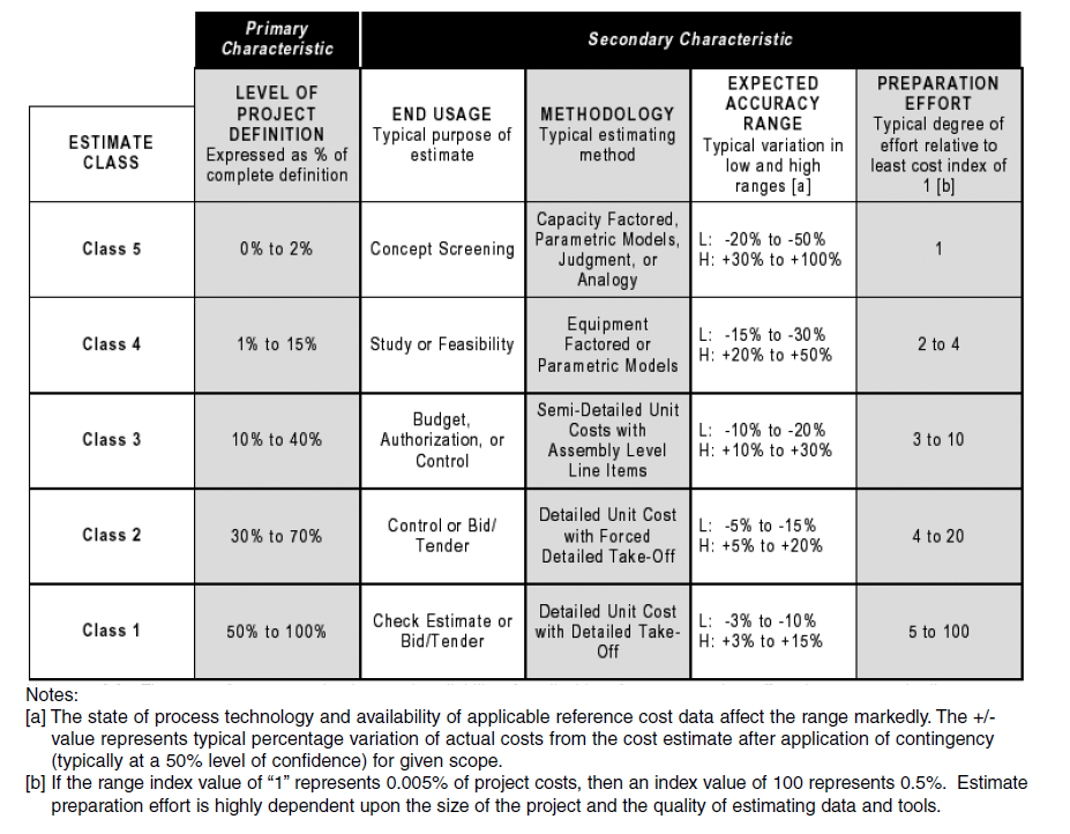 Source: W4_bud_Selection of cost estimation method for subsea facility in offshore development | TOPAZ SMART
Refining Estimates
You may decide to adjust your estimates if:
- Interaction costs are hidden in estimates
- Normal conditions do not apply (for example you need to complete the project faster)
- Things go wrong on projects
- Project scope and plans change
- People are overly optimistic in the estimates they provided
- People engage in strategic misrepresentation
Summary
Practice
Bibliography
The following sources were also consulted in creating this resource: