ProjectManagementOER
What is Scope?
One of the main activities in the Project Planning is determining and documenting the project scope.
Scope is a description of the end result or mission of your project: the product or service for your client/customer. It defines the results to be achieved in specific, tangible, and measurable terms, explicitly describing what aspects of the work are in and what aspects are out, and outlining the boundaries of the project. Determining the scope is a key piece of being able to prepare a plan, because the resources required and the activities that need to be completed are determined by the scope.
In most projects, you actually interact with two scopes:
- Product scope: describes the final deliverables, their features and functions (requirements)
- Project scope: describes the work that must be done to create the product scope and successfully meet the project objectives. Both of these need to be defined in as specific and measurable of a way as possible. This way, your project sponsor will know with certainty whether that part of the scope has been achieved or not.
In simple projects, both of these may be managed by the project manager, while in more technical projects the project manager manages the project scope and a product manager or systems engineer may manage the product scope.
Project boundaries are the area where the project management processes are taking place. It encompasses the team, and the work relevant to the project. The project sponsor shared business documents about the project with the team (one side of the boundary), whom uses the project management processes to create an outcome at the other end of the boundary, delivering deliverables to the end-users and project records to the organization to maintain as part of its organizational process assets.
Scope Management Planning
The first process in scope management is determining and documenting how you are going to complete Scope Management Planning. At this step, your aim is to answer questions such as what terms do you use to describe the scope, what information from the project charter currently describes scope, what information do you need to complete the description, what templates you will use in your description, etc.
The Plan Scope Management has the following elements:
- Inputs
- Project charter
- Project management plan (Quality management plan, Project life cycle description, Development approach)
- Enterprise environmental factors
- Organizational process assets
- Tools & Techniques
- Expert judgment
- Data analysis (Alternatives analysis)
- Meetings
- Outputs
- Scope management plan
- Requirements management plan
Requirements Management Process
The aim of the requirements management process is to collect requirements for the project and the product/service. In most cases, a preliminary set of requirements are available in the project charter. The team would then analyze these alongside assumptions and stakeholders to delineate and create more specific requirements for the project.
It has the following elements:
- Inputs
- Project charter
- Project management plan (Scope management plan, Requirements management plan, Stakeholder engagement plan)
- Project documents (Assumption log, Lessons learned register, Stakeholder register)
- Business documents (Business case)
- Agreements
- Enterprise environmental factors
- Organizational process assets
- Tools & Techniques
- Expert judgment
- Data gathering (Brainstorming, Interviews, Focus groups, Questionnaires and surveys, Benchmarking)
- Data analysis (Document analysis)
- Product analysis (systems analysis, systems engineering, value engineering)
- Decision making (Voting, Multicriteria decision analysis)
- Data representation (Affinity diagrams, Mind mapping)
- Interpersonal and team skills (Nominal group technique, Observation/conversation, Facilitation)
- Context diagram
- Prototypes Outputs
- Requirements documentation
- Requirements traceability matrix
Requirements
A requirement is a condition or capability that must be met or possessed by a system, product, service, result, or component to satisfy a contract, standard, specification, or other formally imposed document. Requirements include the quantified and documented needs, wants, and expectation of the sponsor, customer, and other stakeholders. Project requirements may also tie to things like the organization’s strategic plan and business objectives.
Requirements characterize the project’s end product, and in most cases are not just the realm of the project manager, but also the system engineer or technical lead on the project.
Determining requirements leads to:
- Increased project success, as the team has the same understanding of what has to be achieved
- Improved customer satisfaction, as the customer has a clear understanding of what has to be achieved
- Limited rework, leading to cost and time efficiency
- Improved product quality, as quality requirements are also captured
- Manageable change control as requirements can be traced to customer needs
Requirements Management
Requirements management throughout the project follows the steps below:
- Identify: This is done through brainstorming, stakeholder analysis and discussion with domain experts. What is important is that requirements need to meet the SMART description and describe what shall, will or should happen
- Document: Requirements are usually documented in a requirement’s register. Documentation should:
- Be accessible by all stakeholders
- Present information clearly
- Keep information securely
- Maintain versions
- Record links between items
- Provide clear reporting
- Be easy to use For each requirement:
- Assign a requirement ID which allows for traceability to its parent and child requirements
- Requirement statements:
- Are usually written using shall (must have), should (we would like it to have), or will (fact)
- are stated positively (“shall not” is not allowed)
- are preferably quantified, meaning they include a measure and the method of measurement
- May include “To Be Determined” (TBD) if something is unknown. However, the use of TBD should be minimized. Alternatively, use a best estimate for a value marked with “To Be Resolved” (TBR) with the rationale along with what should be done to eliminate the TBR, who is responsible for its elimination, and by when it should be eliminated.
- Rationale/justification: Including any assumptions and the reason why the requirement is needed/included
- Categorize: Common categories include Functional, Non-functional, Performance, Development, Technical, Business, User, Regulatory, Quality
- Requirement Owner: Assign a person or a team who is in charge of it
- Link to work breakdown structure
- Link to Business Needs, Opportunities, Goals, Objectives
- Test case
- Prioritize: Are the requirements of the same level of importance? Which ones will you monitor more closely?
- Monitor and control: If during the project a new requirement needs to be added or we learn that a requirement cannot be met, then we would need to rely on change management process to change the scope of the project.
Scope Definition Process
The scope definition process tries to clarify and document project scope. It has the following elements:
- Inputs
- Project charter
- Project management plan (Scope management plan)
- Project documents (Assumption log, Requirements documentation, Risk register)
- Enterprise environmental factors
- Organizational process assets
- Tools & Techniques
- Expert judgment
- Data analysis (Alternatives analysis)
- Decision making (Multicriteria decision analysis)
- Interpersonal and team skills (Facilitation)
- Product analysis
- Outputs
- Project scope statement
- Project documents updates (Assumption log, Requirements documentation, Requirements traceability matrix, Stakeholder register)
Project Scope Statement
The project scope statement is the main outcome of the scope definition process. It is a short, one- to two-page summary of key elements of the scope, followed by extended documentation of each element. In some cases, the scope statement takes the form of “statements of work (SOW)”.
The purpose of the scope statement is to:
- Clearly define the deliverable(s) for the end user
- Create a baseline
- Say WHAT will be accomplished
- Clarify what is “included” & “not included” for example is this limited to certain locations? If in an international context, is it in only one language?
- direct focus on the project purpose throughout the life of the project for the customer and project participants
- be published and used by the project owner and project participants for planning and measuring project success
Examples of questions answered by the scope statement include:
- How much is to be achieved in the project?
- What is the length of the project window, i.e., when does the project start and when must it finish?
- What is the obligation of resources (money, people, equipment, supplies, etc.)?
- What are the customer’s measurable expectations, the deliverables?
- What are the critical activities required for success?
- What are the the primary activities that must be completed to meet the expected defined goals?
- What are the resources required for success?
- How can the scope definition be used to implement the schedule?
- How do resources affect the schedule?
- What is the amount of time allocated for communicating progress?
- How is documentation to be accomplished?
As you describe the scope, you may notice that it is too big or small. If you have a very big scope, then you may decide to break your project into smaller subprojects (managed perhaps as a program). While projects with large scope are possible, they include additional complexity and the need for simultaneous management of various elements.
Project Scope Statement - Common Content
While there is no single standard or outline for the project scope statement, the scope statement will address the following topics:
- Problem statement or business case
- Project goals and objective
- Project scope + product/service scope description OR scope summary with boundary conditions (progressively elaborated)
- Justification
- Technical requirements
- Project requirements
- Deliverables
- Milestones
- Limits and exclusions (In Scope, out of Scope)
- Constraints and assumptions
- Acceptance criteria
Scope Creep
Scope creep is the tendency for the project scope to expand over time — usually by changing requirements, specifications, and priorities. When you add work to a project, little by little, insidiously, until the original schedule and cost estimates are completely blown and meaningless, you’ve attained scope creep.
Common causes of scope creep include:
- Poor requirement analysis, resulting in an incomplete understanding of project scope
- Not involving users early enough, resulting in requests for change
- Underestimating project complexity
- Lack of change control, resulting in changes to the scope without formal approval processes
- Gold plating: adding features or enhancements not requested by client with the intention of exceeding expectations
To control scope creep, make sure any changes in either the statement of work or project plan is agreed to in writing, along with the resulting budget and schedule changes.
Pentagon Wars is a good example of how scope creep can break projects.
Work Breakdown Structure
The Work Breakdown Structure (WBS) is a deliverable-oriented hierarchical decomposition of work with different levels of detail. It is essentially a list of all activities/work required to create all the deliverables in the scope and deliver them to the client, broken down into smaller tasks, in a hierarchical pattern. The WBS organizes and defines the total scope of the project by identifying the products and work elements involved in a project, defines the relationship of the final deliverable (the project) to its sub-deliverables, and, in turn, their relationships to work packages, and serves as a framework for tracking cost and work performance.
The WBS can be represented graphically (a hierarchy) or in list form. WBS elements are assigned a numeric id, with the numbering indicating0 the “parent child relationship”.
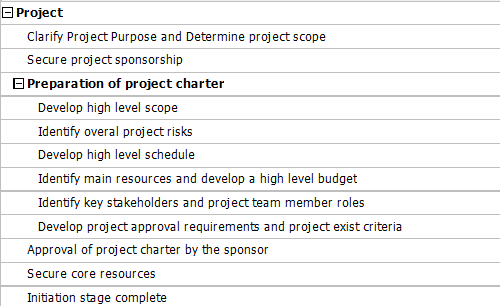

The create WBS process has the following elements:
- Inputs
- Project management plan (Scope management plan)
- Project documents (Project scope statement, Requirements documentation)
- Enterprise environmental factors
- Organizational process assets
- Tools & Techniques
- Expert judgment
- Decomposition
- Outputs
- Scope baseline (including WBS and WBS dictionary)
- Project documents updates (Assumption log, Requirements documentation)
The WBS has several uses:
- Communication tool: it allows communication of scope and expected activities to stakeholders
- Scope control mechanism: Allows tracking of status, exceptions, predicted status, costs and trends of activities
- Helps prevent omission of products & services and ensures full picture is considered
- Allows you to assign responsibilities
- Provides structure & coding system for costs, schedule, contracts
- Provides basis for scheduling and budgeting the project, and managing risk
- Facilitates the use of PM software
- Can be used as “templates” for similar projects
A Good WBS
- Reflects customer requirements
- Does not lead to micro-managing
- Has independent elements
- Is measurable (you can assess how much of the work is complete)
- Is easy to work with owing to its development philosophy
- Reflects project priorities
Creating the WBS
Decomposition is the process used to break the project scope of work into the deliverables, sub-deliverables, and work packages involved in completing the project. The process of decomposition begins with identifying the highest-level deliverables. These deliverables are then broken into sub-deliverables. Many layers of sub-deliverables may be needed for a project.
To create a deliverable-based WBS:
- Start with the project
- List all the project outputs (deliverables and other direct results)
- Deliverables and sub-deliverables are things such as physical objects, software code, or events. They are usually represented by nouns.
- Identify of all the activities required to deliver the outputs
- Subdivide the activities into sub-activities and tasks
- Remember the 100% Rule: The combination of the boxes on each level represent 100% of the parent box.
- At the lowest level you will reach work packages which are assignable units of work that will be performed to create the related deliverable. Work packages are action oriented and may be represented by phrases containing verbs.
- Note that you want to break down all deliverables to the same level of details. This is a common issue, whereby if the project manager is more familiar with a particular task, they may break it down more than others, leading to issues when trying to assign the work.
- Identify the deliverable and milestone(s) of each task At this point, the focus is not in the sequence of activities or their dependencies; instead, our goal is only to identify all activities that describe the full scope of the project.
The process above starts with deliverables as the basis for creating the WBS, making this a scope-driven WBS. There are other methods:
- Scope-driven: Break down by subsystems or area of activity
- Phase driven: Your first level of breakdown is by pre-defined project phases ( for example, conceptual, preliminary and detail design)
- Time driven: Break down starts with milestones
- Quality driven: Highlight testing and quality control, functional areas in WBS
- Cost driven: Start with major cost categories and break down from there
- Process-driven: Specific processes that are needed are listed at the top The choice of which method to use may be informed by what drives the project and experience.
The lowest level you reach in your WBS depends on the amount of control you want. The general rule is to go down to the lowest level that needs to be monitored and communicated, or to the lowest level you can delegate. Generally speaking, you should create a master plan for every project, with detailed plans only for the next 3-4 months for monitoring and resource planning, and with workpackages that take approximately 2 weeks to complete or 8-80 hours of effort.
A Work Package
The smallest elements (lowest level) in the WBS are work packages. They are typically a short-duration task that has a definite start and stop point, consumes resources, and represents cost. These work packages usually involve work by a specific team or person (as such are focused on a specific domain of work) and are assigned to one organizational unit, individual or contractor for ownership. They may in turn be further broken down into activities or tasks by the project team or the experts who will perform that work and planned in detail.
Work packages are the basic unit used for planning, scheduling, and controlling the project. They should be as independent of other work packages of the project as possible and be easily assigned. Depending on your organization and the level of planning required, the size of a workpackage may be different. Generally speaking, a workpackage with a project should not exceed 10 workdays or one reporting period
Workpackages should:
- Be specific and identifiable (WBS dictionary)
- Be assignable to a unit or person
- Be independent – separate
- Be integrateable
- Represent a measurable activity
- Have a scheduled start and finish
- Have a budget in $ or labour hours
Workpackage Information
Each Work Package in the WBS will have the following information recorded in a document called the WBS dictionary:
- ID, based on its level
- Name
- Description of the work, activities, goals and results
- Relevant deliverable
- Relevant milestone
- Dependencies to other work packages
- Effort (number of total hours of work)
- Start Date
- Planned End Date
- Duration
- Resources
- Budget
- Owner/responsible
- Status
- Monitoring points
Keep in mind that at this stage, you only know the name and its relationship to deliverables. The rest of this information is going to be completed as you go through other planning processes. Also note that some organizations only track a subset of these at workpackage level.
Workpackages and Human Resources
While not formally required, at this point a responsibility assignment matrix (also called a linear responsibility chart, responsibility matrix or RACI matrix) may be developed to identify high level responsibilities of workpackages. This chart who has responsibilities with respect to the work package. Particularly, who is:
- R: Responsible for recommending decisions
- A: Authorized to approve decisions
- C: Consulted – two way communication
- I: Informed – one way communication/Notified
- S: Supports/Assists
At a minimum, each work package should have one responsible. Multiple approvers are possible, but keep in mind that this may delay approvals and decision making. The RACI matrix should collaboratively be completed to ensure buy-in.
This will provide a means for all participants in a project to view their responsibilities and agree on their assignments, and clarify interfaces between units and individuals that require coordination. The RACI matrix may include the project team, organization members outside the project team and even other stakeholders.
In addition, the WBS should be integrated with the organization’s resource consideration. An Organization Breakdown Structure (OBS) is used to depict departments, teams and individuals responsible for specific areas of work within the organization. Linking the OBS elements with the WBS will allow us to identify the organization units responsible for work packages. As most resource costs are realized in organizational units, this will also ties the project to cost control accounts within the organization.
We will expand on this topic in resource management.
Relationship Between Work Packages
The Design Structure Matrix (DSM) can address the issue of information flow as well as precedence relationships of work packages. The first step in developing a DSM is to identify all the project’s workpackages and list them in the order in which they are typically carried out. Next, moving across one row at a time, all tasks that supply information to the task being evaluated are noted. This information can then be helpful when creating the schedule.
Summary
Practice
Bibliography
The following sources were also consulted in creating this resource:
- PMBOK Guide 7th ed.
- Process Groups: A Practice Guide
- Essentials of Project Management
- Project Management: A Managerial Approach
- Project Management: A Socio-Technical Approach
- How to Write a Good Requirement— Checklist
- INCOSE Guide to Writing Requirements V4 – Summary Sheet
- 10 Best Practices in Writing Requirements
- Requirements vs Scope - What’s the Difference? - Study Notes for PMP/CAPM