ProjectManagementOER
The Planning Processes
After the project charter is approved, the Project Initiation phase is complete and you are ready to proceed to the Project Planning process group.
One can think of two extremes when it comes to planning:
- “Ready, fire, aim”, where you essentially hop into execution
- “Paralysis by analysis”, where you spend so much time aiming to reach the excellent plan, that you end up without time to execute. The aim of the planning process is to reach a happy medium between these two, a situation where you have enough information about what to expect to ensure the project is implemented successfully.
The purpose of the planning process group is to:
- Establish business requirements
- Create cost, schedule, list of deliverables, and delivery date estimates
- Establish a resources plan
- Getting management approval with the above before proceeding to execution Note that some of the items above might be to an extent outlined in the Project Charter. The Planning Processes would analyze the expectations of the Project Charter to ensure they are feasible, make them more clear, and adjust them based on information that becomes available.
The Planning Process Group includes the following processes:
- Develop Project Management Plan
- Plan Scope Management
- Collect Requirements
- Define Scope
- Create WBS
- Plan Schedule Management
- Define Activities
- Sequence Activities
- Estimate Activity Durations
- Develop Schedule
- Plan Cost Management
- Estimate Costs
- Determine Budget
- Plan Quality Management
- Plan Resource Management
- Estimate Activity Resources
- Plan Communications Management
- Plan Risk Management
- Identify Risks
- Perform Qualitative Risk Analysis
- Perform Quantitative Risk Analysis
- Plan Risk Responses
- Plan Procurement Management
- Plan Stakeholder Engagement
These various processes and plans impact each other, so you need to iterate! You also notice above that many of the processes including their own planning phase (for example plan resource management happens before estimating activity resources). The general idea in project management is “planning prevents poor performance”, but also “planning planning prevents poor performance”!
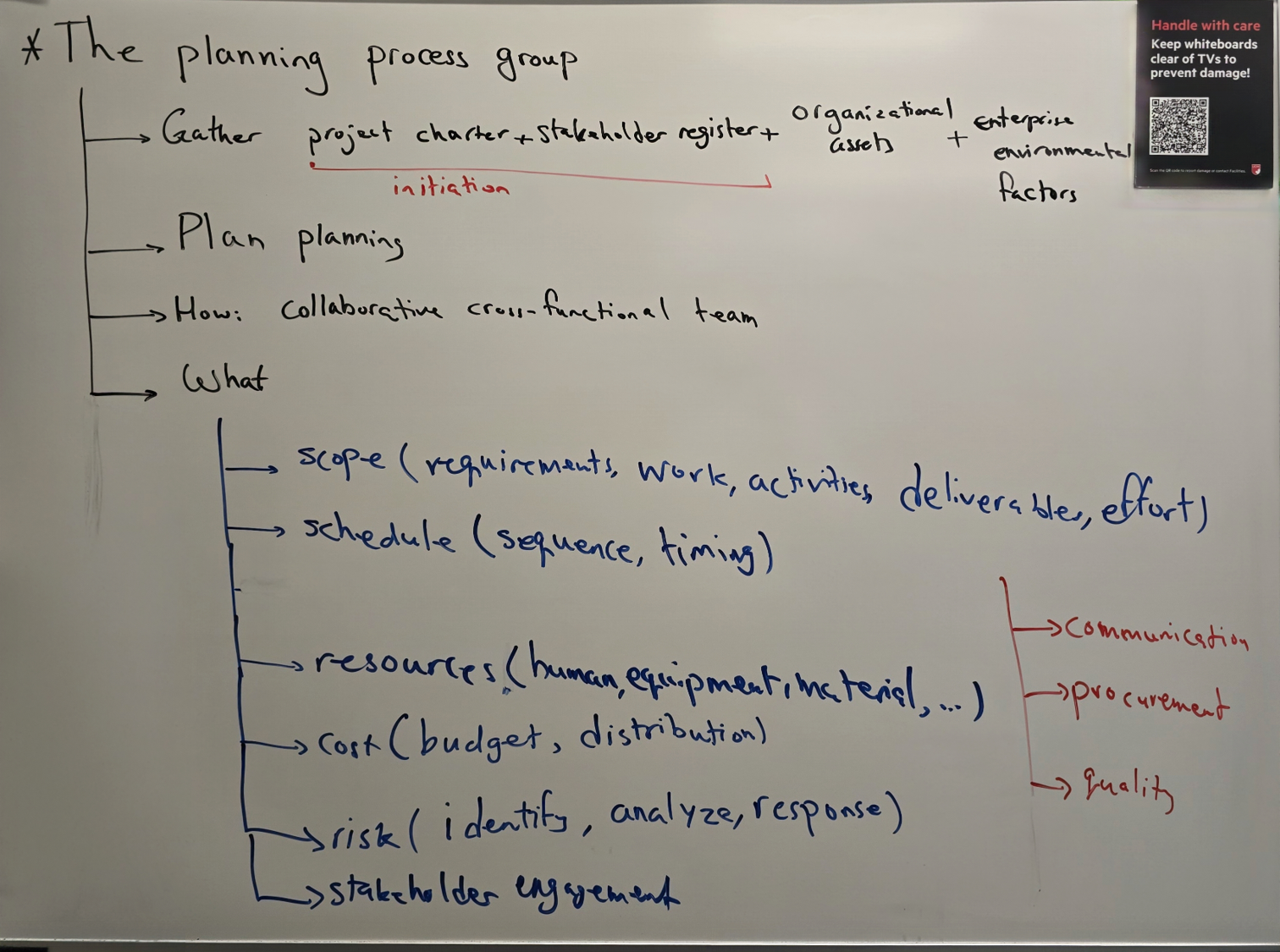
Collaborative Planning
Project management planning is not just completed by the project manager. The project manager ensures that all processes are complete and relevant stakeholders are engaged in the process. This is a collaborative process so those affected should be involved. It is a process that requires realistic goals and tasks. In this process, past information is used but are not the only source of information. The team works together to identify alternatives and ensure a feasible plan is developed.
Collaborative planning allows for:
- Greater understanding of dependencies between activities, as people familiar with those activities are involved in the process
- A systems view on the project and understanding all aspects of project
- A more valid schedule
- Exploration of more alternatives and out of the box thinking
- Time savings, by preventing delays due to not understanding specific aspects of the project
- Greater commitment to the plan and buy-in from stakeholders as they were involved in the process
- Conflict resolution, as potential points of conflict are discussed before there is a need to execute the plan
- Agreements on dealing with future issues
- Team and stakeholder relationship building which should lead to longer term benefits for the project
- Education for everyone involved as team members from different disciplines and functions are working together and benefit from each other’s experience
- Better communication of goals, leading to team focus
The Project Management Plan
The project management plan defines HOW the project is executed, monitored and controlled, and closed. It includes:
- Subsidiary management plans (schedule management plan, cost management plan, risk management plan, etc)
- Project baselines (scope baseline, schedule baseline, cost baseline, risk register, etc…)
The Develop Project Management Plan process involves the following elements:
- Inputs
- Project charter
- Outputs from other processes (any baseline or component plan created by other processes)
- Enterprise environmental factors
- Organizational process assets
- Tools & Techniques
- Expert judgment
- Data gathering (through Brainstorming, Checklists, Focus groups, Interviews and surveys)
- Interpersonal and team skills (such as Conflict management, Facilitation and Meeting management)
- Meetings
- Outputs
- Project management plan
Common issues in project planning which can lead to project failure include:
- Not defining measurable goals
- Not having a realistic schedule
- Not establishing a realistic budget
- Not using skill levels, but head count
- Not having a viable quality control system
Planning 101
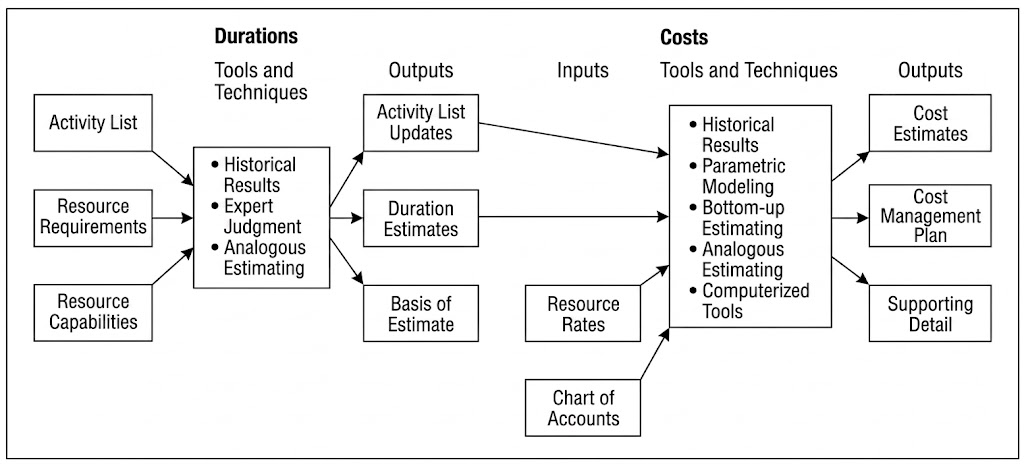
Before we delve into the details, it helps to get a high level view of planning.PM101 Estimating | PMI summarizes it as shown below:
- Clarify project requirements and expectations, prepare an overview definition of the project, identify potential alternative solutions, assumptions, constraints, etc.
- Make rough top-down estimates (starting with the project and then breaking down at least one level): You may use past projects or assigned budget to identify what the cost should be or how it should be broken down
- Develop work breakdown structure: This allows us to identify the activities that need to take place
- Major categories of work (3 to 8 max)
- Main activities or work packages in each category (max 60) and identify who is responsible for each
- Identify who should be involved in estimating the work packages
- Develop flowchart of activities: This allows us to understand the order in which the work needs to take place
- Estimate the time needed for each activity: Use historical records, expert judgment, analogous activities, and take into account resource availability, and capability (type and level of skills). Choosing between duration‑driven and effort‑driven scheduling affects resource assignments, overlaps with other projects, and the feasibility of meeting external deadlines.
- Duration-driven scheduling: You define the duration, calendar and the resource, and the effort gets calculated. For example, Task A must finish in 5 days, with one full-time person → effort = 40 hours..
- Effort-driven scheduling: You define the effort, people and the calendar, and the duration gets calculated. For example, Task B needs 40 hours of effort and can have 2 people half-time → duration = 5 days.
- Perform critical path analysis: We learn about this later but this analysis allows us to take into account the duration and order of the activities to determine the total amount of time the project will take
- Estimate costs bottom up (resources, infrastructure, equipment, materials,maintenance, operations, overhead): Here you are taking into account the details of your plan.
- Reconcile differences between top-down and bottom-up estimates and align with the timeline and budget: For now you disregard predetermined project time and budget requirements. Now we need to understand how we can meet those constraints: Do the differences make sense? If the project costs too much, can we reduce the scope or performance? Or can we ask for more budget? What are the risks involved in the project? Did you take into account all risks? Do you need additional reserves?
Example: Valley College Registration System: Collaborative Planning Workshop
Let’s go back to the case of creating a new registration system for Valley College. The project manager holds a half‑day planning workshop with:
- IT integration team
- Registrar’s office staff
- Students’ union representatives. As a result of the workshop:
- Validate and refine the work breakdown structure (WBS) for requirements, design, build, test, rollout.
- Sequence major activities (e.g., requirements before detailed design; integration prototyping before full build).
- Identify key dependencies (e.g., SIS API updates before full integration).
- Capture risks and assumptions for inclusion in the risk register.
Summary
Bibliography
The following sources were also consulted in creating this resource: