ProjectManagementOER
Project Initiation
Learning Objectives
By the end of this unit, you should be able to:
- Create a project charter
- Identify key stakeholders
The Initiation Process Group
After a project is selected to move forward, we would start the initiation process group. The initiation process group has two main processes:
- Develop project charter
- Identify Stakeholders
At this stage, based on the original project proposal we know:
- The business problem or opportunity
- The general solution
- The business case
And if this information is not available, then we have to determine it.
The goal of initiation is to:
- Document that information and form the project (through the project charter)
- Appoint the project team and identify stakeholders
The information gathered forms the basis of the rest of project planning.
The Project Charter
A project charter, project definition, or project statement is a document that authorizes the project manager to initiate and lead the project, It often includes a brief scope description as well as such items as risk limits, business case, spending limits, roles and responsibilities, objectives and the main stakeholders. It ensures everyone has the same understanding of the project, by clarifying:
- Reasons for undertaking project and its justification
- Objectives and constraints, outlining the general scope of the project
- Directions concerning the solution
- Identities of the main stakeholders and who has authority to approve the charter and project outcomes
- The project manager and his or her authority level The project charter is used by the project manager during the planning process.
Before the project charter is created there may already be a needs assessment, feasibility study, an RFP or contract from external customer, or some form of “Project Statement of Work” or proposal that is linked to a business need/case/justification, the organizations strategic goals, and outlines the initial scope description (requirements & characteristics).
Based on the Process Groups: A Practice Guide, the “develop project charter” process has the following components:
- Inputs: This are the items that need to be consulted in creating the project charter.
- Business documents such as the business case or the benefits management plan
- Organizational agreements relevant to the project
- Enterprise environmental factors: These include internal elements such as organizational culture, structure, facilities, resources, and tools alongside external elements such as market considerations, regulatory requirements, social and cultural influences and financial considerations relevant to the project.
- Organizational process assets: This is the internal accumulated knowledge, processes and information the organization has access to. It may include intellectual property, documentation from past projects, lessons learned, policies and any other knowledge retained in the organization.
- Tools & Techniques: Charters are developed mainly relying on expert judgment, data gathering (through brainstorming, focus groups, interviews and surveys), interpersonal and team skills (to facilitate discussions and manage conflict), and meetings.
- Outputs: The project charter is the main output, along with an assumption log documenting major assumptions.
The project charter is a key document, as it is the main input document for all planning processes for the project. There is no specific standard way to create a project charter, and many templates could be found online. A typical outline will include the following information:
- Background
- Business case and justification / Project purpose
- Measurable goals and project objectives
- Deliverables
- Scope definition and project boundaries
- High-level requirements
- Project budget / Preapproved financial resources / spending limits
- Identification of high-level risks
- Assumptions, constraints and dependencies
- Key Stakeholders
- Major Milestones / Summary milestone schedule
- Project approval requirements and success criteria (i.e., what constitutes success, who decides the project is successful, who signs off on the project)
- Project exit criteria (i.e., what are the conditions to be met in order to close or to cancel the project or phase)
- Related documents
- Project organizational structure
- The project manager assigned to the project, their responsibility, and authority level
- Project authorization (Name and authority of the sponsor or other person(s) authorizing the project charter)
It is generally suggested that the Charter is made as SMART as possible:
- Specific: Be specific in targetting an objective
- What do we want to accomplish?
- Why are we undertaking this project?
- Who is involved or will be affected by the project?
- Where will this project be conducted?
- Which constraints (scope, time, money, risk, etc.) have been placed on our project?
- Measurable: Estabilish measurable indicators of progress
- How will project progress and success be measured?
- What will be the measurable difference once our project is completed successfully?
- Assignable: Make the objectives assignable to one person for accountability
- Who will do the work?
- Can people who have the expertise in the organization be identified to complete this work?
- Can the expert be hired from outside of the organization?
- Realistic: Is it realistic that the organization can achieve this project, given its talents and resources?
- Time Related: When will the project be completed and how long will it take?
If the description for a project does not meet all these criteria, then it is time to go back to the drawing board and make sure that what is being described is really a project, rather than a program or strategic goal.
It is also beneficial to understand the core priorities of the project.Three major criteria (trade-offs) that a project manager has to manage are: Cost (budget), Time (schedule), Performance (scope). As a project manager, you need to understand whether these are a:
- Constraint: the original parameter is fixed. For example, your project may have a fixed end date or fixed resources.
- Enhanceable: A criterion should be optimized. For example, you may be given 10 resources, but using less is better.
- Acceptable: A criterion is tolerable not to meet the original parameter. For example, the timeline proposed may be 10 months, but you can exceed the timeline if needed. These considerations form the project priority matrix.
Once the project charter is approved, a launch/kick-off meeting is scheduled. The goal of this meeting is to ensure:
- The project team and the project sponsor (and potentially other stakeholders) have the same understanding of the project scope and other elements of the project charter
- Various senior managers understand their responsibilities and have committed to develop an initial task and resource plan
- Any potential benefits to the organization outside the scope are noted
- Anything atypical about the project is highlighted The project kick-off is the basis to document any clarifications before the team starts work on the project.
A kick-off meeting agenda might look like this:
- Welcome & Introductions
- Introduce project team members
- Introduce client / stakeholder representatives
- Review roles and responsibilities
- Project Overview
- Background and context
- Problem statement / opportunity
- Project objectives
- Expected outcomes and success criteria
- Scope & Deliverables
- In-scope items
- Out-of-scope items
- Major deliverables
- Assumptions and constraints
- Schedule & Milestones
- High-level timeline
- Key milestones
- Critical dependencies
- Governance & Communication
- Decision-making structure
- Reporting cadence
- Communication channels
- Escalation paths
- Risks & Issues
- Initial risk identification
- Known issues
- Mitigation strategies
- Tools & Ways of Working
- Collaboration tools
- Document management
- Meeting norms
- Change control process
- Next Steps
- Immediate actions
- Responsibilities
- Upcoming meetings
- Q&A / Open Discussion
- Closing Remarks
- Summary of agreements and action items
- Confirmation of next meeting
Example Project Charter – Online Course Registration System
Note: The level of detail in a Project Charter and sections are highly dependent on the nature of the project and the organization you work on. This is just to give you an example for a small project.
Background and Business Case
Valley College relies on in‑person and paper-based registration, leading to long queues, manual errors, and delayed reporting. An online registration system is proposed to improve student experience and operational efficiency.
Purpose and Objectives:
- Implement a web-based system for course search and registration.
- Reduce average registration wait time from 45 minutes to under 5 minutes in the next registration cycle.
- Achieve at least 80% of registrations processed through the online system within one year of launch.
- Reduce manual registration errors by 90% compared to the previous semester.
High-Level Deliverables
- Requirements specification and system design.
- Deployed web application integrated with the student information system.
- Training materials and sessions for staff and students. - Support procedures and documentation.
Scope and Boundaries
- In scope: Online course add/drop, enforcement of pre‑requisites and capacity limits, email confirmations, integration with existing SIS.
- Out of scope: Native mobile apps, redesign of SIS, changes to academic policies.
Key Requirements
- The system shall enforce pre‑requisites and maximum enrolment limits.
- The system shall provide confirmation emails for successful registrations and waitlist placements.
Budget and Pre‑Approved Financial Resources
- Estimated total budget: CAD 250,000.
- Initial approved funding: CAD 200,000, with contingency of CAD 25,000, and management reserve of CAD 25,000 subject to change control
Key Risks (High-Level)
- Technical integration issues with legacy SIS.
- Resistance from staff accustomed to manual processes.
- Performance risks during peak registration periods.
Assumptions, Constraints, Dependencies
- Assumes continued use of the current SIS for at least 3 years.
- Constraint: System must be live before the Fall 2027 registration period.
- Dependency: Availability of IT infrastructure and authentication services from central IT.
Major Stakeholders
- Sponsor: Registrar.
- Key stakeholders: CIO, academic deans, IT services, front‑desk staff, students’ union.
Major Milestones (High‑Level Schedule)
- Project Charter Approval – 15 March 2026.
- Requirements Baseline – 30 May 2026.
- Pilot System Ready – 1 December 2026.
- Full Production Launch – 1 June 2027.
Project Approval Requirements and Success Criteria
- Registrar and CIO sign‑off on scope and requirements.
- Successful pilot with at least 500 students and <2% error rate.
- Post‑implementation survey showing ≥80% student satisfaction with registration experience.
Authority and Approval
- Project Manager Authority Level- Authorized to assign project team members within agreed resource limits; request change control for scope, schedule, and budget adjustments; and approve expenditures up to CAD 20,000 per line item within the approved budget.
- Sponsor Authorization: “I hereby authorize the Online Course Registration System project and assign the Project Manager named above to lead this initiative within the constraints and objectives described in this charter.”
The charter authorizes the project manager to use organizational resources within defined constraints and serves as the basis for detailed planning.
Stakeholder Identification
Stakeholders are people, groups or organizations that could impact or be impacted by the project. Examples include:
- The project team (project team members and project managers)
- The project sponsor
- Customers/users
- Sellers
- Business partners
- Operations management
- Functional managers
- Project Management Office
- Program Manager
- Portfolio Managers
- Unions
- Activities
- Regulatory Bodies
- Governing bodies
- Others (the public, landowners, interest groups, business competitors)
As part of project initiation, it is important to identify stakeholders so they can be consulted while the planning of the project, if needed.
Based on the Process Groups: A Practice Guide, the “identify stakeholders” process has the following components:
- Inputs:
- Project charter
- Business documents (Business case, benefits management plan)
- Project documents (Change log, Issue log and Requirements documentation): Note that these do not exist at the start of the project but are created later on.
- Organizational agreements
- Enterprise environmental factors
- Organizational process assets
- Tools & Techniques: Stakeholder identification relies on expert judgment, data gathering (through questionnaires and surveys, brainstorming and interviews), data analysis (particularly stakeholder analysis and document analysis), data representation (particularly stakeholder mapping/representation) and meetings.
- Outputs:
- Stakeholder register
- Project management plan updates (requirements management plan, communications management plan and stakeholder engagement plan)
- Project documents updates (particularly assumption log, issue log and risk register)
Note that stakeholder identification is not a one time process. Throughout the project, it is important to consistently identify any new relevant stakeholders and determine how to engage them.
The key output of stakeholder identification is the stakeholder register. This document is used throughout the project to inform interactions with the stakeholders. It lists all stakeholders and stakeholder groups with their interests, involvement, interdependencies, influence on project success, interactions with the stakeholders (whether planned or not), and person responsible for the stakeholder on the team. The stakeholder register is continuously updated throughout the project life, and is closely related to the project communication plan. A typical stakeholder register will include the following information:
- Stakeholder Name
- Key interests and issues
- Abilities
- Level of interest
- Level of power
- Will their interest level vary throughout the project?
- Can coalitions be built?
- Communication strategy
- Actions desired from this stakeholder
To create the stakeholder register, first one need to identify stakeholders: This is usually achieved through the expert judgment of project manager and his team. While it is fine to start with general categories, the more specific you can be about stakeholders, the better you can plan.
Next the stakeholders need to be understood, analyzed and prioritized. The first step in this process is understanding the interests of the stakeholders: Why do they care about your project? You should also think about what you want or need from each stakeholder. Armed with this information, three common methods to analyze stakeholders are:
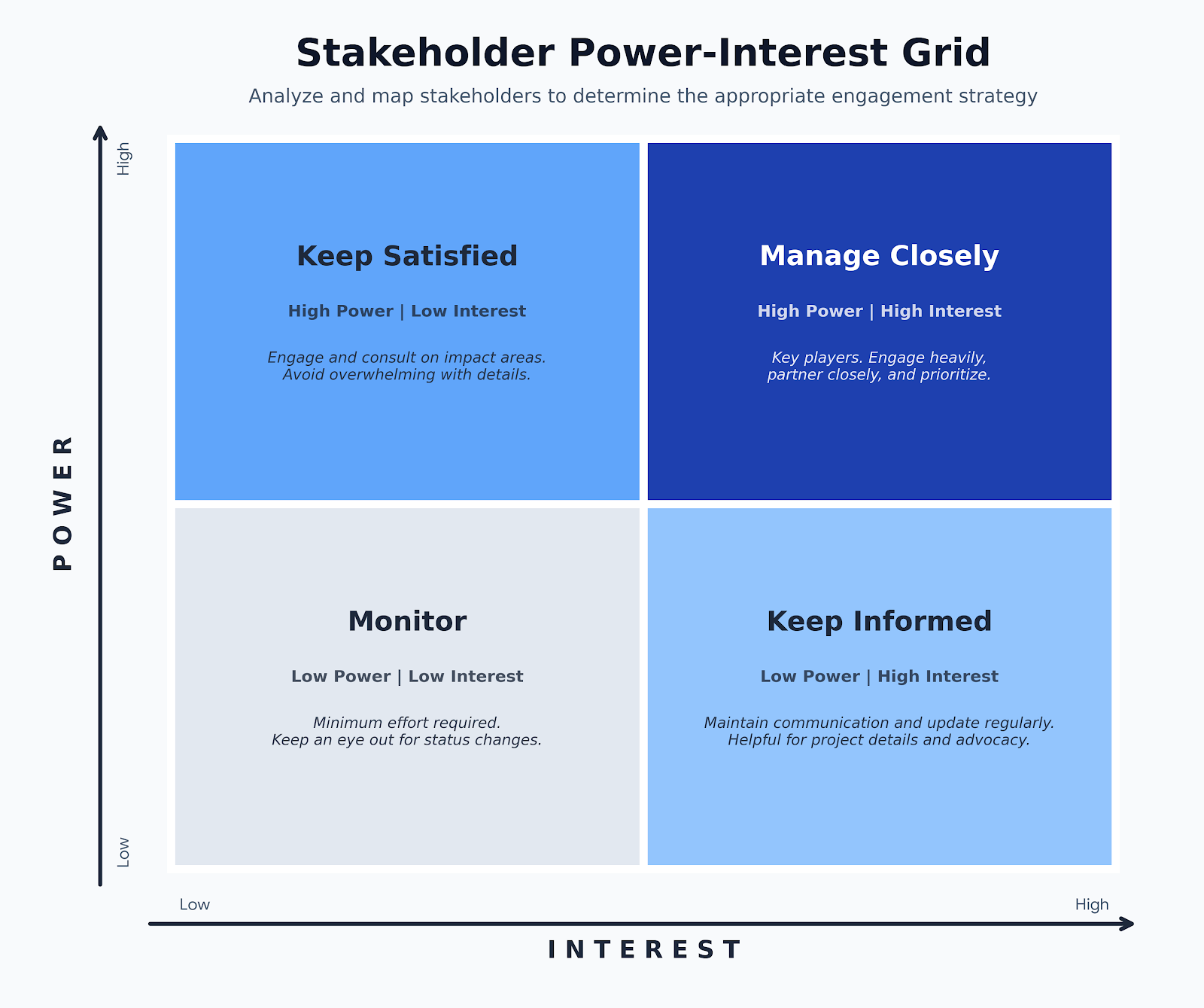
- Power-Interest Grid: The power of the stakeholders and their interests in the project are rated (either through numbers or through high/low). This can be used to map the stakeholders onto a power-interest grid which can help in selecting a communication approach:
- High interest and power must be fully engaged and managed closely (Engage frequently - Involve in decision-making - Provide detailed updates)
- High power and low interest must be kept satisfied (Provide high-level updates - Address concerns proactively - Avoid overwhelming with detail)
- Low power and high interest must be kept informed (Share regular updates - Provide opportunities for feedback - Maintain transparency)
- Low power and low interest must be monitored (Monitor periodically - Communicate only as needed)
- Commitment Assessment Matrix: Stakeholders may be analyzed using a scale of strongly opposed to strongly supporting, or Unaware, Resistant, Neutral, Supportive, Leading. This can inform the level and frequency of communication.
| Stakeholder | Unaware/Strongly Opposed | Resistant/Opposed | Neutral | Supportive | Leading / Strongly Support |
|---|---|---|---|---|---|
| S1 | Current | Desired | |||
| S2 | Current | Desired |
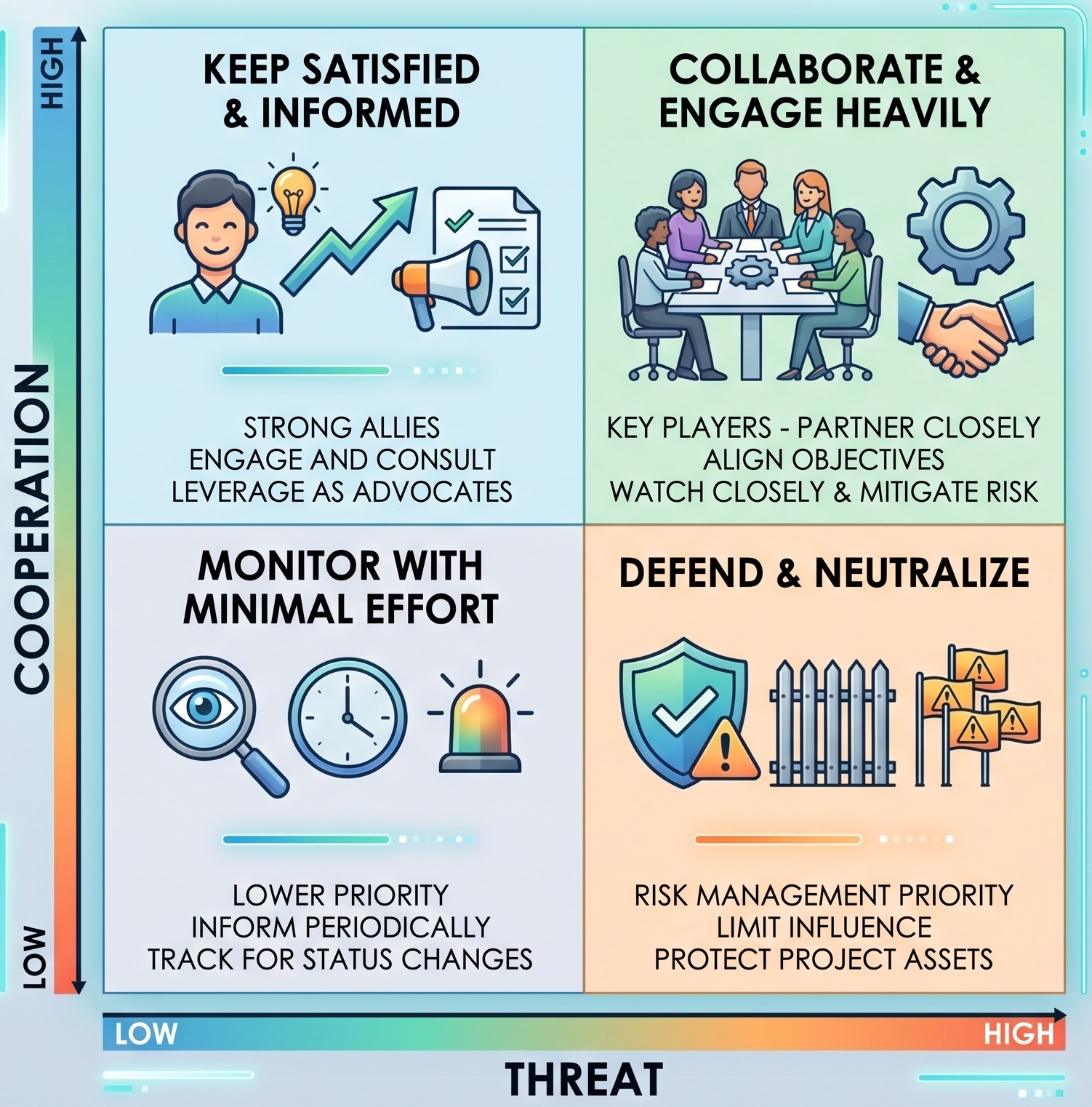
- Cooperation-Threat Matrix: This method categorizes stakeholders based on the threat they post to the project and their potential for cooperation:
- If the potential for threat and cooperation are both low, the stakeholder should be monitors.
- If the potential for threat is low and cooperation is high, then these are supportive stakeholders that should be involved in the project.
- If the potential for threat is high and cooperation is low, these are non-supportive stakeholders that should be defended against.
- If the potential for threat and cooperation is high, these stakeholders should be collaborated with.
These analysis will allow you to decide how to communicate with the stakeholders, and whether there are opportunities to partner with specific stakeholders, or to turn them into supportive stakeholders.
Example: Stakeholder Register (Excerpt)
| Stakeholder | Role | Interest | Power | Key Concerns | Engagement Strategy |
|---|---|---|---|---|---|
| Registrar | Sponsor | High | High | Student experience, accuracy | Manage closely |
| CIO | Executive stakeholder | Medium | High | Integration, security, capacity | Keep satisfied |
| Academic Deans | Functional stakeholders | Medium | Medium | Course capacity, policy enforcement | Consult regularly |
| Students’ Union | User representative | High | Low–M | Ease of use, fairness | Keep informed, interactive |
The Communication Plan
In most cases, the stakeholder analysis forms the basis for the project communication plan, which addresses the following questions:
- What information needs to be collected, what do they need/want to know and when/how frequently?
- Who will receive the information?
- What methods will be used to gather and store information?
- What are the limits, if any, on who has access to certain kinds of information?
- When will the information be communicated?
- How will it be communicated? (what method(s) do they prefer? Are there methods that are unsuitable)
- Who will be the contact point from the project for this communication?
Stakeholder analysis helps you identify different groups with different communication needs and also sources of information. Information communicated during a project include project status reports, deliverable issues, changes in scope, team status meetings, gating decisions, accepted request changes, action items, and milestone reports.
The form of communication should be analyzed as well:
- Formal verbal communication through presentations, project reviews, briefings, product demos, brainstorming or meetings
- Informal verbal communication through conversations or ad hoc discussions
- Formal written communication in the form of progress reports, project documents, business case
- Informal written communication in the form of brief notes, Email, instant messaging/texting, or social media Nowadays, an important factor is also providing access to information, be it through a website or a shared folder. Another factor is whether synchronous or asynchronous communication is a better choice.
Finally, the project needs to assign communication and engagement to someone on the team, and determine how regularly stakeholders should be engaged.
Example:
| What Information | Target Audience | When? | Method of Communication | Provider |
|---|---|---|---|---|
| Milestone report | Senior management and project manager | Bimonthly | E-mail and hardcopy | Project office |
| Project status reports & agendas | Staff and customer | Weekly | E-mail and hardcopy | Project manager |
| Team status reports | Project manager and project office | Weekly | Team recorder | |
| Issues report | Staff and customer | Weekly | Team recorder | |
| Escalation reports | Staff and customer | When needed | Meeting and hardcopy | Project manager |
| Outsourcing performance | Staff and customer | Bimonthly | Meeting | Project manager |
| Accepted change requests | Project office, senior mgmt., customer, staff, and project mgr. | Anytime | E-mail and hardcopy | Design department |
| Oversight gate decisions | Senior management and project manager | As required | E-mail meeting report | Oversight group or project office |
Sample Stakeholder Register
Project Information
- Project Name:
- Project Manager:
- Date Created:
- Last Updated:
1. Stakeholder Identification
| Stakeholder Name | Role / Position | Organization | Contact Information | Category (Internal/External) |
|---|---|---|---|---|
2. Stakeholder Assessment
| Stakeholder Name | Interest in Project | Influence / Power | Impact | Expectations | Attitude (Supportive/Neutral/Resistant) |
|---|---|---|---|---|---|
3. Stakeholder Classification
| Stakeholder Name | Power | Interest | Engagement Level (Current) | Engagement Level (Desired) | Strategy |
|---|---|---|---|---|---|
| High/Med/Low | High/Med/Low | Unaware / Resistant / Neutral / Supportive / Leading | Same scale | Engagement strategy summary |
4. Communication Requirements
| Stakeholder Name | Communication Needs | Frequency | Format / Channel | Owner |
|---|---|---|---|---|
5. Notes & Additional Considerations
- Risks related to stakeholder engagement:
- Opportunities from stakeholder involvement:
- Special considerations (cultural, regulatory, political):
6. Version History
| Version | Date | Changes | Author |
|---|---|---|---|
Summary
Practice
Bibliography
The following sources were also consulted in creating this resource: