ProjectManagementOER
Project Selection
Learning Objectives
By the end of this unit, you should be able to:
- Categorize projects based on their nature
- List the functions of a Project Management Office and Project Portfolio Management
- Understand how multi-criteria models can be used to select projects and align project management with organizational strategy
- Apply financial and nonfinancial criteria to assess the value of projects
- Explain why it is important for project managers to understand their organization’s strategy
Where do projects come from?
Before we delve into project management processes, it is beneficial to consider where projects come from. Projects arise owing to the strategic management process, the process of assessing “what we are” and deciding and implementing “what we intend to be and how we are going to get there.” This is a continuous, iterative process aimed at developing an integrated and coordinated long-term plan of action.
The strategic management process can be broken down into four steps:
- Review and define the organizational mission: Regularly, organizations review and define their mission and vision based on the internal environment (strengths and weaknesses) and external environment (opportunities and threats). Through this process, the organization understands “what we are now” and defines a mission: “what we want to become.” Mission statements identify the scope of the organization’s activities in terms of its product and service.
- Analyze and formulate strategies: Based on the mission, the organization formulates a strategy: what needs to be done to achieve its mission. Strategy formulation includes determining and evaluating alternative approaches that support the organization’s mission and selecting the best alternatives.
- Set objectives to achieve strategies: Objectives translate the organization strategy into specific, concrete, measurable term, and answers the question “how are we going to get there”. Through this process you create a portfolio of strategic choices.
- Implement strategies through projects: Implementation answers the question of how strategies will be realized, given available resources. Usually the strategic choices give rise to project options, and organizations need to select the best projects to focus on. These projects are run in tandem with standard operations to help achieve strategic goals.
So projects arise due to an organization’s strategy, and need to be aligned with its strategic goals. Project managers need to understand their organization’s mission and strategy so they can:
- Make appropriate decisions and adjust their activities to keep project aligned with strategic goals
- Be effective project advocates by being able to:
- demonstrate to senior management how their project contributes to the firm’s mission in order to garner their continued support
- explain to stakeholders why certain project objectives and priorities are critical to secure buy-in on contentious trade-off decisions
- explain why the project is important to motivate and empower the project team
Based on experience, successful projects:
- Create a unique competitive advantage and/or exceptional value for stakeholders
- Require a long period of project definition dedicated to defining a powerful vision, a clear need, and a successful execution approach
- Create a revolutionary project culture
- Need a highly qualified project leader who is unconditionally supported by top management
- Maximize the use of existing knowledge, often in cooperation with outside organizations
- Use integrated development teams with fast problem-solving capability and the ability to adapt to business, market, and technology changes
- Possess a project team with a strong sense of partnership and pride
The Project Management Office (PMO)
Due to the importance of projects in most organizations, some organizations create a centralized unit or a department that oversees and supports the execution of projects. These PMOs can take on various roles, including:
- Acting as a centre of excellence (best practices, training, historical data)
- Establishing project administrative procedures and shared tools
- Ensuring the firm’s project portfolio supports its overall goals and strategies
- Gradual assimilation of project management practices into the entire firm
- Facilitating (but not doing) projects
- Establishing a resource database and monitor inter-project dependencies
Seven out of 10 organizations have PMOs, although the name of the organizational unit can differ in different organizations. PMOs tend to help organizations improve their maturity on a scale like the one below:
- Ad hoc/Initial: Disorganized with no formal process, accidental successes and failures relying on specific individuals involved
- Managed/Repeatable/Structured: Some processes exist (perhaps at project or program level) but these are inconsistently used and results are unpredictable
- Defined/standardized: Standardized processes exist and are followed, leading to more predictable results. Integrated system for tracking and managing may exist but are not consistently used
- Quantitatively Managed: Processes are controlled and measured, with results more in line with plans
- Optimizing: Continuous improvement is taking place by tracking historical project data, success is normal, and performance keeps improving
According to Process Groups: A Practice Guide, there are several types of PMOs in organizations. Each type varies in the degree of control and influence it has on projects within the organization, such as:
- Supportive. Supportive PMOs provide a consultative role to projects by supplying templates, best practices, training, access to information, and lessons learned from other projects. This type of PMO serves as a project repository. The degree of control provided by the PMO is low.
- Controlling. Controlling PMOs provide support and require compliance through various means. The degree of control provided by the PMO is moderate. Compliance may involve:
- Adoption of project management frameworks or methodologies;
- Use of specific templates, forms, and tools; and
- Conformance to governance frameworks.
- Directive. Directive PMOs take control of the projects by directly managing the projects. Project managers are assigned by and report to the PMO. The degree of control provided by the PMO is high.
Summary: strategy → portfolio → programs/projects → PMO support
Project Portfolio Management
- Identify (projects, programs, non-projects)
- Categorize: Locate project at the right place for coordination
- Evaluate and prioritization
- Limit no. projects for focus and fit
- Identify co-dependant projects
- Eliminate high risk low return
- Eliminate projects that skip the formal selection process
- Balance the portfolio
- Keep from overloading the organization
- To balance the resources with needs
- To balance returns
- To balance short-, medium-, and long-term returns
- Authorize projects
Doing projects right is project management. Doing the right projects is project portfolio management
Why do we need portfolio management?
- Builds discipline into project selection process.
- Links project selection to strategic metrics.
- Prioritizes project proposals across a common set of criteria, rather than on politics or emotion.
- Allocates resources to projects that align with strategic direction.
- Balances risk across all projects.
- Justifies killing projects that do not support organization strategy.
- Improves communication and supports agreement on project goals.
Project Selection
With organizations having limited resources, and a political environment, not all possible projects are implemented. Organizations need to screen various projects and select those that best align with the organization’s strategy.
When a project idea is conceptualized, both its costs and benefits are uncertain. There is also uncertainty about timing (whether the project will be completed on time) and scope (what will be accomplished). Organizations need to control the level of uncertainty in their activities, and as such they rely on selecting the right mix of projects to get involved in.
Project selection aims to identify the projects that are more beneficial for the organization. Usually this involves answering questions like:
- Is the project potentially profitable?
- Is the project required?
- Does our firm have the skills to complete the project ?
- Does the project involve building strategic competencies?
- Does the organization have capacity to carry out the project ?
- Can project be economically successful? These need to be answered before the project starts and a PM is appointed!
An organization then creates a portfolio of projects. Balancing the number and types of projects is key to the success of the organization. Misaligned portfolios:
- Include too many projects
- Are inconsistent at determining the benefits of the projects
- Include projects that do not contribute to the strategy
- Include projects that compete with each other
- Spend more than the benefit they realize
- Do not consider project risks
- Do not track progress against a plan
- Have no client for their project
Proposing projects
Before projects can be selected, they need to be conceptualized and proposed. Depending on the organization, there are regular processes that lead to the conception of new projects, with someone assigned to lead the project conception process. This leader is usually asked to make their case by submitting a project proposal/overview, which typically:
- Describes the problem or opportunity
- Identifies a specific overall goal or purpose and how it aligns with organizational objectives
- Defines SMART objectives
- Analyzes the business benefits, costs, risks, and issues
- Clarifies success criteria (4-8) for all players: client, user, funder, researcher, developer, etc
- Lists assumptions made
- Lists main project requirements
- Identifies major risks
- Describes alternative solutions considered
- Describes the preferred solution
- Summarizes plan for implementation that includes a schedule (milestones) and financial analysis
This description should meet the SMART criteria:
- Specific
- What do we want to accomplish?
- Why are we undertaking this project?
- Who is involved or will be affected by the project?
- Where will this project be conducted?
- Which constraints (scope, time, money, risk, etc.) have been placed on our project?
- Measurable
- How will project progress and success be measured?
- What will be the measurable difference once our project is completed successfully?
- Assignable : Who will do the work?
- Can people who have the expertise in the organization be identified to complete this work?
- Can the expert be hired from outside of the organization?
- Realistic: Is it realistic that the organization can achieve this project, given its talents and resources?
- Time-bound: When will the project be completed and how long will it take?
If the description for a project does not meet all these criteria, then it is time to go back to the drawing board and make sure that what is being described is really a project, rather than a program or strategic goal
Project Classification
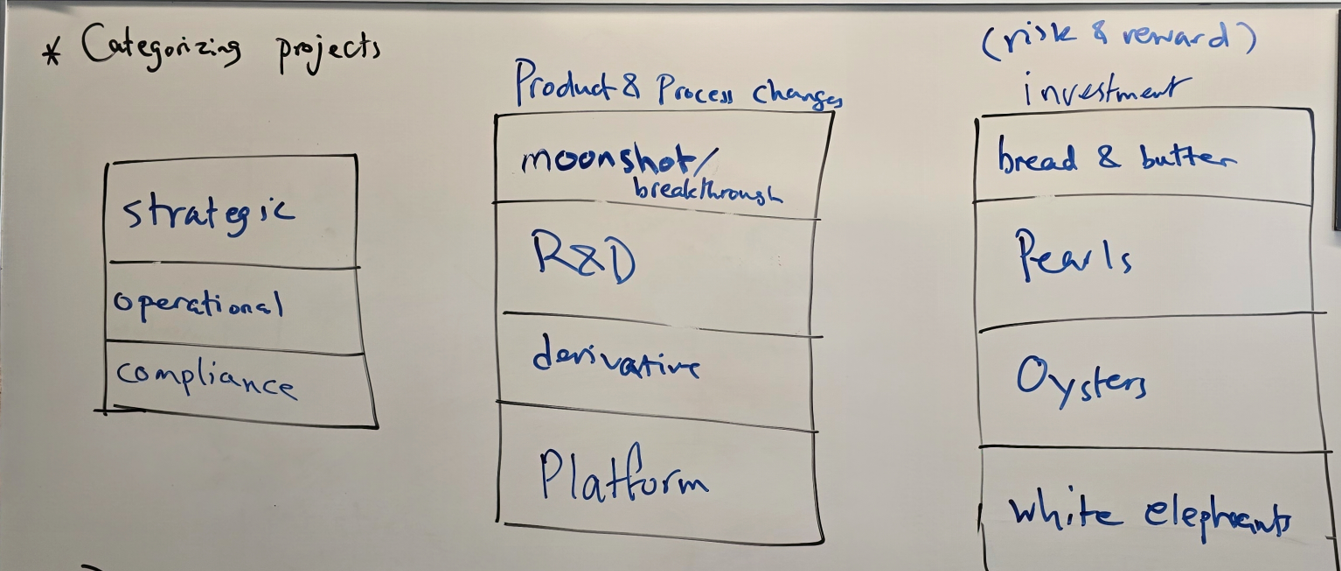
Most organizations develop a system to classify their projects, in order to better prioritize project choices. One method of classification categorizes projects into:
- Strategic Projects: These projects create something new and innovative which will allow an organization to gain strategic advantage over its competitors. For example a new product, new service, new retail location, new branch or division, or even a new factory
- Operational Projects: These projects focus on improving current operations. While they may not produce radical improvements, they will reduce costs, get work done more efficiently, or produce a higher quality product.
- Compliance Projects: These projects must be done in order to comply with an industry or governmental regulation or standard. Often there is no choice about whether to implement a project to meet a regulation; however, there may be several possible projects any of which would result in meeting compliance requirements.
Another approach is breaking down projects into four categories based on how extensive of a change in product and process is involved:
- Derivative projects are only incrementally different from existing offerings
- Platform projects involve major departures from existing offerings, enabling the next generation of products
- Breakthrough projects involve a newer technology, with potential for market disruption
- R&D projects are “blue sky” or visionary endeavors
Another approach is separating projects in terms of degrees of difficulty and commercial value:
- Bread-and-butter projects involve evolutionary improvements to current products and services with high probability of success and low reward
- Pearls represent revolutionary commercial advances using proven technology with high probability of success and high reward
- Oysters involve technological breakthroughs with tremendous commercial potential with low probability of success and high rewards
- White elephants showed promise at one time but are no longer viable with low probability of success and low reward
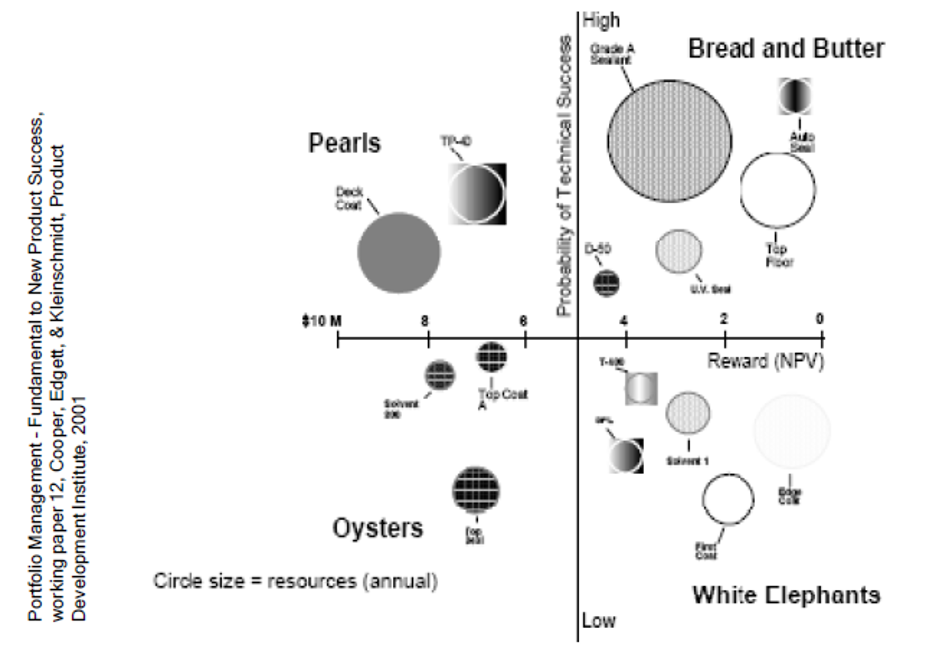
Organizations will consider the number of each type of these projects that they are involved in and aim to balance their focus based on the risk-level and interests, as part of portfolio management. This may be done as part of project selection, or as a screening step before the project selection process is followed.
How Are Projects Selected?
After a set of possible projects are identified, they need to be assessed based on a set of criteria. Organizations need to define their assessment criteria before any analysis is performed. The selection process acts like a sieve: the aim is to narrow down the number of options to a manageable set that meets the organization’s resource limitations.
Project selection usually involves the following steps:
- Create a selection model: This includes identifying the selection criteria aligned with the current organization strategies in consultation with senior management, and how these criteria are used in the selection process.
- Source and solicit project proposals: This may involve an internal call for proposals in your organization or an external Request for Proposal (RFP) for external contractors and vendors.
- Ranking proposal: In this step, each proposal is evaluated in terms of feasibility, potential contribution to strategic objectives, and fit within a portfolio of current projects. Scores are calculated based on criteria you defined in your selection model. As an option, the team may request additional information before finalizing their prioritization. Some organizations break step 3 into two steps: 3a. Getting an initial proposal with a high-level concept of the project. At this stage some proposals will be rejected based on one set of criteria and shortlist is created. 3b. A project manager and staff is assigned to short-listed proposals to develop a detailed implementation plan, which is the basis of project selection.
- Select projects: At this point projects are accepted or rejected based on their score in the model, and the mix in the current portfolio, or directives from senior management. While the goal is to rely objectively on the selection model, in most cases other factors need to be considered to maintain good diversity in the project portfolio. Based on availability of resources, some selected projects may also be put on hold until resources become available.
- Decide whether the project fits with the organization strategy: This is key to ensure that the end result makes sense. Portfolios regularly (usually annually) go through these steps to balance the available organizational resources (people and capital) among the different types of projects. There may be the need to stop some projects, or start new ones based on the priorities of the organization.
Organizations with good governance processes also ensure that the priority of each project is published, the selection process is transparent and free of power politics, the progress of current projects is monitored, and that the external environment is continuously monitored to inform decision on selection criteria and organizational focus.
The Criteria
Common financial criteria used in project selection include:
- Payback period: This criterion measures the time the project will take to recover the original project investment. The shorter the payback period, the more desirable the project. This is the simplest and most widely used criterion, and emphasizes cash flows, a key factor in any business. In a way, it is a surrogate measure of risk.
Payback period (yrs)= (Estimated project cost)/(Annual Savings or Annual Cash Flow)
In many cases, not only the payback period, but the cash flow during the period is visually depicted, with time on horizontal axis and money on the vertical axis.
Some limitations of the payback method include:
- Ignores the time value of money
- Assumes cash inflows for the investment period (and not beyond)
- Does not consider profitability
- More difficult to use when cash flows change over time
- Less meaningful for longer periods of time (due to time value of money)
- Compares cumulative costs to cumulative benefits
- Net present value (NPV) or discounted cash flow: Uses management’s minimum desired rate of return (discount rate) to compute the present value of all net cash inflows. This approach is more realistic because it considers the time value of money, cash flows, and profitability. Higher positive NPVs are more desirable. $NPV = I_0 + \sum_{t=1}^{n} \frac{F_t}{(1+k)^t}$ With $I_0$ being the initial investment (a negative number considering this is an outflow of money), $F_t$ is the net cash flow for period t, $k$ is the required rate of return, and $n$ is the number of years. There will usually be one overall discount rate for the company, determined based on the cost of capital and the level of acceptable risk for the organization. In the early years of a project when outflows usually exceed inflows, the NPV for those years will be negative. If the project becomes profitable, inflows become larger than outflows and the NPV for those later years will be positive.
- Return on Investment (ROI): This is simply calculated by comparing total benefits to total costs. Organization may have a minimum acceptable rate of return for projects. ROI = (Total benefits – Total costs) / Total costs
- Internal Rate of Return (IRR): This factor is calculated based on a NPV = 0. It represents the annualized rate of return a project or investment.
- Profit: How much profit is gained from the project.
- Opportunity cost
- Value of future opportunities
- Real options
- Window-of-opportunity analysis:The cost, time, and performance specs are defined that must be met before any R&D work begins
In addition to financial criteria, none financial criteria may be selected based on the nature of the organization’s activities. While organizations try to balance financial and none financial criteria, at times organizations my do projects that are losing money but have a strategic importance to the firm. Such criteria include:
- Sacred Cow: A project may be suggested by top management or be their pet projects. A decision may be made to maintain these until completion or boss terminates it.
- Operating necessity: A project that is required in order to protect lives or property or to keep the company in operation.
- Competitive necessity: A project that is required in order to maintain the company’s position in the marketplace, capture larger market share or make it difficult for competitors to enter the market, reduce dependency on unreliable suppliers or allow to bid on a lucrative, follow-on contract.
- New business necessity: A project may broaden a product line or line of business, position the organization to capitalize on future opportunities, reduce technological or commercial risk of new products, enable a product which by its introduction will increase sales in more profitable products, developing core technology that will be used in next-generation products or get the organization’s “foot in the door”.
- Product Line Extension: Project evaluated on fit with existing product line, fills a gap, strengthens a weak link, or extends a line.
- Sustainability: A project may offer long-term profitability rather than short-run payoff
- Prevent government intervention and regulation
- Strategic alignment
- Risk level
The Selection Model
While project selection could be done using a single criterion, in most cases multiple criteria are used. Many organizations have to select from a list of projects that are complex, difficult to assess, and often noncomparable.
Most organizations need to start by bringing the number of projects under consideration down. This can be achieved using a threshold on a few single criteria, or using checklists and Q-sort method.
Some organizations use checklist models. These take the form of a list of questions which are used to assess potential projects and to determine their acceptance or rejection. These allow greater flexibility in selecting among many different types of projects and are easily used across different divisions and locations. However, they fail to answer the relative importance or value of a potential project to the organization and does not allow for comparison with other potential projects. They can be helpful as screening tools to narrow down the number of projects being considered.
Example:
| Topic | Question |
|---|---|
| Strategy/alignment | What specific organization strategy does this project align with? |
| Driver | What business problem does the project solve? |
| Sponsorship | Who is the project sponsor? |
| Risk | What is the impact of not doing this project? |
| Risk | How risky is the project? |
| Benefits, value, ROI | What is the value of the project to this organization? |
| Benefits, value, ROI | When will the project show results? |
| Objectives | What are the project objectives? |
| Organization culture | Is our organizational culture right for this type of project? |
| Resources | Will internal resources be available for this project? |
| Schedule | How long will this project take? |
| Finance/portfolio | What is the estimated cost of the project? |
| Portfolio | How does this project interact with current projects? |
Another method used is the Q-Sort method:
- Develop a set of statements or project descriptions for evaluation.
- Define the condition: For example, rank these projects from most to least important, or group these projects into high, medium and low priority.
- Administer the Q-sort to respondents: Each respondent is given a set of cards with the descriptions printed on them and is asked to sort them based on the condition.
- Calculate the correlation coefficients between each respondent’s sort and a “standard” sort
- Analyze the correlations to identify clusters of similar attitudes or perspectives, and facilitate a discussion to better understand opinions with the potential to reach a consensus
When a small enough number of projects are being considered, a weighted decision matrix is considered the best approach. This method can consider multiple financial and non-financial quantitative and qualitative criteria to create a composite score for the possible projects. Each criterion is weighted relative to its importance, allowing important factors to stand out.
Another approach is a scrub down, where a group of experts attempts to “murder” a project proposal by pointing out its flaws and weaknesses.
The organization may also decide to perform discovery-driven planning. In this approach, the project is not fully funded, but instead funds are assigned to determine if the initial assumptions were accurate. This will allow the organization to learn more about the project, rather than necessarily implement it.
Irrespective of which combination of these methods are used, in the end one has to assess whether the final selection makes strategic sense or not.
Why Projects Fail?
- 90% of projects fail due to poor project execution → Problem 1: The Implementation Gap
- < 50% strategic projects are successful
- 25%+ lack sponsor and detailed implementation process –> Problem 2: Organization Politics
- 40% had adequately skilled personnel → Problem 3: Resource Conflicts and Multitasking
- Only 20% prioritized hiring skilled staff
Summary
Practice
Bibliography
The following sources were also consulted in creating this resource: