ProjectManagementOER
Project Life Cycle and Processes
Learning Objectives
By the end of this unit, you should be able to:
- Identify the different stages of the project life cycle
- Compare Agile PM, traditional PM and hybrid PM
Development Life Cycle
Most projects aim at developing a product or a system. Understanding the life-cycle of the product and the approach to developing it is the first step to understanding the processes used by project management.
From a project management perspective, the product or system life cycle has four phases according to Process Groups: A Practice Guide:
- Starting the project
- Organizing and preparing
- Carrying out the work
- Ending the project
At the end of each stage, most organization include a phase gate: this is a decision point, where the organization has to decide whether to move to the next phase, stay in the current phase or end the project. This decision is usually made based on the deliverables developed by the project.
From a systems engineering perspective (the Guide to the Systems Engineering Body of Knowledge), a more complex system life cycle may have these stages:
- Definition phase (concept definition + system definition): This is the phase where the system is designed, defining its components, what they will do, what they should look like and how they interact with each other.
- Realization phase: This is where the system components are built, integrated together and texted.
- Production: This is when the system is mass produced or the final product is created.
- Utilization and support: This is when the system is used, and support is provided as needed.
- Retirement: At the end of life, the system is retired and disposed of or replaced.
These life cycles are common in the space, defense and maritime industries, among others, with many standard life cycle phases and phase gates defined specific to the industry (as an example, see the V-process in NASA Systems Engineering Handbook v1 or NASA’s Space Flight Project Life Cycle). A project manager needs to understand what life cycle is common in their industry and align project activities with that life cycle.
From a market perspective, a product goes through the following life cycle:
- Introduction
- Growth
- Maturity
- Decline/Retirement
A system or product which goes through the market or system phases above, as a whole is usually considered or program or portfolio. Each phase in itself then may be defined as a project or a program, depending on the complexity of the activities and scope of work.
Project Management Processes
The project management processes are the activities that happen in every project phase. In a way, each phase of the life cycle we defined above, requires the application of these processes.The 5 project management process groups are:
- Initiation: Defining the goals of the project and understanding its environment
- Planning: Planning the cost and resources of the project, and creating a timeline for delivery
- Executing: This is where much of the work of the project happens
- Monitoring and Controlling: To assess whether the project is on track based on the plan and make adjustments as needed
- Closing: Ensuring all deliverables of the project are complete and delivered, and any lessons learned are documented
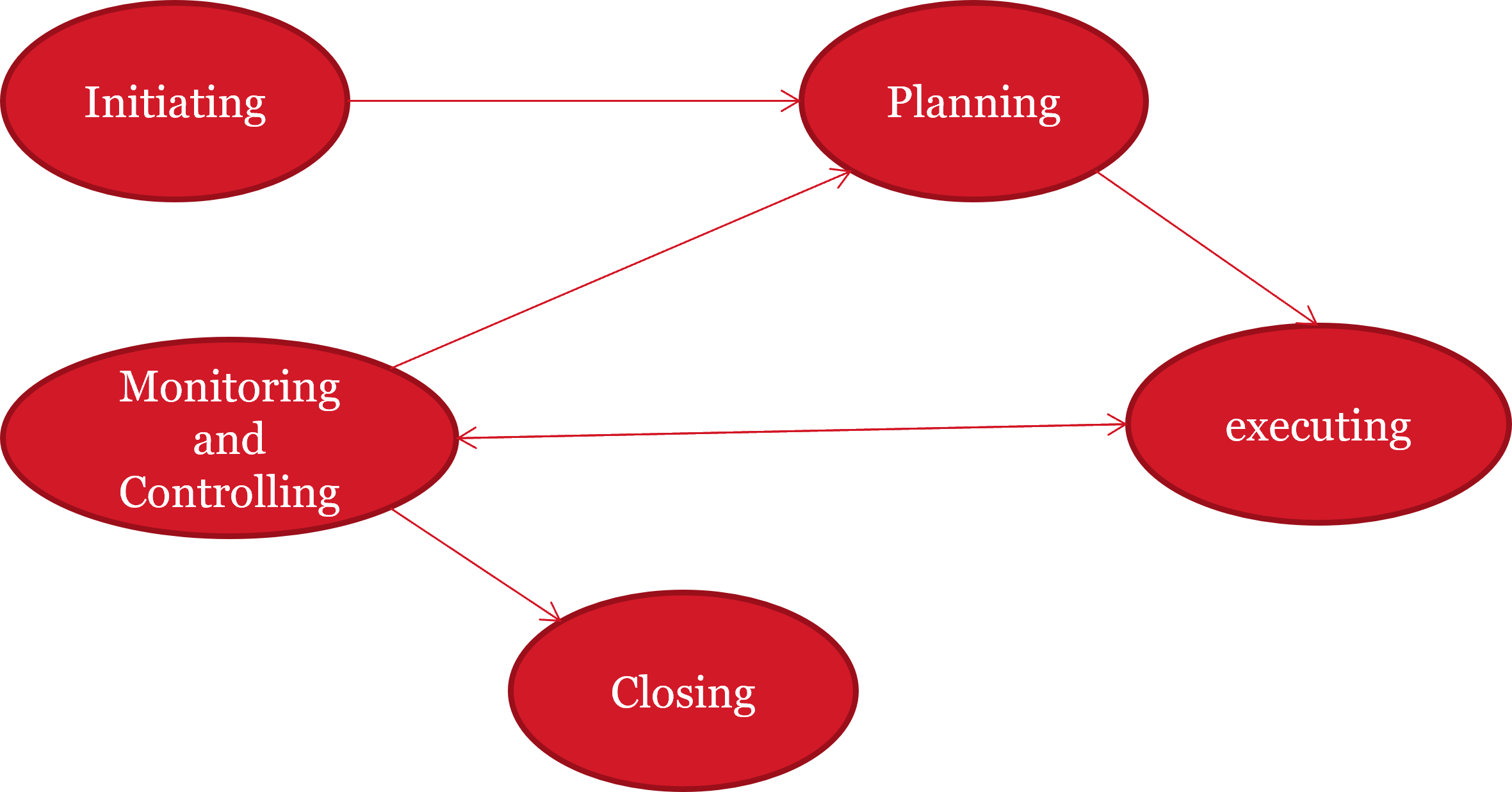
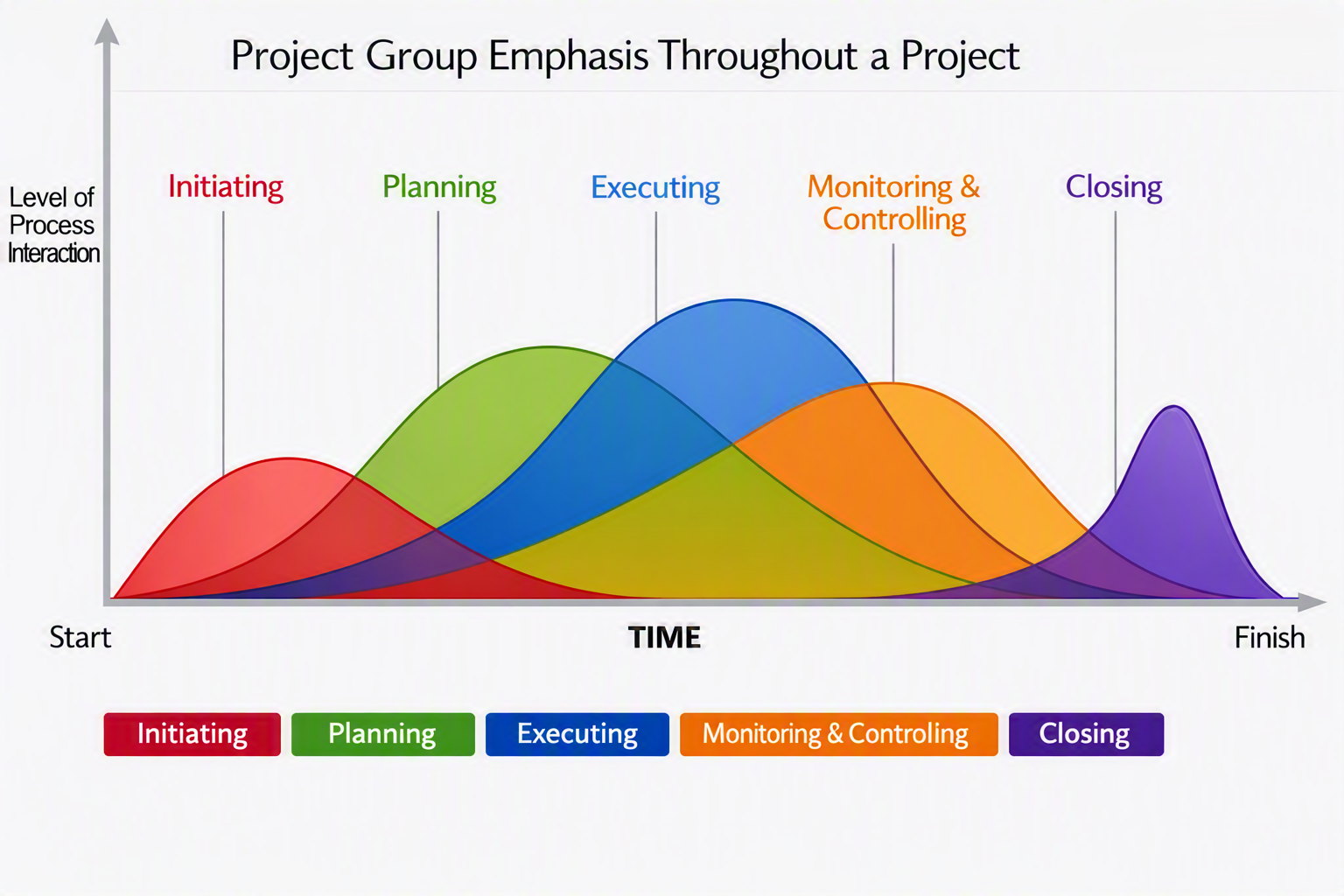
While it is possible to complete 4 of these phases sequentially, in practice this goes against the goal of monitoring and controlling. As such, planning, executing and monitoring and controlling happen in parallel, albeit with different levels of emphasis throughout the life of the project.You can see this in the image below (adapted from the PMBOK guide, 5th ed.).
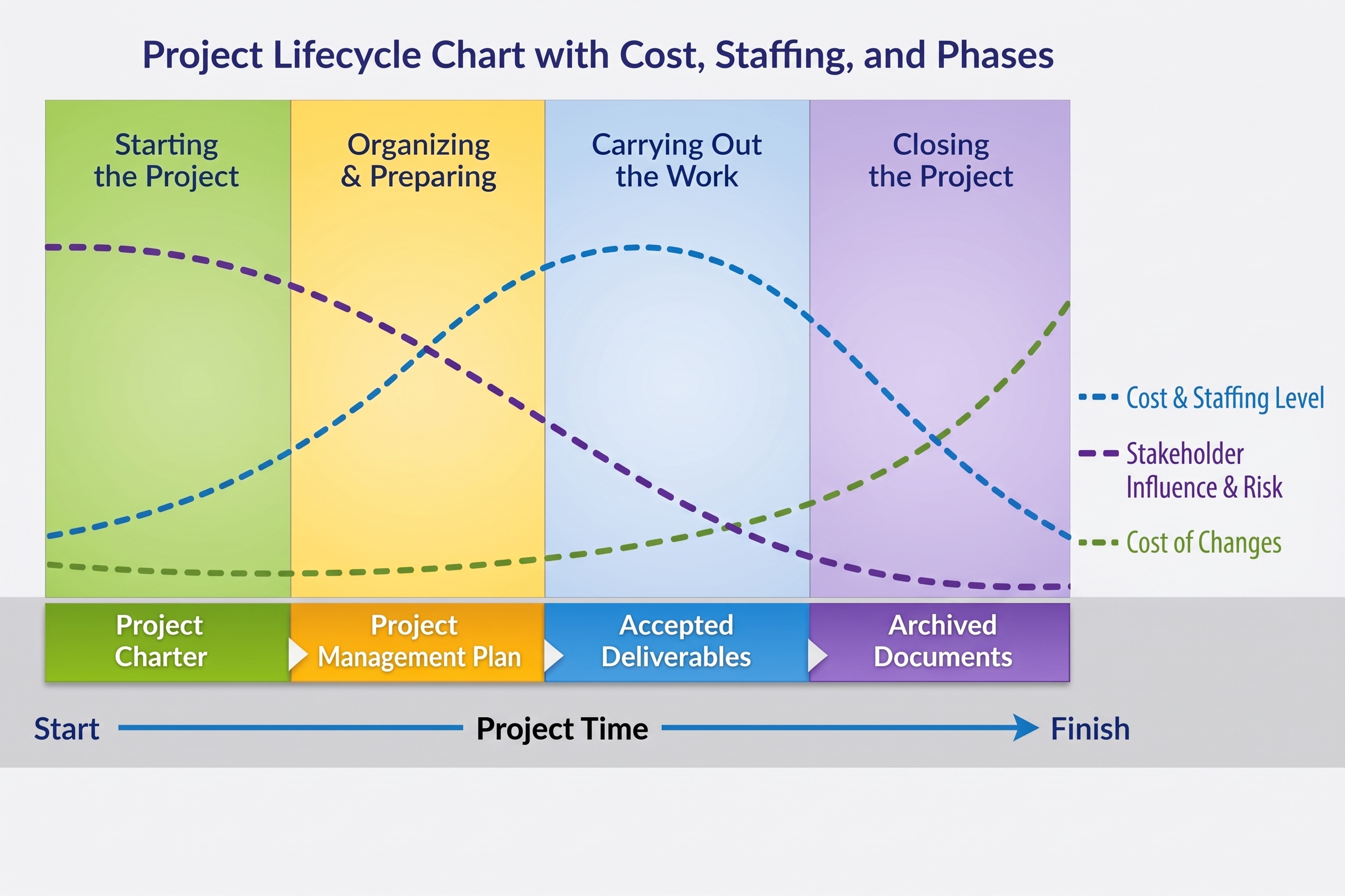
Owing to how the processes take place, a few things happen in the life of the project as shown in the image below (adapted from the PMBOK guide, 5th ed.):
- Resource use (and cost) of the project peaks somewhere in the middle and then drops as the project closes.
- Earlier in the project (when initiating) stakeholders can impact decisions more. As the project progresses, it is harder to make changes (they become costly: you might have already built the wall so a change requires breaking it down and doing it again - rework) and as such, the influence of stakeholders falls.
The image below also highlights some of the key documents we will learn about in this course:
- The project Charter, which is the output of the initiation process group and helps kick off the project
- The project Management Plan, which is the output of the planning process group and help the project stay organized
- Accepted deliverables, which are the outputs of executing the planned activities
- Archived documents, which are the outputs of the closing process group
According to Process Groups: A Practice Guide, these processes can be further broken down as follows:
- Initiating Process Group
- Develop Project Charter
- Identify Stakeholders
- Planning Process Group
- Develop Project Management Plan
- Plan Scope Management
- Collect Requirements
- Define Scope
- Create WBS
- Plan Schedule Management
- Define Activities
- Sequence Activities
- Estimate Activity Durations
- Develop Schedule
- Plan Cost Management
- Estimate Costs
- Determine Budget
- Executing Process Group
- Direct and Manage Project Work
- Manage Project Knowledge
- Manage Quality
- Acquire Resources
- Develop Team
- Manage Team
- Manage Communications
- Implement Risk Responses
- Conduct Procurements
- Manage Stakeholder Engagement
- Monitoring and Controlling Process Group
- Monitor and Control Project Work
- Perform Integrated Change Control
- Validate Scope
- Control Scope
- Control Schedule
- Control Costs
- Control Quality
- Control Resources
- Monitor Communications
- Monitor Risks
- Control Procurements
- Monitor Stakeholder Engagement
- Closing Process Group
- Close Project or Phase
We will review some of these topics throughout the course.
Phases vs Process Groups
It is important to distinguish between project phases and the process groups. Let’s say you have hired a contractor to construct the house for you. They may approach this a few different ways:
- If you are just building a single house, they may decide to approach this as a single project. They may decide that the project has 3 phases: design, build and hand-off. In these 3 phases, they may then apply the process groups as shown below.
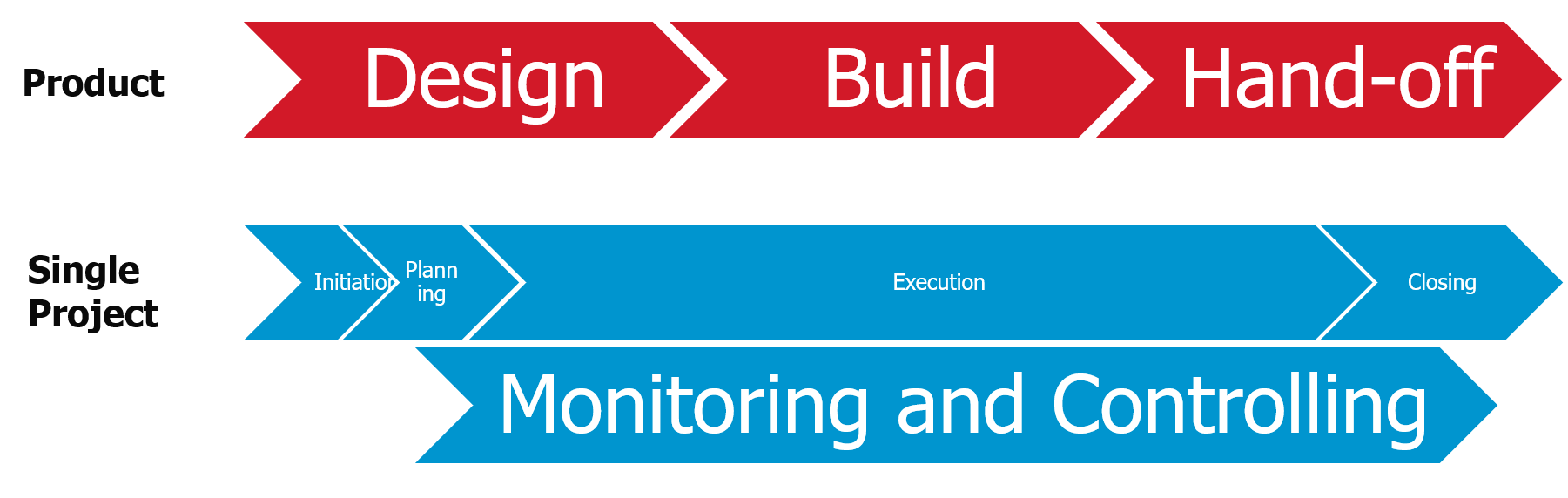
- Now let’s assume your construction project is more complex; perhaps you are building an apartment complex. While you still have the same 3 phases, you may decide to consider each phase as a project, as each of them is more complex compared to our first example. Now you have to apply the project management process groups within each phase, as shown below. Since you are essentially completing 3 projects, you may consider the construction of the apartment complex as a program with 3 projects. Programs go through similar process groups, albeit applied differently.
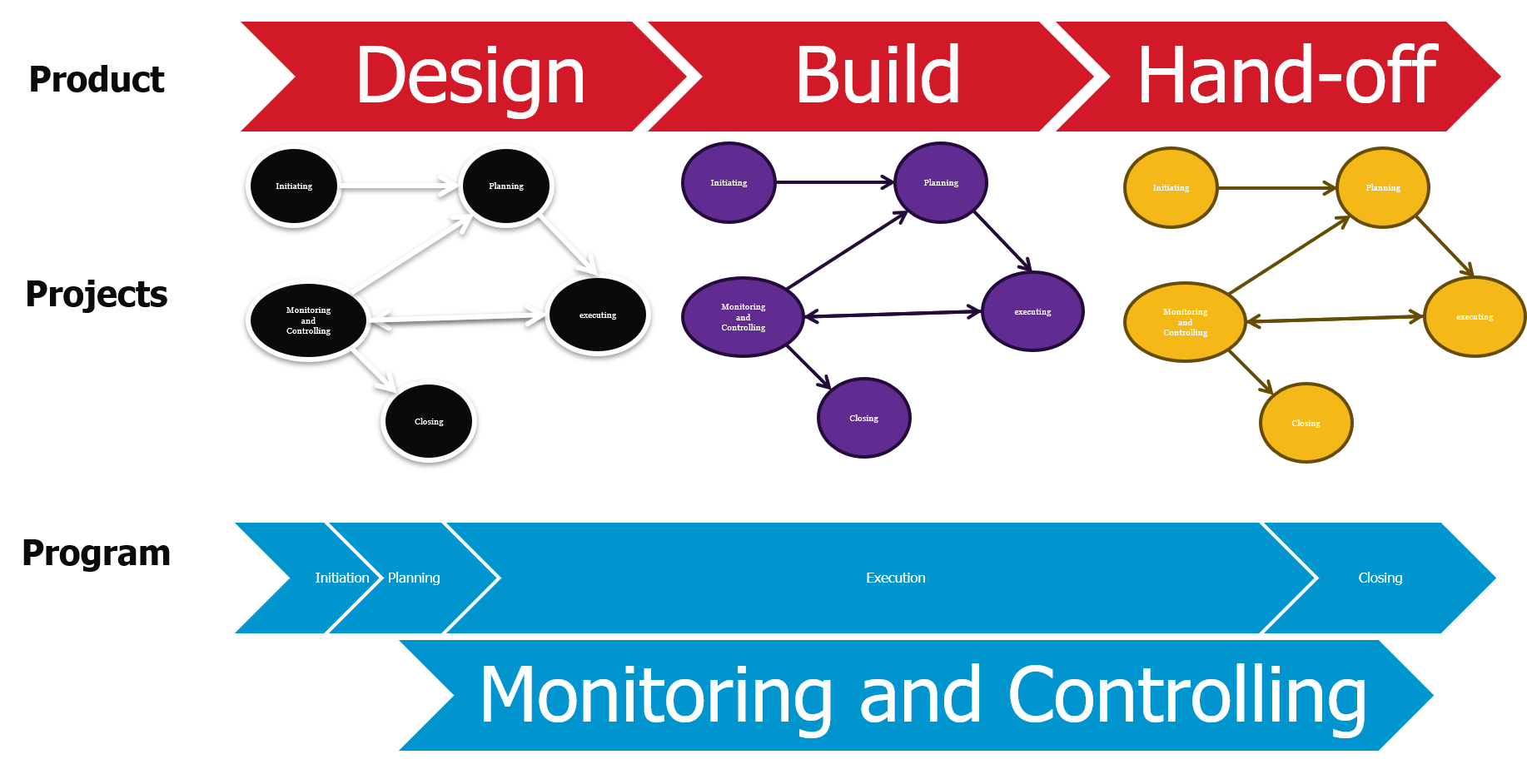
For another example, consider developing an Online Course Registration System. The development lifecycle might have phases such as concept development, design, build, test, and deployment. Across these phases, the project manager applies the five PMI process groups:
- Initiating: secure authorization to proceed with concept and feasibility work.
- Planning: refine scope, schedule, budget, and risks at the start of each phase.
- Executing: implement the work defined in the plan (e.g., build and test the system).
- Monitoring and Controlling: track performance, manage changes, and address issues throughout the entire lifecycle.
- Closing: formally close phases (e.g., end of pilot) and the overall project. Phases and process groups overlap: planning may continue into build, and monitoring and controlling cuts across all phases.
Development Approaches
In addition to the project management processes, understanding your organization’s approach to developing the outcome is key. Generally speaking, we can define two extremes for project and product development:
- Traditional or predictive development: In this approach, work is planned at the beginning of the project, usually in the form of a sequence of work packages, and the implementation happens afterwards.You essentially define a target, take aim and fire, with the hope that the target does not move. The most famous example of this is the waterfall approach. This approach works for simple, unchanging or well-defined projects (for example developing a computer server for a client or building a standard house).
- Agile/Adaptive: Adaptive development relies on feedback from the development work to improve implementation; in other words, the project has a continuous improvement loop within it. In these approaches, a vision is defined for the outcome, you start in the broad direction of the vision, and adapt to the conditions, learning from them with the hope that you home in on the target in the end. There are various agile methods in use nowadays, relying on continuous development cycles, small high-functioning collaborative teams, and closely integrating customer feedback into development. Adaptive approaches are helpful for cases where there is a lot of uncertainty in the scope of work that needs to be completed (be it due to complexity or unknown elements such as new technology, or unknown user preferences). For example if you are designing a new platform for a bank, you may want to develop parts, test them with users to make sure they work before developing the rest or finalizing the web platform.
Example: Let’s say you are developing a new student registration system. Integrating this system with the legacy student information system is better managed using a more predictive approach, because requirements and constraints must be well understood and documented before implementation. Development of a new analytics dashboard may be done using an agile approach: short sprints, backlog prioritization, and frequent demos to customers to make sure you are building the right tool.
In reality, these two extremes are on a continuum of project development approaches, with most projects taking a hybrid approach, not fully predictive and not fully adaptive. A hybrid approach combines both: predictive planning and governance for well defined scope, and agile delivery for less well-defined or user‑facing features.
To add adaptivity, one can use a few concepts:
- Iterative development: The team develops the solution, presents it to the users, gets feedback and then uses the feedback to improve the solution in the next iteration. For example, you develop a full website, show it to the users and then use their feedback to make it better.
- Incremental development: Instead of developing a complete solution, you develop an initial simplest solution and progressively add features and functions based on feedback from the customer. For example, you develop a website that only has a landing page, then meet with the client and show it to them. The next round, you add some features (logging in, etc) and at the same time include any feedback you got from showing the first website to the user.
- Progressive Elaboration: Increasingly adding more detail to a project plan as more information becomes available. A good example of this is rolling wave planning, where the project team plans the closest phase in more detail, and later phases in less detail.
Agile essentially integrated both incremental and iterative development into a single approach. A good comparison between Agile and Traditional approaches (the two extremes) can be found in Project Management in Practice:
| Dimension | Agile Project Management | Traditional Waterfall Approach |
|---|---|---|
| Planning | Short-term plans that are adjusted as project progresses | Attempts to stick to long-term plans made in advance |
| Client involvement | Throughout the project | Beginning and end of project |
| Project execution | Broken down into incremental stages called iterations or sprints | Work completed based on comprehensive and highly structured plan |
| Communication | Open, frequent (daily) communication among stakeholders encouraged | Mainly for project control |
| Feedback on results | At the end of each iteration | At the end of the project |
| Work structure | Integrated cross-functional team | Team members tend to work independently and rely on project manager to coordinate tasks |
| Project leadership | Self-managed teams with project manager as facilitator of process | Project manager allocates work to team members and controls process |
| Team member feedback | Open communication encouraged by all team members | Feedback typically provided confidentially by project manager |
| Process ownership | Team | Project manager |
| Experimentation | Encouraged to identify ways to best meet customer requirements | Discouraged to meet project deadline and stay on budget |
| Scope | Flexible | Rigid |
| Change | Welcome and expected part of project | Resisted and often requires formal change order request |
| Priorities | Customer is top priority followed by team and then scope | Schedule is top priority followed by scope and then team |
| Measures of success | Agile Triangle: value (extrinsic quality), quality (intrinsic quality), and constraints (cost, schedule, and scope) | Iron Triangle: cost, schedule, and scope |
Benefits of more adaptive approaches include:
- Opportunity for Change
- Increase in quality
- Progress transparency
- Engagement with stakeholders
- Early delivery of functional product
- Predictable schedule and cost
- User-focused Process
- Ideal for innovative projects (past experience does not exist)
- Promotes team collaboration
- Fosters continuous improvement
Some drawbacks of these approaches include:
- Extensive time commitment from team members and customers
- Quantifying the real scope is challenging
- Endless or boundless work
- Potential gaps in documentation
- Resource allocation and scaling can be a challenge
- Not suitable for very predictable projects (will lead to extra costs)
- Changing delivery dates
- Requires highly skilled team members
Summary
Practice
Bibliography
The following sources were also consulted in creating this resource:
- PMBOK Guide 7th ed.
- Process Groups: A Practice Guide
- Essentials of Project Management
- Project Management: A Managerial Approach
- Project Management: A Socio-Technical Approach
- # Agile Project Management Methodology vs. Waterfall Project Management Methodology: Understanding the Differences
- What is agile project management?
- Agile Model Advantages and Disadvantages
- Agile pros and cons: should CEOs embrace agility?