ProjectManagementOER
Risk
Learning Objectives
By the end of this unit, you should be able to:
- Describe the risk management process
- Understand how to identify project risks
- Distinguish between risks and issues
- Assess the significance of different project risks
- Describe the five responses to managing risks
- Understand the role buffers and contingency plans play in the risk management process
- Recognize the need for risk management being an ongoing activity
- Describe the change control process
- Create a risk register and mitigation plan for a project
What is Risk?
Risk is an uncertain event or condition that, if it occurs, can have a positive or negative impact on a project objective.
- Negative risk: threat
- Positive risk: opportunity
No amount of planning can overcome or control all risks. What we can do, is plan for them. The most important risk management tool is your own ability to learn about the project. The more you know about a project, the better you will foresee the many ways the project could go wrong and what the consequences will be if they do, and the better you will be at responding to these unexpected challenges.
Risk can also be mathematically defined, one definition being: Risk = Probability x Impact If we can somehow assess the probability of a risk, and its impact (in $s), we can assign a value to each risk, which will allow us to calculate things like contingency funds. Let’s say you have bought a part for $1,000 and you know there is a 1 in 100 chance that that part fails based on past experience. Then the risk here is equivalent to $1,000 x 1 / 100 = $10. This quantitative approach allows us to quantitatively assess the commulative risk of the project, which is the sum of all the small risks you identify.
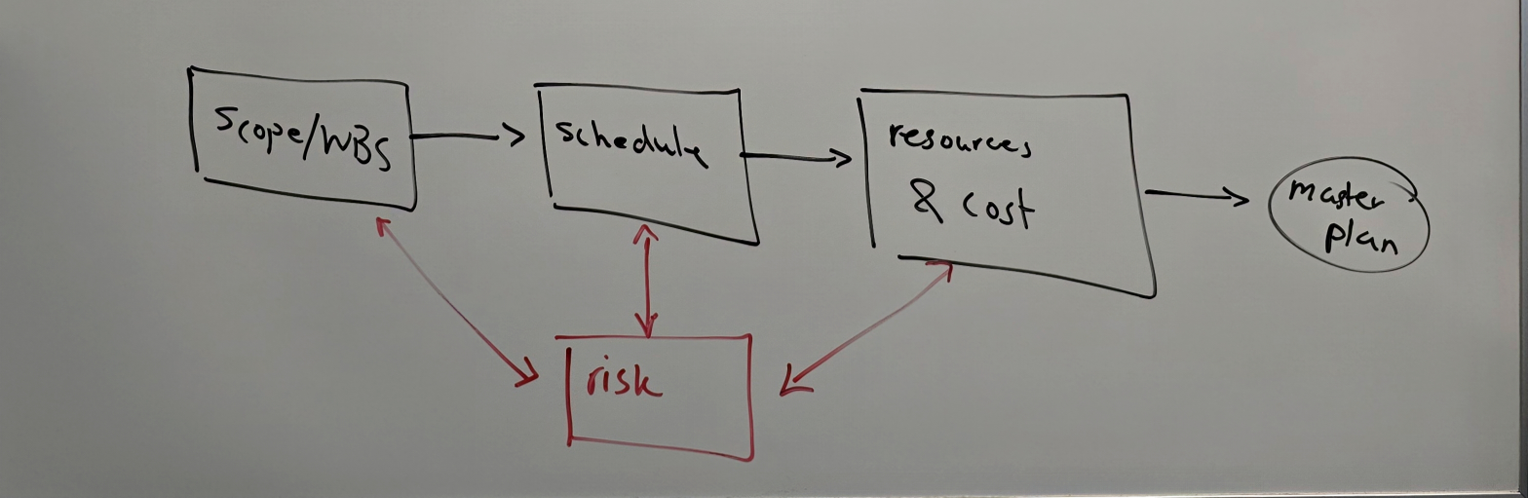
Acceptability of Risk
There is always risk! Whether the risk is acceptable or not depends on stakeholders or project sponsor and their
- Risk Appetite: Degree of uncertainty an entity is willing to take on in anticipation of a reward
- Risk tolerance: The degree, amount, or volume of risk that an organization or individual can withstand
- Risk threshold: Point above which a stakeholder or organization is no longer willing to accept the level of uncertainty or impact
Other factors that affect whether one would accept a risk or not include:
- Is it voluntary or involuntary?: You can choose to ride a motorcycle without a helmet, but it would be unacceptable for a company or the government to require you to ride without a helmet.
- Does it impact one person or multiple?: In the US 33,808 traffic fatalities were recorded in 2009, the equivalent of a large plane crashing every two days. However, air travel would be perceived as unacceptably risky if a large plane crashed every other day.
- Is it part of a common activity?: People rarely worry about the risks involved in walking down a sidewalk because this is a common part of everyday life in society. They worry more about the risks associated with skydiving because this is an uncommon activity.
- Are stakeholders well informed?: Society considers it acceptable for a person to take a medication that has risks associated with it, as long as the person is well informed and chooses to take the medication voluntarily (i.e., informed consent)
- What is the reward and is it important?: Engineers cannot design a car that does the job of getting people from A to B without also having designed a machine that can injure or kill people. Society tolerates this risk because of the valuable function cars serve.
- How mature is the technology or our understanding of the problem?: In the 1950s and 1960s, seat-belts in cars were optional, and children were allowed to freely move around in cars. Today, bothseat-belts and airbags are mandatory in passenger cars in most places, and special child car seats are required. Keep in mind that doing nothing can also involve risk. Throughout the project life cycle, the chances of risks occurring goes down, while the cost to fix the risk event goes up.
Components of Risks
Each risk has a series of components:
- Event: This is a description of the risk itself (usually in the form of a cause and an effect).
- Probability/likelihood
- Impact
- Severity: Usually defined as probability times the impact
- Trigger: Indication that a risk has occurred or is about to occur. Triggers may be discovered in the risk identification process and watched in the risk monitoring and control process.
- Detectability: Can you detect the risk event beforehand. For example, on airplanes, you would look for crack in specific areas as indicators for increased likelihood of structural failure.
- Urgency
- Tolerance
Sources of Risk
Risks can be associated with the following elements:
- Triple triangle
- Cost
- Time/Schedule
- Scope
- Technology
- Technical capability
- Capacity
- Weather
- Financial situation
- Political
- Legal and regulatory
- Client
- Human resources
- Stakeholders
- Contractual
- Environmental
Some of the common risk categories used include:
- Portfolio component risk
- Organizational risk
- Performance risk
- Resource risk
- Financial / budget risk
- Market risk
- Regulatory risk
- Data / information quality risk
- Stakeholder risk
- Procurement risk
- Supply chain risk
- Image and public relations risk
- Environmental risk
- Natural factors risk
Risk Process Groups
PMI defines a particular set of processes when it comes to risk management. These are outlined in this section.
Planning Process Group
Plan Risk Management Process
This process focuses on setting up the approach and definitions for risk management.
- Inputs
- Project charter
- Project management plan (all components)
- Project documents (stakeholder register)
- Enterprise environmental factors
- Organizational process assets
- Tools & Techniques
- Expert judgment
- Data analysis (stakeholder analysis)
- Meetings
- Outputs
- Risk management plan
Here you should start with existing information.
- Does your organization have an existing risk management approach, templates, roles, authority levels?
- What is the risk tolerance of stakeholders?
- What are the requirements and scope
The Risk Management Plan itself should outline:
- Methodology, roles and responsibilities
- Budget and schedule for risk management
- Categories for risk identification, such as risk breakdown structure
- Probability & Impact Matrix
- Reporting formats, tracking of risks
Identify Risks
- Inputs
- Project management plan (requirements management plan, schedule management plan, cost management plan, quality management plan, resource management plan, risk management plan, scope baseline, schedule baseline, cost baseline)
- Project documents (assumption log, cost estimates, duration estimates, issue log, lessons learned register, requirements documentation, resource requirements, stakeholder register)
- Agreements
- Procurement documentation
- Enterprise environmental factors
- Organizational process assets
- Tools & Techniques
- Expert judgment
- Data gathering (brainstorming, checklists, interviews)
- Data analysis (root cause analysis, assumption and constraint analysis, SWOT analysis, document analysis)
- Interpersonal and team skills (facilitation)
- Prompt lists
- Meetings
- Outputs
- Risk register
- Risk report
- Project documents updates (assumption log, issue log, lessons learned register)
Perform Qualitative Risk Analysis
- Inputs
- Project management plan (risk management plan)
- Project documents (assumption log, risk register, stakeholder register)
- Enterprise environmental factors
- Organizational process assets
- Tools & Techniques
- Expert judgment
- Data gathering (interviews)
- Data analysis (risk data quality assessment, risk probability and impact assessment, assessment of other risk parameters)
- Interpersonal and team skills (facilitation)
- Risk categorization
- Data representation (probability and impact matrix, hierarchical charts)
- Meetings
- Outputs
- Project documents updates (assumption log, issue log, risk register, risk report)
Perform Quantitative Risk Analysis
- Inputs
- Project management plan (risk management plan, scope baseline, schedule baseline, cost baseline)
- Project documents (assumption log, basis of estimates, cost estimates, cost forecasts, duration estimates, milestone list, resource requirements, risk register, risk report, schedule forecasts)
- Enterprise environmental factors
- Organizational process assets
- Tools & Techniques
- Expert judgment
- Data gathering (interviews)
- Interpersonal and team skills (facilitation)
- Representations of uncertainty
- Data analysis (simulations, sensitivity analysis, decision tree analysis, influence diagrams)
- Outputs
- Project documents updates (risk report)
Plan Risk Response
- Inputs
- Project management plan (resource management plan, risk management plan, cost baseline)
- Project documents(lessons learned register, project schedule, project team assignments, resource calendars, risk register, risk report, stakeholder register)
- Enterprise environmental factors
- Organizational process assets
- Tools & Techniques
- Expert judgment
- Data gathering (interviews)
- Interpersonal and team skills (facilitation)
- Strategies for threats
- Strategies for opportunities
- Contingent response strategies
- Strategies for overall project risk
- Data analysis (alternatives analysis, cost-benefit analysis)
- Decision making (multicriteria decision analysis)
- Outputs
- Change requests
- Project management plan updates (schedule management plan, cost management plan, quality management plan, resource management plan, procurement management plan, scope baseline, schedule baseline, cost baseline)
- Project documents updates (assumption log, cost forecasts, lessons learned register, project schedule, project team assignments, risk register, risk report)
Implement risk response process (during execution)
- Inputs
- Project management plan (Risk management plan)
- Project documents (Lessons learned register, Risk register, Risk report)
- Organizational process assets
- Tools & Techniques
- Expert judgment
- Interpersonal and team skills (Influencing)
- Project management information system
- Outputs
- Change requests
- Project documents updates (Issue log, Lessons learned register, Project team assignments, Risk register, Risk report)
Monitor Risks (during monitoring and controlling)
- Inputs
- Project management plan (Risk management plan)
- Project documents (Issue log, Lessons learned register, Risk register, Risk report)
- Work performance data
- Work performance reports
- Tools & Techniques
- Data analysis (Technical performance analysis, Reserve analysis)
- Audits
- Meetings
- Outputs
- Work performance information
- Change requests
- Project management plan updates
- Project documents updates (Assumption log, Issue log, Lessons learned register, Risk register, Risk report)
- Organizational process assets updates
Risk Management
Risk management is an attempt to recognize and manage potential and unforeseen trouble spots that may occur when the project is implemented. Your aim is to identify:
- What can go wrong? (risk event)
- How to minimize the risk event’s impact? (consequences)
- What can be done before an event occurs? (anticipation)
- What to do when an event occurs? (contingency plans)
By proper implementation of risk management, we will:
- Take a more proactive rather than reactive approach
- Reduce surprises and negative consequences
- Prepare the project manager to take appropriate action
- Provide better control over the future
- Improve chances of reaching project objectives on time, within budget, and of meeting required performance
The risk management cycle follows these processes:
- Risk Planning: Define scope, team and strategy
- Risk Identification: Identify risk event, its impact and the likelihood of the event
- Risk Analysis: Use qualitative (ex. risk matrix) and quantitative (ex. Monte Carlo) methods to better understand the risks and their impact (on cost, schedule, technical performance, capability or functionality)
- Risk Response Planning: Create an action plan to mitigate the effects of the risk if possible, assign a resolution date and assign the risk to an owner
- Risk Monitoring and Control: Reassess the situation at regular intervals (weekly, monthly, quarterly) to identify new risks and update response plans
Risk Identification
The goal of risk identification is to generate a list of all the possible uncertain events that could affect the project. Of course, project objectives are themselves uncertain, but here our aim is to identify events that can product consequences (positive or negative) with respect to achieving project objectives.
Some of the common methods to identify risks are:
- Brainstorming
- Interviewing: Be it the user, other stakeholders or subject matter experts
- SWOT analysis (Strengths, Weaknesses, Opportunities and Threats): Opportunities and threats are uncertain, and hence risks
- Analyze assumptions: If you made assumptions, they may be wrong. What is the consequence of these wrong assumptions?
- Review documentation: Documentation of past projects, existing processes and policies, decisions you have made (be it from a design perspective or project management perspective) may all give rise to risks.
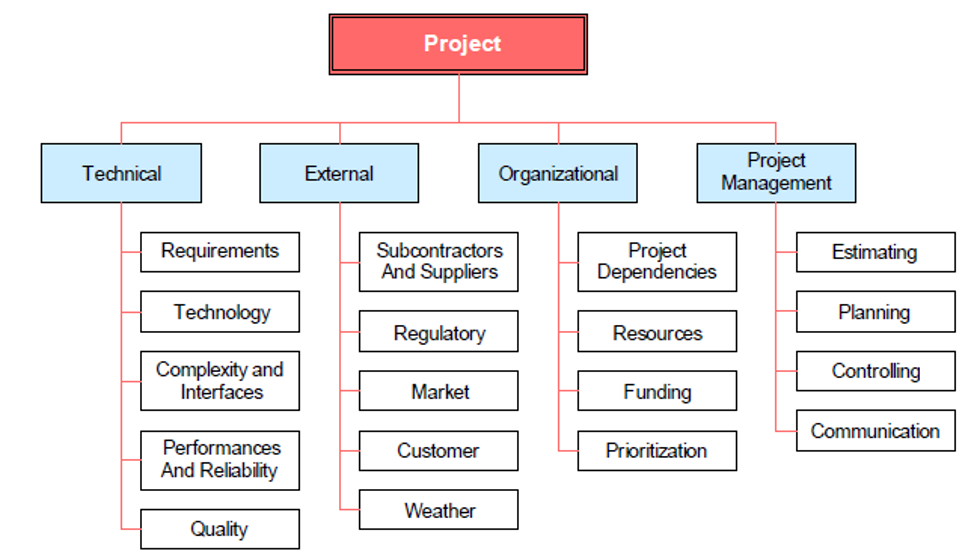
- Template checklists, risk profiles or a risk breakdown structures: Organizations may develop checklists and breakdown structures that can help identify risk. These can be helpful to address traditional areas of uncertainty.
- Analysis of each element of the scope Statement or WBS: In many cases, risks have to do with how we plan the project. Looking at each task, its timeline, resources and relationships with the rest of the project may help identify risks.
- Root cause analysis: Various methods used in root cause analysis (such as fishbone diagrams) may be used in risk identification.
Example Risk Breakdown Structure
 Example risk checklist:
- Technical Requirements
- Are the requirements stable?
- Design
- Does the design depend on unrealistic or optimistic assumptions?
- Testing
- Will testing equipment be available when needed?
- Development
- Is the development process supported by a compatible set of procedures, methods, and tools?
- Schedule
- Is the schedule dependent upon the completion of other projects?
- Budget
- How reliable are the cost estimates?
- Quality
- Are quality considerations built into the design?
- Management
- Do people know who has authority for what?
- Work Environment
- Do people work cooperatively across functional boundaries?
- Staffing
- Is staff inexperienced or understaffed?
- Customer
- Does the customer understand what it will take to complete the project?
- Contractors
- Are there any ambiguities in contractor task definitions?
After a risk is identified, a risk statement should be developed to describe the event and its effect:
- If…then… statements: These are the simplest risk statements, as risk events are focused on an event and its consequence. The “If” statement describes the risk event and the “then” describes the effect or consequence. For example: If the system weight is not met, then a re-design will be necessary. Or if a domestic part can be found to replace the foreign procured part, then the cost for the part may be reduced.
- As a result of a <definite cause>, an <uncertain event> may occur, which could lead to a <consequence>:
- Cause: Definite events or sets of circumstances that exist in the project and its environment, and which give rise to uncertainty
- Risks: Uncertain events or sets of circumstances that, if they occur, would affect the project objectives
- Effect/consequence: Unplanned variations from project objectives, either positive or negative, which arise as a result of risks occurring
Risk Assessment
After risks are identified, we need to analyze them to decide which one have higher priority than others. Usually this is done in two steps.
First, qualitative risk analysis is performed. Here the goal is to use experience to prioritize the list of risks and identify ones which may be worthy of further analysis. Usually this is done through a risk matrix, focused on probability of a risk and its impact (sometimes also the detection difficulty). To perform this qualitative assessment, we need to define the subjective scales for levels of probability and impact. Risks with high probability and impact are the most important to focus on, while as the combination of probability and impact is lowered, the risk becomes less important.
Second, we have quantitative risk assessment. Generally, the value of a risk in $ amounts can be defines as: Risk Value = Impact x Probability x Detection
Using probability analysis, statistical techniques, decision trees, net present value (NPV), or program evaluation and review technique (PERT) we can use this formula to assign a dollar amount to each risk, and compare them in terms of one factor. By adding the value of all risks we get to the total financial risk of the project.
Qualitative Risk Assessment
In this approach we first need to define a scales for probability and impact. For example, a probability scale may look like this:
| Level | Prob. | Probability of Occurrence |
|---|---|---|
| 1 | 0.1 | You would be surprised if this happened. |
| 2 | 0.3 | Less likely to happen than not. |
| 3 | 0.5 | Just as likely to happen as not. |
| 4 | 0.7 | More likely to happen than not. |
| 5 | 0.9 | You would be surprised if this did not happen. |
Or this:
| Level | Probability of Occurrence (%) | Impact of Occurrence |
|---|---|---|
| High | 41–50 | Likely to occur. Has occurred in past projects. |
| Medium | 31–40 | Possible to occur. |
| Low | 10–30 | Unlikely to occur. |
An impact scale may look like this:
| Project Objective | 1 Very Low | 2 Low | 3 Moderate | 4 High | 5 Very High |
|---|---|---|---|---|---|
| Cost | Insignificant cost increase | < 10% cost increase | 10–20% cost increase | 20–40% cost increase | > 40% cost increase |
| Time | Insignificant time increase | < 5% time increase | 5–10% time increase | 10–20% time increase | > 20% time increase |
| Scope | Scope decrease barely noticeable | Minor areas of scope affected | Major areas of scope affected | Scope reduction unacceptable to sponsor | Project end item is effectively useless |
| Quality | Quality degradation barely noticeable | Only very demanding applications are affected | Quality reduction requires sponsor approval | Quality reduction unacceptable to sponsor | Project end item is effectively useless |
Or this:
| Project Objective | 1 Very Low | 2 Low | 3 Medium | 4 High | 5 Very High |
|---|---|---|---|---|---|
| Cost | Insignificant cost increase | < 5% cost increase | 5–10% cost increase | 10–20% cost increase | > 20% cost increase |
| Schedule | Insignificant schedule slippage | Overall project slippage < 5% | Overall project slippage 5–10% | Overall project slippage 10–20% | Overall project slippage > 20% |
| Functionality | Functionality decrease barely noticeable | Minor areas of functionality affected | Major areas of functionality affected | Functionality reduction unacceptable to client | Project end item is effectively useless |
| Quality | Quality degradation barely noticeable | Only very demanding applications affected | Quality reduction requires client approval | Quality reduction unacceptable to client | Project end item is effectively useless |
You would then rate each risk on these scales. This will essentially help you identify the severity of the risks, something we can visualize in a risk matrix:
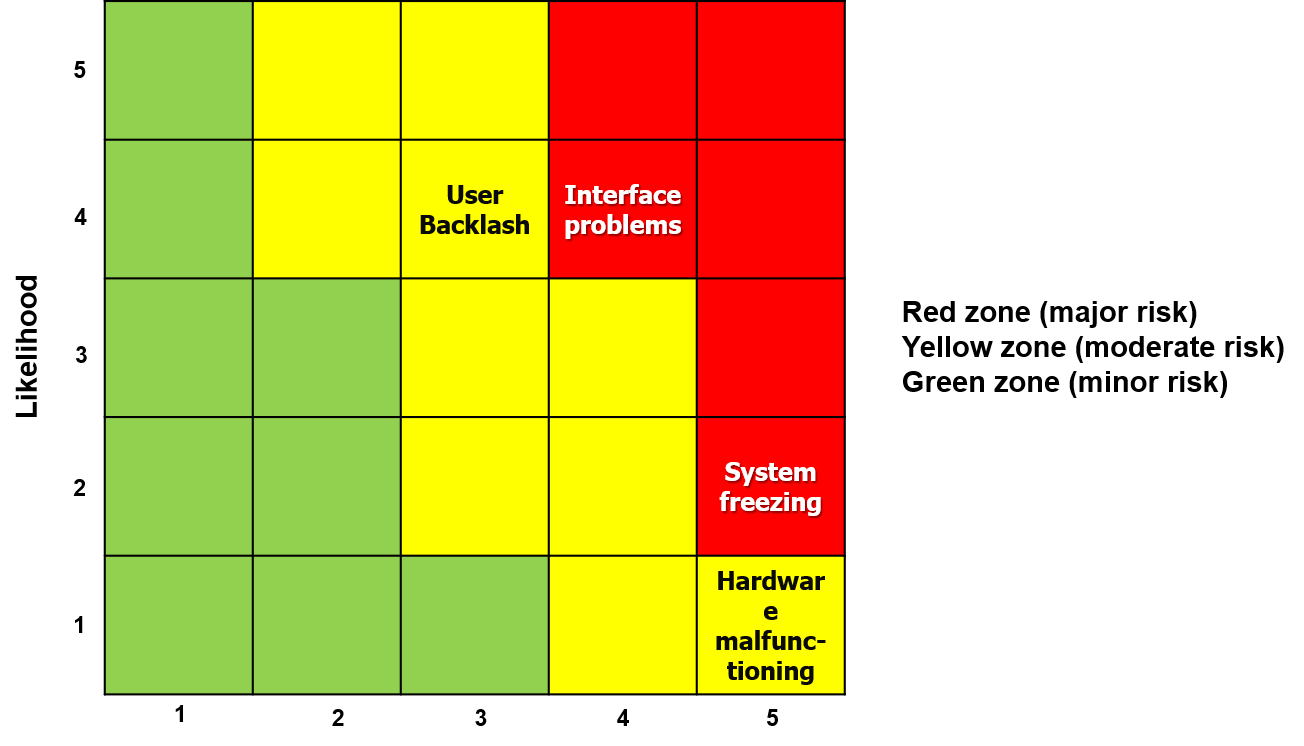 The result of this analysis may look like this:
| Risk Category | Event Description | Probability Criteria | Prob. Score | Impact Criteria | Impact Score | PI Score |
|---|---|---|---|---|---|---|
| Scope | The scope of the project might change | - Product scope well defined, only minor changes expected (Low) - Product scope somewhat defined at a high level, a few changes expected (Med) - Product scope very vague, large changes expected (High) |
3 | - Minor changes added via change control (Low) - Moderate changes added with some difficulty (Med) - Major changes added with severe impact to other requirements (High) |
2 | 6 |
| Scope | Other projects may be added that depend on this project’s scope/work product | - No overlap in scope with other projects (Low) - Possible overlap in scope (Med) - Overlap in scope with other projects (High) |
1 | - Other projects will not affect this project’s scope (Low) - May require some cross-project coordination (Med) - May require detailed cross-project coordination (High) |
1 | 1 |
| Team | Team members may leave the project | - Staff attrition < 20% (Low) - Staff attrition 20–40% (Med) - Staff attrition > 40% (High) |
1 | - Team is cross-trained and ready for attrition (Low) - Key members can be replaced with lead time (Med) - Some key members have unique skills no one else can perform (High) |
2 | 2 |
Source: Introduction to Risk Assessment in Project Management (projectmanagementacademy.net)
Quantitative Risk Assessment Example
Let’s consider the case of Valley College’s project to develop a new student course registration system. To integrate this system into their existing student information system (SIS), the project team has to options:
- Option 1 – Use existing SIS API
- Upfront cost: CAD 10,000.
- 40% chance of a major integration failure requiring rework costing CAD 40,000.
- 60% chance of success with no additional cost.\
- Option 2 – Purchase middleware
- Upfront cost: CAD 50,000.
- 10% chance of minor issues requiring CAD 10,000 of corrective work.
- 90% chance of success with no additional cost.
To quantitatively assess these options taking into account the risk, we can calculate the expected monetary value (EMV):
- Option 1: EMV = 10,000 + 0.4 × 40,000 + 0.6 × 0 = 26,000.
- Option 2: EMV = 50,000 + 0.1 × 10,000 + 0.9 × 0 = 51,000.
Option 1 is cheaper in expectation but carries higher risk; Option 2 costs more but reduces risk. Decision‑makers compare EMV alongside risk appetite, strategic factors (e.g., vendor lock‑in), and schedule impacts.
Risk Response Options
Now that we have identified the most important risks, we can decide what to do with them.
Our options for threats include:
- Avoid: Eliminate the threat or condition, or isolate the project objectives from its impact. This could be done for example by declining the project, relaxing requirements, reducing the scope, or changing the technology. It may cost more but has a higher probability of success.
- Mitigate: Reduce the expected monetary value of a risk event by lowering the probability of occurrence, or reducing its impact. Examples of actions that fit this description include using more experienced project managers, vendors or team members; increasing project controls; performing regular formal risk status reviews; additional testing; or further investigation.
- Transfer: This can be achieved by changing the contract type, adding contract clauses, looking for warranties or guarantees, including liquidated damages, or buying insurance. In all these cases you will pay a “risk premium”, an additional cost to transfer the risk. But this does not completely eliminate the risk.
For opportunities, we have the option to:
- Exploit (opposite of avoid): Make the risk event happen by removing the uncertainty associated with it.
- Enhance (similar to mitigate): Increase the likelihood or the impact of the risk event.
- Share (similar to transfer): Bring in a partner to leverage the risk together. The partner should be someone that has better ability to capture the opportunity.
Finally, we have two other options:
- Accept/retain: Passively ignoring, or.actively recognizing and accepting the consequences.
- Escalate: Notifying the appropriate people within the organization of the threat and let them make the decision.
Which option you chose depends on various factors, including:
- Who/what is the source of the risk?
- Is there a reason to retain the risk? Is the risk due to the project objectives?
- What is the cost of mitigating the risk?
- Who can best manage it? Does customer want to retain involvement in managing the work? Can recipient withstand consequences?
- Is the risk premium reasonable?
When a decision has been made on how to respond to the risks, we can document it in a Risk Response Matrix, which includes:
- Risk Event
- Response
- Contingency Plan
- Trigger
- Responsible persons
You can create a mitigated risk matrix showing the impact of risk responses.
Example: Risk Responses in Painting
Let’s assume we are painting a room. Before paint can be applied, the surface must be cleaned. Toxic chemicals are one method of cleaning. Risk: someone may injure their skin or their eyes due to a spill or splash of the chemical
Options:
- Avoid: find another method of cleaning—would high-pressure water work as well? Could a longer delay for curing be considered? Is painting really necessary?
- Transfer: get insurance on the workers; if toxic exposure is based on time limits, use a larger workforce for shorter each. (An unethical method sometimes used: outsource internationally)
- Reduce the probability of injury: require protective equipment such as clothing and safety goggles and mask; provide training and information to the workers.
- Reduce the degree or impact of possible injury: ensure that onsite first aid attendants are available; eyewash stations, etc.
- Accept: do nothing
In the real-world, you would use multiple responses. So you may get that insurance, require protective equipment, and make sure there is an eyewash station if you cannot use a different cleaner.
Contingency planning
A contingency plan is a predetermined response plan that is activated if a possible foreseen risk event becomes a reality. This is not part of the initial implementation and only goes into effect after risk or its trigger are recognized, with the goal of reducing or mitigating the negative impact of risk. A contingency plan is created as decision making under the risk condition may be delayed, there may be panic. and bad decisions may be made owing the the pressure. By planning ahead, you ensure better decisions are made.
Some examples of contingencies may include:
- If there are technical risks, you may decide to have backup strategies if chosen technology fails, or identify quick fixes for technical uncertainties.
- For schedule risks, you may decide to expedite or “crash” the project to get it back on track, or schedule activities in parallel or use start-to-start lag relationships, or assign the best people for high-risk tasks.
- For funding risks, you may have a minimum funding plan
In terms of scheduling and costing, we have:
- Contingency funds: These are funds set aside to cover the cost of project risks and assigned to specific work packages or deliverables. The value is usually calculated based on quantitative risk analysis.
- Time buffers: These are amounts of time used to cushion against potential delays in the project resulting from risks. They may be added to activities with severe risks, to merge activities that are prone to delays, to noncritical activities to reduce the likelihood that they will create another critical path or to activities that require scare resources. The amount should be aligned with the amount of delay. Projects may also have access to management reserves, which are used to cover the cost of unidentified risks.
Examples of contingencies:
- Technical Risks
- Backup strategies if chosen technology fails
- Assess whether technical uncertainties can be resolved
- Schedule Risks
- Expedite or “crash” the project to get it back on track
- Schedule activities in parallel or use start-to-start lag relationships
- Use the best people for high-risk tasks
- Cost Risks
- Review price to avoid the trap of using one lump sum to cover price risks
- Funding Risks
- Evaluate the risk of reductions in funding—a cut in the project
Risk and Contracts
For every element of the project, a project manager needs to make a “Make-or-Buy Analysis” to decide which work is done in house and which is done out of the organization. This decision is made based on: How much does it cost to build it as opposed to buying it? How will this decision affect the scope of your project? How will it affect the project schedule? Do you have time to do the work and still meet your commitments?
There are three main forms of contracts used to buy products, and outsource risks:
- Fixed-price contract: In this contract, goods or services are provided to the project at an agreed-on price regardless of the actual costs incurred.Using them shifts the risk of cost overruns to the seller, while the buyer benefits from price certainty. This contract works well when the scope is well-known and the cost is predictable. The seller must include risks budget and schedule in baseline because there is no additional funding.
- Cost-reimbursable or cost-plus contract: In this contract, the seller is reimbursed for the costs of providing the goods or services. This shifts risk of cost overruns to the buyer, while the seller is protected from financial loss. It is common on large development projects where accurately estimating scope, schedule and costs is difficult. Cost-reimbursable contracts require good documentation of the costs that occurred on the project to ensure that the contractor gets paid for all the work performed and to ensure that the organization is not paying for something that was not completed.
- Time and materials contract: Time and materials contracts combine elements of both fixed-price and cost-reimbursable contracts. The price is based on the actual time spent and materials used, plus a predetermined fee. This type of contract carries a moderate level of risk for both parties.
Putting it all together: Risk Register
The risk register is a documentation of all all identified risks, including descriptions, category, probability of occurring, impact, responses, contingency plans, owners, and current status. It includes:
- Category
- Cause
- Risk
- Effect
- Trigger
- Impact
- Probability
- Mitigation plans
- Contingency plans
- Contingency reserves
- Risk owners
- Date identified
- Date reviewed
- Progress on action
- Status
- Resources
As time passes, some risks are no longer uncertain. Residual risks are those that remain. Secondary risks are those that arise as a result of our risk responses.
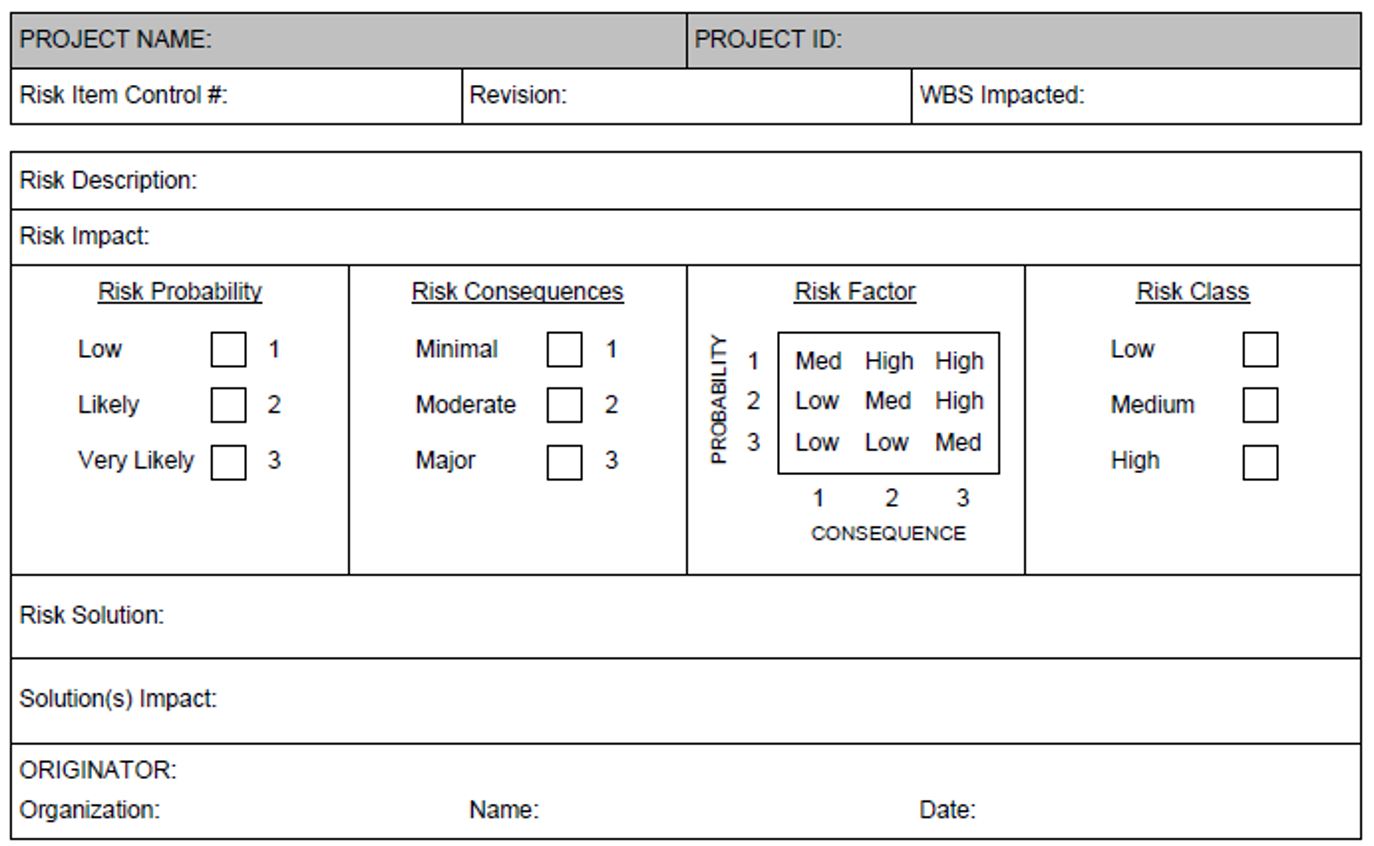
A project manager may elicit risks from team members using a form like this:
 A risk register may look like this:
| Sr No | Date Raised | Risk Description | Likelihood | Impact | Severity | Owner | Mitigating Action | Contingency Plan | Progress on Action | Status | Resource |
|---|---|---|---|---|---|---|---|---|---|---|---|
| 1 | 20 Dec 2021 | Project Sprints stories are not well defined | High | High | High | Product Owner | Complete the Project Charter with full business cases and ensure requirements are gathered properly | Escalate to project board | Project Charter should be rewritten with full business case and requirements | Open | Project Charter Template |
| 2 | 22 Dec 2021 | Project design and deliverables/milestones are incomplete | High | High | High | Product Owner | Define scope and deliverables in detail or seek expert help | Assumptions and constraints defined; remove high‑risk items | Workshops scheduled for training on deliverables and milestones | In Progress | Assumptions Log |
| 3 | 23 Dec 2021 | Non‑Competent Resources | Medium | Medium | Medium | Project Manager | Schedule training or coaching from experts | Escalate to project sponsor | Sponsor agrees to hold briefing and arrange new resources | In Progress | Resource Planning Sheet |
| 4 | 24 Dec 2021 | Delays in appointing Expert Consultant or Freelancer | Low | Low | Low | Project Manager | Communicate schedule early; check in with consultants regularly | Escalate to project sponsor | Build lead time into project schedule for onboarding delays | Open | Lead Time |
| 5 | 26 Dec 2021 | Unplanned work | High | High | High | Project Manager | Review all plans and scope; document assumptions; communicate clearly | Escalate to project manager; develop mitigation plan for cost/schedule | Project manager to meet with project sponsor | Open | Project Schedule |
| 6 | 27 Dec 2021 | Lack of communication causes issues | High | High | High | Project Manager | Create proper communication plan and ensure adherence | Clarify misunderstandings immediately; seek sponsor support | Communication plan in progress | In Progress | Communication Plan |
Risk Monitoring and Control
The risk owner is tasked with:
- Keeping track of the identified risks
- Carrying out the risk responses
- Looking for triggers
- Analyzing contingency reserves
- Responding to actual risk events as they occur
- Identifying and responding to potential new risks as they arise
Change Control Management
As the project is being implemented, a risk may be realized and become issue: a problem or situation that has already happened and requires resolution. There may also be non- conformances: failure to meet specific documented requirements or plans. There may also be new requests from a client to change the scope. All these changes need to be managed strategically to ensure prevention of scope creep and enable project success.
A change management systems is created for the project to ensure systematic change management. This is achieved through the following steps:
- Identify proposed changes (this is done by requiring change request submissions for each risk)
- List expected effects of proposed change(s) on schedule and budget
- Review, evaluate, and approve or disapprove of changes formally
- Negotiate and resolve conflicts of change, condition, and cost
- Communicate changes to parties affected
- Assign responsibility for implementing change
- Adjust master schedule and budget
- Track all changes that are to be implemented
By defining these various steps:
- Inconsequential changes are discouraged by the formal process
- Costs of changes are maintained in a log
- Integrity of the WBS and performance measures is maintained
- Allocation and use of contingency and management reserves are tracked
- Responsibility for implementation is clarified
- Effect of changes is visible to all parties involved
- Implementation of change is monitored
- Scope changes will be quickly reflected in baseline and performance measures
Example: Project Change Request
Project Name: Irish/Chinese culture exchange
Project Sponsor: Irish embassy
Request Number: 12
Date: June 6, 2xxx
Originator: Jennifer McDonald
Change Requested By: Chinese culture office
Description of Requested Change
- Request river dancers to replace small Irish dance group.
- Request one combination dance with river dancers and China ballet group.
Reason for Change River dancers will enhance the stature of the event. The group is well known and loved by Chinese people.
Areas of Impact
- ☒ Scope
- ☒ Cost
- ☐ Other
- ☐ Schedule
- ☐ Risk
Disposition
- ☐ Approve
- ☒ Approve as amended
- ☐ Disapprove
- ☐ Deferred
Priority
- ☐ Emergency
- ☒ Urgent
- ☐ Low
Funding Source
- ☐ Mgmt. reserve
- ☐ Budget reserve
- ☒ Customer
- ☐ Other
Sign-off Approvals
- Project Manager: William O’Mally — June 12, 2xxx
- Project Sponsor: Kenneth Thompson — June 13, 2xxx
- Project Customer: Hong Lee — June 18, 2xxx
- Other: ___ — *Date: _______*
Change Request Tracking
Owner Requested Change Status Report — Open Items
| Rc# | Description | Reference Document | Date Rec’d | Date Submit | Amount | Status | Comments |
|---|---|---|---|---|---|---|---|
| 51 | Sewer work offset | — | — | — | –188,129 | OPEN | Funding from other source |
| 52 | Stainless Plates at restroom Shower Valves | ASI 56 | 1/5/2020 | 3/30/2020 | 9,308 | APPROVED | — |
| 53 | Waterproofing Options | ASI 77 | 1/13/2020 | — | 169,386 | OPEN | — |
| 54 | Change Electrical floor box spec change | RFI 113 | 12/5/2020 | 3/29/2020 | 2,544 | SUBMIT | — |
| 55 | VE Option for Style and rail doors | Door samples | 1/14/2020 | — | –20,000 | ROM | — |
| 56 | Pressure Wash C tower | Owner request | 3/15/2020 | 3/30/2020 | 14,861 | SUBMIT | — |
| 57 | Fire Lite glass in stairs | Owner request | — | — | 8,000 | QUOTE | ROM based on FireLite NT |
| 58 | Cyber Café added tele / OFOI equipment | ASI 65 | 1/30/2020 | 3/29/2020 | 4,628 | APPROVED | — |
| 59 | Additional Dampers in C wing | ASI 68 | 2/4/2020 | 3/29/2020 | 1,085 | SUBMIT | — |
| 60 | Revise Corridor ceilings | ASI 72 | 2/13/2020 | 3/31/2020 | –3,755 | SUBMIT | — |
Legend
- OPEN — Requires estimate
- ROM — Rough order magnitude
- QUOTE — Subcontractor quotes
- SUBMIT — RC letter submitted
- APPROVED — RC letter approved
- REVISE — RC letter to be reviewed
- ASI — Architect’s supplemental instructions
- RFI — Request for information
Risk vs Issue
Risks are uncertain future event with a positive or negative impact on the project. A realized risk is a risk that has become a reality. If the realized risk can be overcome with the existing mitigation or contingency plan, then the system is working. However, it the realized risk is not resolved, or something happens that we did not expect, we have an issue.
An issue is a problem or situation that has already happened and requires resolution. It may be a nonconformance: Failure to meet specific documented requirements. Or it may be an anomaly: An unexpected observation that needs vetting to determine if it reflects a real problem. In any case, issues are to be tracked and resolved.
| Feature | Risk | Issue |
|---|---|---|
| Timing | Future | Present |
| Probability | Uncertain | Certain |
| Nature | Positive or negative | Almost always negative |
| Resolution | Mitigation planning | Immediate action and resolution |
Summary
Bibliography
The following sources were also consulted in creating this resource:
- PMBOK Guide 7th ed.
- Process Groups: A Practice Guide
- Essentials of Project Management
- Project Management: A Managerial Approach
- Project Management: A Socio-Technical Approach
- Project Risk Management - MBP (mbpce.com)
- How to Write a Good Risk Statement - www.dau.edu
- Introduction to Risk Assessment in Project Management (projectmanagementacademy.net)
- What is Risk Register? Definition with Example. (pmstudycircle.com)
- 20 Common Project Risks - example Risk Register (stakeholdermap.com)
- Qualitative risk assessment
- A model to develop and use risk contingency reserve